
Wormwood aphid
Capitophorus horni
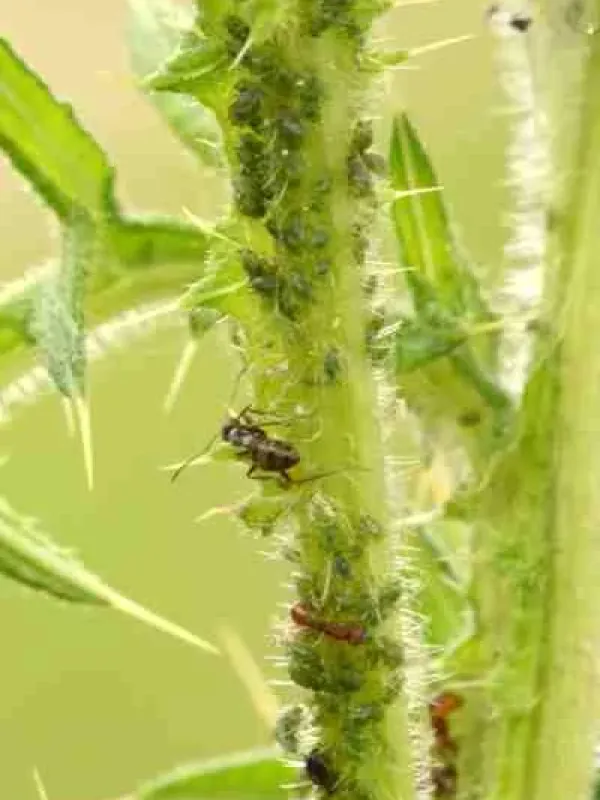
Description
How to identify
The wormwood aphid, scientifically known as Capitophorus horni, is a member of the order Hemiptera and the family Aphididae. This small pest exhibits specific morphological traits that make it a specialist on certain plants within the Asteraceae family.
Adult individuals are typically pale yellow or light green in color, providing effective camouflage against the foliage of host plants. The body is pear-shaped and bears long, slender cornicles, which are key diagnostic features used by entomologists for precise identification.
The life cycle involves both asexual (parthenogenetic) reproduction throughout the spring and summer and sexual reproduction as winter approaches. This reproductive strategy allows for an exponential increase in the population size during the growing season.
This species is known for its migratory behavior, often utilizing wormwood (Artemisia) as its primary winter host before dispersing to secondary hosts, including various ornamental and commercial crops.
Because of their small size and cryptic behavior, identifying Capitophorus horni requires careful inspection of the lower leaf surfaces, particularly in the apical regions of the plants where colonies preferentially establish.
What it damages
The primary hosts for the wormwood aphid are plants belonging to the Asteraceae family. In commercial agriculture, the species is particularly notorious for damaging chrysanthemum crops and other susceptible ornamental plants.
Feeding occurs through the extraction of cell sap from tender tissues. This process directly depletes the plant's resources, resulting in significant physiological stress, stunted shoot growth, and a reduction in overall biomass.
Severe infestations lead to the deformation of leaves and buds. As the aphids extract sap, leaves may curl, become chlorotic, and eventually drop prematurely, severely compromising the aesthetic and economic value of the produce.
Beyond direct feeding damage, Capitophorus horni acts as a vector for various plant viruses. These pathogens can cause systemic infections that are often more destructive to the crop's long-term health than the aphids themselves.
The accumulation of honeydew secreted by the aphids serves as a substrate for sooty mold growth. This dark fungal layer blocks sunlight from reaching the leaves, further inhibiting photosynthesis and overall plant development.
When it appears
The seasonal activity of the wormwood aphid begins in early spring, when overwintered eggs hatch into fundatrices on their primary wild hosts. These first generations then lead to the production of winged migratory forms.
Summer months, particularly June and July, represent the period of peak infestation. During this time, the aphids are highly mobile, dispersing across fields and creating new colonies on susceptible crops.
Environmental conditions significantly influence the population dynamics of this pest. Warm and dry weather facilitates rapid population growth, while heavy rainfall can temporarily mitigate the spread of the colonies.
As daylight hours decrease and temperatures drop in late autumn, the aphids switch to sexual reproduction. This leads to the production of winter eggs, ensuring the species' survival through the dormant period on wild Artemisia.
Field scouting should be prioritized during the late spring and early summer to detect the arrival of the first winged aphids before they can establish large, difficult-to-control colonies.
Signs of infestation
Early symptoms of a Capitophorus horni infestation include slight curling or puckering of the youngest leaves. If left untreated, this deformation becomes more pronounced and can affect the entire shoot.
Upon closer examination of the undersides of the leaves, one can observe crowded colonies of aphids. Additionally, the presence of white, cast-off exuviae (molted skins) is a strong indicator of an active and growing population.
The presence of sticky honeydew on the leaf surface is a hallmark sign of aphid activity. This substance is highly attractive to ants, and their presence on the plant is a reliable secondary indicator of an aphid infestation.
The appearance of a black, powdery growth known as sooty mold on the foliage is a late-stage sign. It indicates that the colony has been feeding for an extended period and that immediate intervention is required.
- Curled and deformed apical leaves
- Sticky honeydew secretions on foliage
- Clusters of aphids on the undersides of leaves
- Increased ant activity on plant stems
- Sooty mold growth (black fungus)
Control measures
Effective management begins with strict sanitation practices. Removing wild wormwood and other weed hosts from the vicinity of cultivation areas is essential to disrupt the aphid's life cycle and reduce migratory pressure.
Biological control methods are highly effective and environmentally sustainable. The introduction or preservation of natural predators such as lady beetles, lacewings, and parasitic wasps can significantly keep aphid populations below economic injury levels.
When chemical intervention is necessary, the use of systemic insecticides is recommended to target the aphids within the curled leaves where contact sprays might be ineffective. Proper timing is critical to achieve maximum coverage.
To prevent the development of insecticide resistance, it is vital to rotate products with different modes of action. Always ensure the spray reaches the undersides of the leaves where the pests congregate.
Regular monitoring using yellow sticky traps is an excellent tool for tracking the migration of winged aphids. This data allows for targeted, localized treatments, which minimize the environmental impact while protecting the crop.
Taxonomy
- Latin name
- Capitophorus horni
- Order
- Hemiptera (bugs, aphids, leafhoppers)
- Family
- Aphididae
- EPPO code
- CAPIHO
Discussion
No discussions yet — be the first.