
Wormwood aphid
Capitophorus flaveolus
Description
How to identify
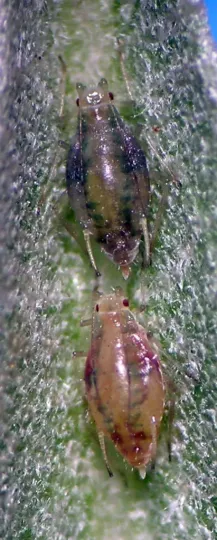
The wormwood aphid (Latin Capitophorus flaveolus) is a member of the Aphididae family, order Hemiptera. These small insects typically measure between 1.5 and 2.2 mm in length.
Their body color ranges from pale yellow to greenish-yellow, providing excellent camouflage against the foliage of host plants.
A key morphological feature is the presence of long, often club-shaped siphunculi and specialized body hairs that are distinguishable only under high magnification.
The life cycle is closely linked to plants of the Asteraceae family, with Artemisia species serving as the primary host throughout the growing season.
They typically exhibit colonial behavior, congregating on the undersides of leaves and on young shoots, where they feed and reproduce efficiently.
What it damages
The primary food source for this species is various types of wormwood (Artemisia), though they can occasionally infest related Asteraceae crops.
Damage is caused by the aphid sucking sap from plant tissues, which depletes the plant's metabolic reserves and hinders normal physiological processes.
Severe infestations lead to the deformation, curling, and yellowing of leaves, ultimately resulting in reduced vigor and potential premature senescence of the plant.
As the aphid feeds, it can cause physical stunting of shoots and disrupt the development of flowers or seeds in susceptible host species.
Furthermore, Capitophorus flaveolus is recognized as a potential vector for several plant viruses, which significantly increases the economic impact of an infestation.
When it appears
The aphid's seasonal cycle begins in early spring when overwintered eggs hatch, giving rise to the founding generation that starts feeding on fresh growth.
Population levels usually peak during mid-summer, when favorable temperature and humidity conditions allow for rapid asexual reproduction.
Multiple generations occur throughout the season, with the rate of population turnover being highly dependent on local climatic variables.
As autumn approaches, the aphid produces a sexual generation, leading to the deposition of overwintering eggs on host plants to survive the cold months.
The egg stage is highly resilient, ensuring that the pest survives winter conditions and successfully re-establishes its population in the following spring.
Signs of infestation
Early detection is possible by inspecting the undersides of leaves for clusters of aphids and checking for the presence of ants, which often tend the aphid colonies.
The presence of honeydew—a sugary substance excreted by aphids—on leaves and stems is a strong indicator of an active infestation.
Plants infested by these aphids often show signs of reduced growth, distorted leaves, and chlorotic spotting due to the extraction of plant juices.
- Curling and distortion of young apical leaves.
- Visible sticky residue (honeydew) on foliage.
- Presence of shed white larval skins (exuviae) on leaves.
- Yellowish spots on leaves where feeding has occurred.
- Development of sooty mold on honeydew-covered areas.
Regular field scouting focusing on the undersides of leaves is essential for identifying these pests before they reach damaging levels.
Control measures
Effective management requires an integrated approach that prioritizes cultural practices and biological control to minimize chemical intervention.
Cultural control involves the removal of alternative host weeds, such as wild Artemisia species, from the vicinity of commercial crop fields.
Biological control can be enhanced by conserving populations of natural predators like lady beetles, lacewings, and hoverfly larvae in the ecosystem.
If economic thresholds are exceeded, the use of systemic insecticides is recommended to ensure that the active ingredient reaches the aphids hidden under leaves.
Applications should be timed carefully and performed with sufficient water volume to ensure thorough coverage of all plant surfaces, particularly the leaf undersides.
Taxonomy
- Latin name
- Capitophorus flaveolus
- Order
- Hemiptera (bugs, aphids, leafhoppers)
- Family
- Aphididae
- EPPO code
- CAPIFV
Discussion
No discussions yet — be the first.