
Thistle aphid
Capitophorus carduinus
Description
How to identify
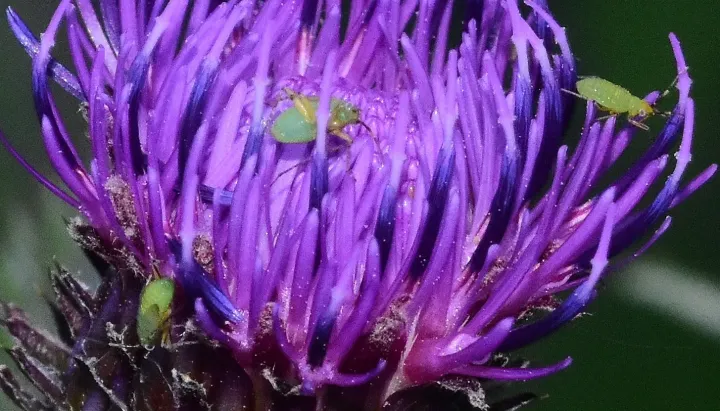
The thistle aphid (Capitophorus carduinus) is a small insect belonging to the family Aphididae, order Hemiptera. Adult individuals typically have a pear-shaped body, reaching lengths of 1.5–2 mm, and display a light green to yellowish-green coloration that provides excellent camouflage on host leaves.
A key morphological feature is the presence of long siphunculi and well-developed antennae, which often exceed the length of the body itself. The population consists of both apterous (wingless) and alate (winged) forms, facilitating rapid dispersal throughout the growing season.
The biological cycle starts with eggs that overwinter on the base parts of perennial weeds, particularly members of the Asteraceae family. In spring, stem mothers hatch from these eggs, initiating several generations of offspring.
Throughout the season, the species reproduces via parthenogenesis, where females produce live young without mating. This reproductive strategy leads to a rapid increase in population density on infested plants.
By autumn, sexual morphs appear; after mating, females lay eggs that enter diapause, ensuring the survival of the species throughout the winter period until the next spring.
What it damages
The thistle aphid primarily feeds on thistle (Carduus) and plume thistle (Cirsium) species. However, when population pressure is high, they may migrate to related ornamental or agricultural crops within the Asteraceae family.
The primary damage is caused by the extraction of sap from tender leaves, flower stalks, and shoots, which leads to severe physiological exhaustion of the host plant.
Infested plant parts often exhibit curling, deformation, and stunted growth, which severely impairs the plant's ability to flower and produce viable seeds, reducing its overall vitality.
Aphids secrete honeydew, a sugary byproduct that encourages the growth of sooty mold. This black fungal layer covers the leaves, effectively blocking sunlight and inhibiting the plant's natural photosynthesis processes.
Furthermore, the thistle aphid acts as a vector for various plant viruses, transmitting pathogens from infected weeds to healthy crops, which can lead to systemic disease outbreaks.
Control measures
The primary strategy for controlling the thistle aphid involves integrated pest management, with a heavy emphasis on cultural practices to eliminate the pest's primary reservoir hosts.
Regular mowing or mechanical removal of thistles and related weeds before they flower is crucial to limiting the available food source and preventing the buildup of large aphid colonies.
Biological control methods focus on protecting and encouraging natural predators, such as lady beetles, lacewings, and hoverflies, which are highly effective at suppressing aphid numbers in natural habitats.
In cases where infestations exceed economic thresholds, the application of systemic or contact insecticides may be necessary to protect high-value crops, ensuring appropriate application timing.
- Monitor fields and gardens for early signs of colony formation.
- Maintain weed-free borders around agricultural or ornamental plots.
- Remove and destroy severely infested plant debris during autumn clean-up.
- Use insecticidal soaps for localized control in sensitive areas.
Taxonomy
- Latin name
- Capitophorus carduinus
- Order
- Hemiptera (bugs, aphids, leafhoppers)
- Family
- Aphididae
- EPPO code
- CAPICA
Discussion
No discussions yet — be the first.