
Horse-chestnut leaf miner
Cameraria ohridella
Description
How to identify
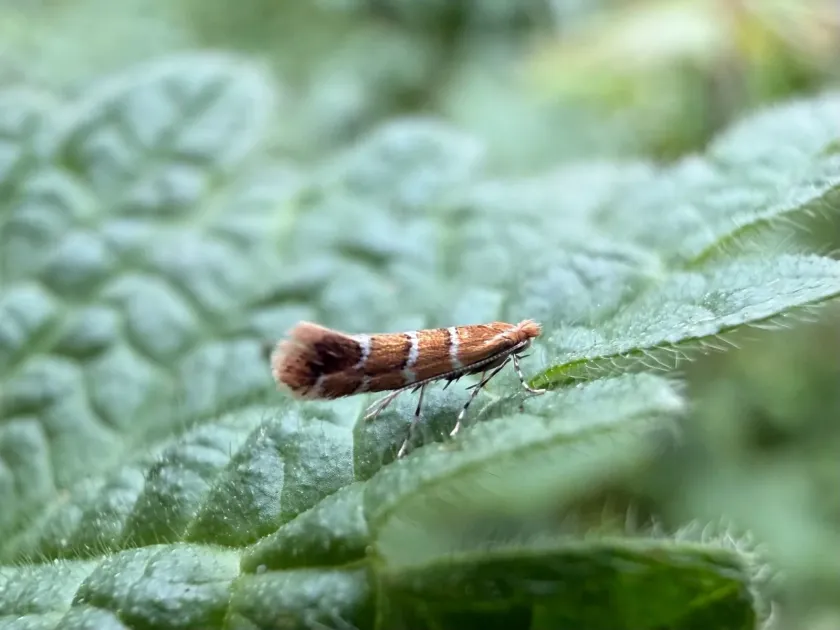
The horse-chestnut leaf miner (Cameraria ohridella) is a small moth belonging to the Gracillariidae family. Adult moths are roughly 7–9 mm long with a distinct, striking golden-brown pattern and white stripes on their wings.
The larval stage is highly specialized, living entirely within the leaf tissue. Larvae are flattened, which allows them to mine between the leaf epidermal layers without breaking the surface.
This species is highly prolific, completing between two to four generations per year depending on the climatic zone and temperature availability during the season.
The pupal stage is the primary overwintering form of the pest. Pupae remain inside the dry, fallen leaves throughout the winter, protected from cold temperatures by the leaf litter.
Emergence of adult moths in the spring typically coincides with the budburst and flowering of the horse chestnut tree, their primary host.
What it damages
The primary host for this pest is the common horse chestnut (Aesculus hippocastanum), which is frequently targeted in urban landscapes and parks.
While occasional infestations on maples have been reported, the horse chestnut remains the species most significantly impacted by the larvae's feeding habits.
Damage is caused exclusively by the larvae, which feed on the mesophyll tissue, destroying the internal structure of the leaf and impairing photosynthetic capacity.
Heavy infestation levels can lead to dozens of mines per single leaf, which effectively kills the tissue and causes severe stress to the entire tree canopy.
The resulting damage reduces the tree’s overall vitality, making it prone to secondary infections and reducing its ability to accumulate reserves for the following season.
When it appears
The active life cycle of the moth begins in spring when average temperatures reach the threshold required for mating and egg-laying activities.
The eggs are laid individually on the leaf surface. Once hatched, the larva bores directly into the leaf to begin its development cycle, which lasts roughly one month.
Summer months usually show the highest pest density, as multiple generations overlap, resulting in a continuous presence of various life stages on the host tree.
As autumn approaches, the final generation of the year develops into the pupal stage, preparing to overwinter within the fallen leaves until the following spring.
Environmental conditions, particularly temperature, play a crucial role in the speed of development, allowing the population to explode if winters are mild.
Signs of infestation
Early signs of infestation appear as tiny, faint white dots on the upper leaf surface, representing the sites where eggs were deposited by the female moths.
As the larvae feed and grow, these dots evolve into elongated, light-colored mines that eventually turn dark brown as the tissue within the leaf dies.
A classic sign of severe infestation is the "scorched" appearance of the tree canopy, where foliage browns and curls prematurely, often by mid-summer.
In cases of heavy infestation, the entire tree may lose its leaves weeks earlier than expected, which is highly visible even from a significant distance.
The presence of small, empty pupal skins (exuviae) protruding from the leaf surface is a definitive indicator that the adult moth has successfully emerged.
Control measures
The most effective cultural control method is the thorough collection and destruction of fallen leaves in the autumn to eliminate the overwintering population.
Pheromone traps are widely used to monitor moth activity and can assist in timing chemical applications to target the most vulnerable stages of the insect.
In high-value ornamental trees, systemic insecticides delivered via trunk injection provide a localized and effective way to protect the tree without spraying the canopy.
Chemical spraying of the canopy is possible but must be precisely timed with the period of egg hatching to ensure the larvae are exposed to the active substance.
- Sanitation of leaf litter
- Biological control with parasitoid wasps
- Trunk injection systems
- Monitoring with pheromone traps
Taxonomy
- Latin name
- Cameraria ohridella
- Order
- Lepidoptera (butterflies)
- Family
- Gracillariidae
- EPPO code
- LITHOD
Discussion
No discussions yet — be the first.