
Aster leafminer
Calycomyza humeralis
Description
How to identify
The Aster leafminer (Calycomyza humeralis) belongs to the Agromyzidae family of the order Diptera. These small flies are typically 2–3 mm in length and feature a dark, brownish-black body.
The larvae are small, legless, and white or yellowish. They spend their entire developmental period inside the leaf, protected from external predators by the plant's epidermis.
The life cycle involves an egg stage, three larval stages, a pupal stage, and the adult fly. These insects thrive in warm, humid conditions where they can complete multiple generations in one season.
Adult flies are highly mobile and use their ovipositors to pierce leaves for both feeding and laying eggs, which results in characteristic puncture marks on the foliage.
Overwintering occurs primarily in the pupal stage, buried in the soil or protected within dried leaf tissue, allowing the population to emerge as soon as spring temperatures rise.
What it damages
This pest specifically targets plants within the Asteraceae family. Favorite hosts include asters, chrysanthemums, dahlias, and several wild species such as thistles or sow-thistles.
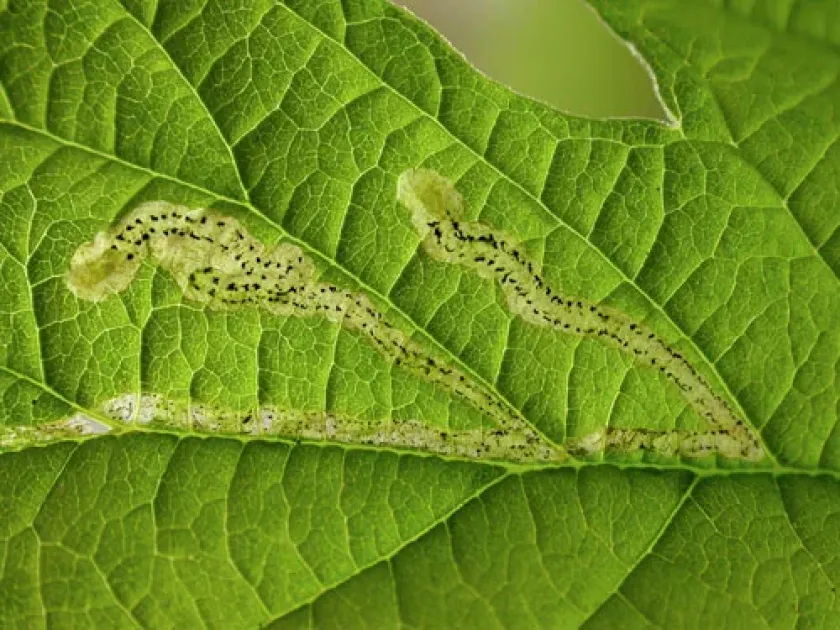
The larvae consume the internal leaf tissues (parenchyma) while leaving the upper and lower layers intact, creating distinct winding mines that look like silver or white ribbons.
Severe infestations significantly reduce the plant's photosynthetic efficiency, which leads to stunted growth, reduced flowering, and overall plant weakening.
In nursery or greenhouse settings, damage is particularly devastating as the aesthetic value of the ornamental crops is compromised, often making them unmarketable.
Damaged leaves are prone to premature drop and secondary infections, as the mining activity creates entry points for various bacterial and fungal pathogens.
Signs of infestation
The most diagnostic sign is the presence of pale, serpentine mines that wander across the leaf surface. These are clearly visible when holding the leaf against a light source.
Black or dark brown dots of frass (larval excrement) are usually deposited inside the tunnels, providing a reliable way to distinguish these mines from other types of leaf damage.
Early symptoms include tiny, circular puncture marks where the female fly has fed or deposited an egg, appearing as speckles on the leaf surface before the mines form.
As the infestation progresses, leaves may begin to curl or turn yellow, particularly at the leaf tips, and eventually dry out if the larval density is high.
- Winding, light-colored tunnels visible on leaves.
- Small dark pellets of waste inside the mine patterns.
- Wilting or premature yellowing of lower foliage.
Control measures
Cultural control is the first line of defense; this includes removing and destroying infested plant material promptly and eliminating weeds that act as alternative hosts.
Deep cultivation or tilling of the soil after the growing season helps to disrupt the pupal stage, significantly reducing the emergence of the next generation.
Yellow sticky cards placed near the plants are effective for trapping adult flies and monitoring population levels, which helps determine the best timing for insecticide application.
For chemical control, systemic insecticides are the most effective choice, as they are absorbed by the plant and kill the larvae feeding safely inside the leaf mines.
Maintaining proper plant spacing and ensuring good airflow can help create less favorable conditions for the fly population to establish and spread.
Taxonomy
- Latin name
- Calycomyza humeralis
- Order
- Diptera (flies)
- Family
- Agromyzidae
- EPPO code
- CALZHU
Discussion
No discussions yet — be the first.