
Walnut leaf miner
Caloptilia roscipennella
Description
How to identify
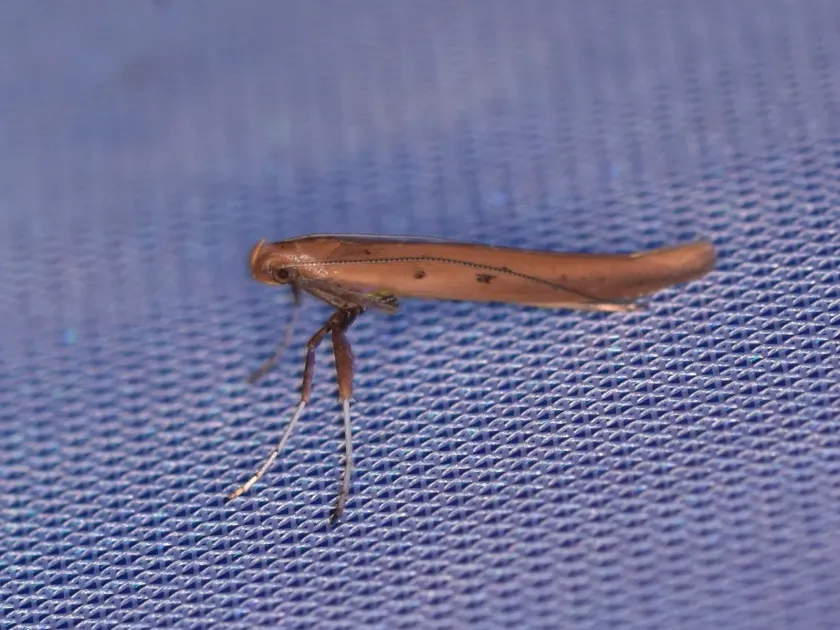
The Walnut leaf miner (Caloptilia roscipennella) is a small moth belonging to the Gracillariidae family. Adults typically have a wingspan of about 12–15 mm. Their forewings feature a characteristic golden-brown pattern, providing effective camouflage when resting on tree trunks or foliage.
The larvae are slender, active caterpillars that undergo several instars. In their early stages, they feed internally within the leaf tissues, while in later stages, they emerge to create characteristic leaf rolls, which serve as their primary shelter and feeding site.
What it damages
This moth primarily targets walnut trees. The larvae cause significant damage by feeding on the leaf parenchyma, which impairs the plant's photosynthetic efficiency. This reduction in energy production can stunt tree growth and reduce nut yield significantly.
Severe infestations often result in premature leaf drop during the peak growing season. When a tree loses a substantial portion of its canopy in mid-summer, its ability to store nutrients for winter survival is severely compromised, leading to long-term tree decline.
When it appears
The insect typically overwinters as a pupa protected by a dense silken cocoon. These cocoons are cleverly hidden within bark crevices or amongst leaf litter on the orchard floor, providing protection against adverse weather conditions.
Adult emergence typically begins in early spring, synchronized with the onset of host tree budding. Throughout the season, multiple generations may occur, with peak larval activity often observed during the late spring and early summer periods when foliage is lush and abundant.
Signs of infestation
Visual confirmation of the pest involves inspecting the foliage for unique deformation patterns. The most indicative sign is the presence of leaves that have been rolled or folded into tube-like structures, often secured by fine silk threads.
- Linear mines or blotches appearing on the leaf surface during early larval stages.
- Curled or rolled leaves at the tips or margins of the canopy.
- The presence of frass (larval waste) inside the rolled leaf shelters.
- Yellowing and necrotic spots on leaves, followed by mass leaf drop in the orchard.
Control measures
Integrated Pest Management (IPM) is essential for controlling this pest. Sanitation practices are paramount; removing and destroying fallen leaves under infested trees during late autumn or winter effectively reduces the overwintering population.
Chemical control should be timed according to the lifecycle stages, targeting the larvae before they create the protective leaf rolls. Utilizing systemic insecticides can be effective, provided they are applied in accordance with regional agricultural safety regulations.
Taxonomy
- Latin name
- Caloptilia roscipennella
- Order
- Lepidoptera (butterflies)
- Family
- Gracillariidae
- EPPO code
- GRACRO
Discussion
No discussions yet — be the first.