
Oak leafminer
Caloptilia alchimiella
Description
How to identify
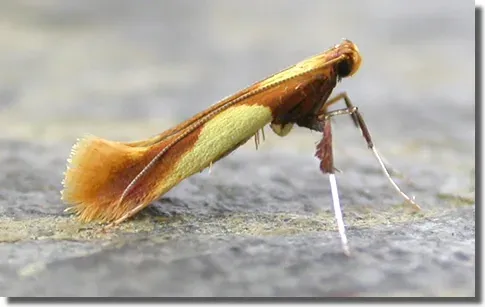
The oak leafminer (Caloptilia alchimiella) is a small moth belonging to the Gracillariidae family, with a wingspan of approximately 10–12 millimeters. Its forewings exhibit a characteristic yellowish-brown color with a metallic sheen and a prominent dark triangular spot.
This insect is recognized by its slender body and long, thread-like antennae. As a member of the leaf-mining group, its larval stage is highly specialized for feeding within the leaf tissues of its host plant.
The larvae progress through several developmental stages, initially appearing pale green and transitioning to a yellowish hue as they mature. They are notably active and agile when disturbed.
Pupation occurs within a white, silk-lined cocoon, usually situated inside a leaf that the larva has folded or rolled into a cone-like shape for protection.
Because the adult moths are nocturnal and rarely seen during the day, identification is typically confirmed by examining the specific leaf-mining patterns and the characteristic leaf rolls on host trees.
What it damages
The primary host plant for this species is the oak (Quercus), although in high-density populations, larvae may also be found on other broad-leaved trees.
Damage begins as the larvae consume the parenchyma (inner tissue) of the leaf. They initially create narrow, winding mines that eventually expand into large, irregular, semi-transparent patches.
The most significant damage occurs in young nurseries and ornamental oak plantations, where heavy infestation can lead to significant defoliation and weakened tree health.
The curling of leaves caused by the larvae restricts normal photosynthesis, which reduces the tree's ability to accumulate reserves for growth and winter survival.
Furthermore, damaged leaves become prone to secondary infections, including various fungal diseases that further degrade the aesthetic and structural quality of the foliage.
When it appears
The life cycle of the oak leafminer is closely synchronized with the phenology of the host oak. The first generation of adults typically emerges in late spring, coincident with the bud-bursting season.
Depending on the climatic zone, the pest may complete one or two generations per year. The second generation is generally most active during mid-summer, around July.
Females lay eggs on the surface of the leaves, and the larvae emerge shortly thereafter to begin their feeding cycle, which lasts several weeks.
The peak of larval activity is observed during June and August, during which time the characteristic folded leaves become most evident on the canopy.
Overwintering occurs primarily at the pupal stage, hidden within the folded foliage or in crevices of the tree bark, remaining dormant until the following spring.
Signs of infestation
Early signs of infestation include delicate, thread-like mines on the leaf surface, which progressively widen as the larva grows and consumes more leaf tissue.
The most diagnostic sign of Caloptilia alchimiella activity is the folding of the leaf margin into a distinct cone or tube shape, secured with silk threads.
Upon closer inspection, one can often find frass (larval excrement) inside these rolled leaf structures, indicating current larval feeding activity.
- Conical or rolled leaves at the tips of shoots.
- Semi-transparent patches or "windows" on the leaf surface.
- Visible silk webbing holding the leaf rolls together.
- Premature leaf drop during the summer season.
When a leaf roll is carefully opened, the larva can usually be found inside, often rapidly moving to escape the disruption.
Control measures
Mechanical control involves the removal and destruction of fallen leaves during autumn, as this effectively eliminates a large portion of the overwintering pupal population.
Biological control methods focus on maintaining healthy populations of natural predators and parasitoids, such as ichneumon wasps, which can suppress moth outbreaks.
Chemical treatments using systemic or contact insecticides are recommended only when infestations exceed economic or aesthetic thresholds, ensuring application timing matches larval emergence.
Environmentally friendly options, such as microbial insecticides based on Bacillus thuringiensis, provide effective control without harming beneficial pollinators or the surrounding ecosystem.
Regular monitoring using pheromone traps can help track moth activity, allowing for precise and efficient timing of control measures to minimize pesticide use.
Taxonomy
- Latin name
- Caloptilia alchimiella
- Order
- Lepidoptera (butterflies)
- Family
- Gracillariidae
- EPPO code
- GRACAL
Discussion
No discussions yet — be the first.