
Bulb mite
Caloglyphus spinitarsus
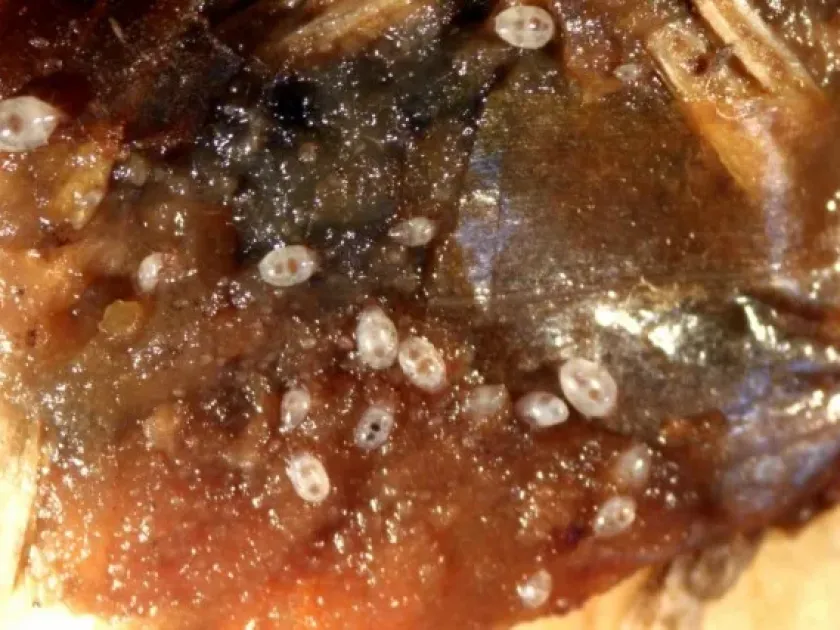
Description
How to identify
The bulb mite (Caloglyphus spinitarsus) is a microscopic pest belonging to the Acaridae family. Adults are small, roughly 0.5–1 mm long, with a pearly white or yellowish-brown, shiny, oval-shaped body.
This mite has eight legs and moves slowly. It is a cryptic organism that prefers high humidity and moderate temperatures, making it a severe problem in damp soil and poorly ventilated storage facilities.
The life cycle consists of egg, larva, protonymph, deutonymph (hypopus), and adult stages. The deutonymph stage is highly resistant to environmental stress, chemicals, and starvation, allowing the mite to persist for long periods.
Under optimal conditions (20–25°C), reproduction is extremely rapid. A single female can lay hundreds of eggs, allowing populations to explode within just a few weeks if environmental factors remain stable.
They are primarily soil-dwelling mites that feed on decaying organic matter but readily shift to healthy plant tissues when populations become dense or conditions are favorable for infestation.
What it damages
The mite attacks a wide range of bulbous crops, including onions, garlic, shallots, tulips, narcissi, and gladioli. In storage, it can also infest potatoes, carrots, and other fleshy root vegetables.
The mites typically enter the bulb through the basal plate. They feed on the inner fleshy scales, creating cavities that become colonized by bacteria and fungi, leading to severe decay and total loss of the bulb.
Field-grown plants infested with bulb mites show stunted growth and yellowing of the leaf tips. Often, the roots are absent or poorly developed, and the plants may easily pull out of the soil due to root rot.
In storage, infested bulbs can become "hollowed out" or turn into a soft, brownish, foul-smelling mass. The infestation can spread from one bulb to the entire crop if moisture levels are not managed correctly.
Damage caused by these mites is often misdiagnosed as fungal disease, because the secondary rot often masks the presence of the tiny mites that initiated the breach in the bulb's defense.
Signs of infestation
Visible signs of infestation in the field include poor seedling establishment, yellowing or wilting leaves, and a generally stunted appearance of the foliage compared to healthy plants.
Upon examination of the basal plate of a suspected bulb, one may find it to be soft, sunken, or showing signs of internal decay. If cut open, the interior may be riddled with tunnels or partially disintegrated.
A fine, brownish dust around the base of the bulb or between the scales is a common indicator of mite activity, which consists of feces and debris from their feeding process.
In storage, the separation of the basal plate from the rest of the bulb is a classic sign of advanced mite damage. The tissue becomes mushy and releases a strong, putrid odor characteristic of secondary rot.
Using a hand lens is essential for detection, as the mites appear as tiny, slow-moving white dots clustered in the crevices of the bulb scales or near the basal plate.
Control measures
Crop rotation is the primary cultural control method. Avoiding planting onions or lilies on the same ground for at least three to four years helps significantly reduce the population of mites in the soil.
Sanitation is critical for storage areas. Keeping storage facilities clean, dry, and cool (near 0°C) with humidity levels below 60% prevents the mites from reproducing and spreading.
Treating planting material (sets or bulbs) with appropriate acaricides or using hot water treatment can eliminate mites before they are introduced into the field.
- Select only clean, firm bulbs for planting.
- Immediately rogue and destroy any infested plants found in the field.
- Improve drainage in fields to prevent localized moisture build-up.
- Apply registered acaricides if threshold levels of infestation are exceeded.
Effective management requires a combination of good agricultural practices and careful monitoring. Since these pests are difficult to control once established, preventing the initial infestation is the most cost-effective strategy.
Taxonomy
- Latin name
- Caloglyphus spinitarsus
- Order
- Mites
- Family
- Acaridae
- EPPO code
- CALNSI
Discussion
No discussions yet — be the first.