
Coffee leaf miner
Callisto coffeella
Description
How to identify
The coffee leaf miner, scientifically known as Leucoptera coffeella, is a tiny moth belonging to the Lyonetiidae family. Despite its small size, it is a major pest of coffee crops worldwide.
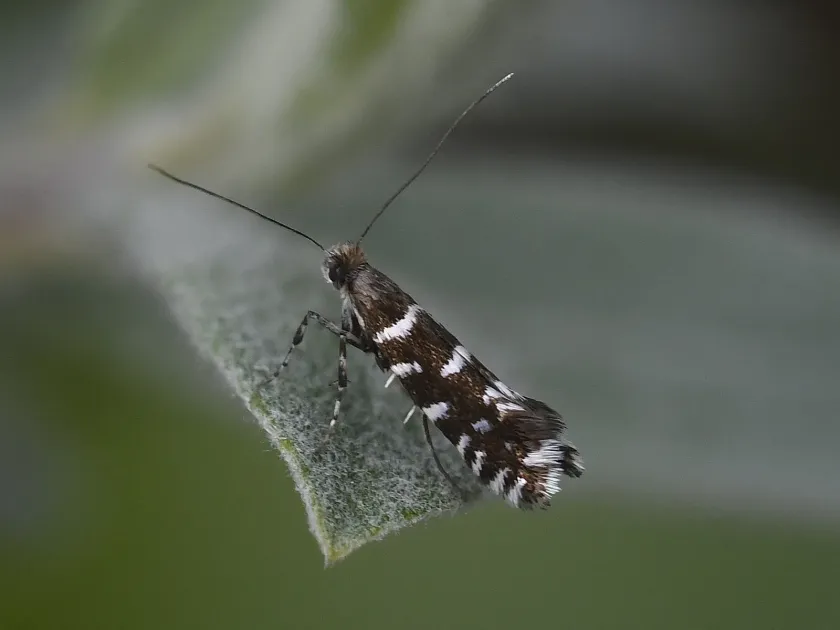
The adult moth is silvery-white, measuring about 6 to 7 mm in wingspan. It is primarily nocturnal, making it difficult to detect during daylight hours on the coffee bushes.
Eggs are deposited individually on the upper surface of the coffee leaf. They are minute and oval-shaped, requiring close inspection to be identified in the field.
The larval stage is the most destructive phase. The larvae are flat, legless caterpillars that tunnel directly into the leaf, feeding exclusively on the inner parenchyma tissue.
Pupation occurs in a small, white, Y-shaped or net-like cocoon attached to the underside of the leaf, which is a definitive sign of the species' presence.
What it damages
The pest specifically targets coffee trees, such as Coffea arabica and Coffea canephora. The feeding damage manifests as brownish, scorched-looking mines on the leaves.
As larvae consume the internal leaf tissues, they leave behind trails of excrement and destroyed cells. This process severely disrupts the tree's photosynthetic capacity.
Heavy infestations lead to widespread leaf drop, which weakens the coffee tree, reduces its vigor, and negatively impacts the total yield of coffee cherries.
The loss of foliage leaves the tree vulnerable to other pathogens, as the open wounds and weakened state facilitate the entry of various fungi and bacteria.
In severe cases, entire branches can become defoliated, resulting in significant financial losses for coffee farmers and a drop in overall bean quality.
When it appears
In tropical climates, the coffee leaf miner reproduces continuously throughout the year, with generation times ranging from 3 to 4 weeks depending on temperature.
The population tends to surge during drier periods, as high humidity and rainfall can sometimes be detrimental to the survival of the adult moth stage.
The presence of flushes—the periodic growth of new leaves on coffee trees—is a key factor that stimulates the egg-laying activity of the female moths.
Farmers usually observe peaks in the moth population by monitoring traps, which helps in timing control measures to coincide with the most vulnerable larval stages.
Consistent temperatures around 25°C provide optimal conditions for the life cycle, leading to overlapping generations and a constant presence of the pest.
Signs of infestation
The primary symptom is the appearance of distinct mines on the leaves. These start as small translucent spots and expand into brown, irregular patches.
- Translucent winding trails visible on the leaf surface.
- Necrotic, brown, dry patches covering large portions of the leaf.
- Rapid and widespread leaf abscission, often starting from the bottom of the tree.
- Presence of small white cocoons under the leaf blades.
Examining the underside of the leaves is crucial, as that is where the pupation process occurs and where the cocoons are typically found.
If you observe a tree shedding leaves prematurely while the branches remain otherwise healthy, it is highly likely that a leaf miner infestation is present.
A yellowing effect on the foliage, combined with the presence of visible mines, confirms that the photosynthesis is being compromised by the larvae.
Control measures
Integrated Pest Management (IPM) is the most effective approach, combining biological, cultural, and chemical strategies to maintain the pest population.
Biological control involves the conservation of naturally occurring parasitic wasps that prey upon the larvae, effectively keeping the miner population in check.
Cultural methods, such as regular pruning, ensure proper light penetration and air circulation, which helps dry out the microclimate and discourage moths.
Chemical control using systemic insecticides is applied when thresholds are exceeded, ensuring the product is absorbed by the plant to target feeding larvae.
Effective management requires scouting programs to identify the infestation early, allowing for targeted treatments rather than broad-spectrum pesticide usage.
Taxonomy
- Latin name
- Callisto coffeella
- Order
- Lepidoptera (butterflies)
- Family
- Gracillariidae
- EPPO code
- ORNXGU
Discussion
No discussions yet — be the first.