
Walnut yellow aphid
Callaphis juglandis
Description
How to identify
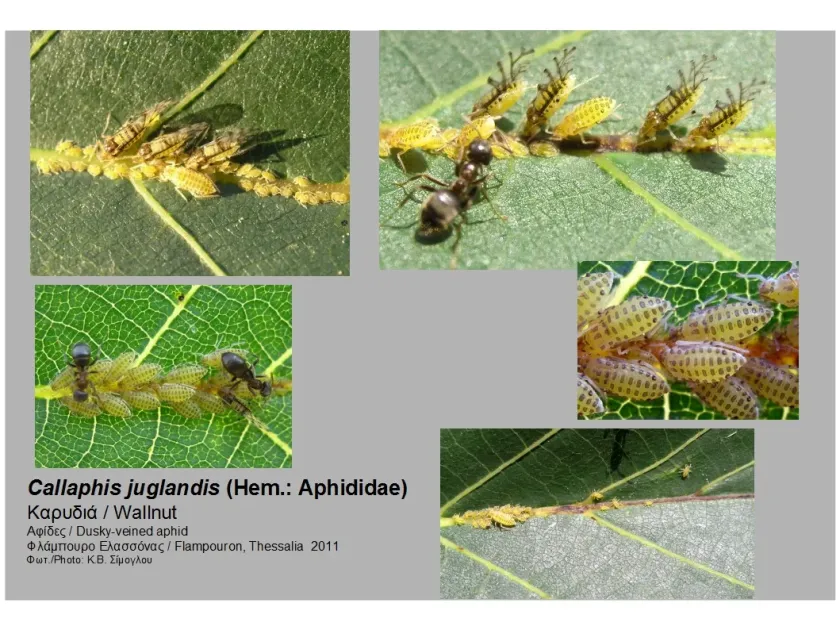
The walnut yellow aphid (Callaphis juglandis) belongs to the order Hemiptera and the family Aphididae. It is a highly host-specific pest that strictly targets walnut trees of the genus Juglans.
Adult aphids typically measure 2–3 mm in length and exhibit a distinct yellow body coloration with dark markings. The species includes both winged and wingless forms to facilitate movement.
Overwintering occurs in the egg stage. These eggs are deposited by females in late autumn, usually hidden in bark crevices near buds or at the base of young shoots to ensure survival.
The species reproduces parthenogenetically during the growing season, allowing for rapid generation turnover. This leads to the establishment of dense colonies on the foliage within a very short time.
As the season nears its end, sexual forms emerge to mate and produce the overwintering eggs, which remain dormant until the following spring's environmental cues trigger hatching.
What it damages
The aphid feeds exclusively on walnut leaves. By colonizing the underside of the leaves, they pierce the epidermis and extract nutrient-rich phloem sap, disrupting essential plant functions.
Feeding injury causes chlorosis (yellowing) of the leaf tissue. Persistent sap extraction prevents the tree from efficiently conducting photosynthesis, leading to reduced vigor and stunted growth.
The aphids excrete honeydew, a sugary substance that coats the leaves. This serves as a substrate for sooty mold growth, which blocks sunlight and creates a detrimental layer on the foliage.
Severe infestations often result in premature leaf drop, which weakens the tree significantly and makes it more susceptible to environmental stressors and secondary infections.
Young trees are particularly vulnerable, as chronic aphid infestation can lead to stunted shoot development, irregular branching, and a overall decline in the health of the nursery stock.
Signs of infestation
Early detection is possible by inspecting the underside of leaves for small yellow aphids. Curled or crinkled leaf margins are a classic sign of localized feeding damage.
The presence of honeydew makes leaves feel sticky to the touch. This substance often attracts ants, which aggressively farm the aphids, making the presence of ant trails on tree trunks a reliable indicator.
Sooty mold, appearing as black, soot-like dust on the leaf surface, indicates that an aphid colony has been established on that tree for a significant amount of time.
Yellowing leaves in the mid-summer period, followed by premature leaf senescence and abscission, are clear signs that the aphid population has reached harmful levels.
Fruit development may be negatively impacted if the infestation occurs during the critical periods of nut fill, resulting in lower yields or decreased nut quality.
Control measures
Cultural control involves maintaining optimal tree health through proper fertilization and pruning to ensure the tree can withstand minor pest pressures without severe degradation.
Controlling ant populations is vital, as they protect aphids from natural predators. Using tree bands or sticky barriers can effectively block ant access to the foliage.
In cases of high infestation, chemical control using systemic insecticides is recommended. It is essential to choose products compatible with integrated pest management programs.
Beneficial insects, such as lady beetles, lacewings, and parasitic wasps, play a significant role in natural regulation and should be protected by avoiding broad-spectrum pesticides.
- Monitor foliage weekly during the spring and early summer months.
- Promote biodiversity in the orchard to encourage natural aphid predators.
- Apply treatments only when the economic threshold of damage is exceeded.
Taxonomy
- Latin name
- Callaphis juglandis
- Order
- Hemiptera (bugs, aphids, leafhoppers)
- Family
- Aphididae
- EPPO code
- CLLAJU
Discussion
No discussions yet — be the first.