
Caenis horaria
Caenis horaria
Description
How to identify
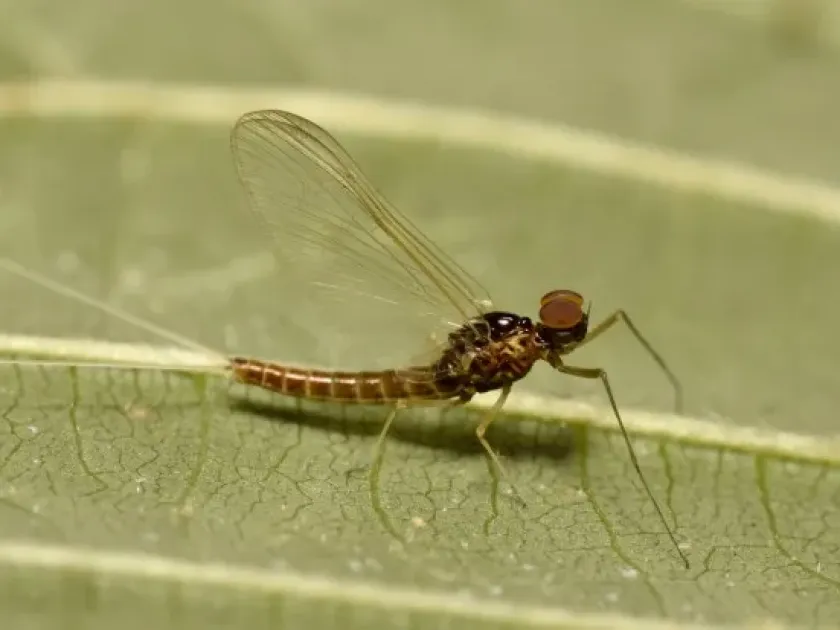
Caenis horaria is a species of mayfly belonging to the order Ephemeroptera and the family Caenidae. These insects are characterized by their extremely delicate appearance and short-lived adult phase.
The adult mayflies possess translucent wings and two or three elongated caudal filaments. Their mouthparts are vestigial, meaning they do not consume food or cause any damage to vegetation during their final stage of life.
The larval stage is strictly aquatic, living within the sediment at the bottom of ponds, lakes, or slow-moving rivers. Larvae are well-adapted for burrowing in mud and debris.
For agricultural purposes, identifying this insect is important primarily to differentiate it from actual pests. They appear as small, fragile organisms that often gather in large numbers near water bodies.
Accurate identification of Caenis horaria involves examining the structure of the gill covers and the specific venation patterns of the wings, typically conducted by entomologists.
What it damages
It is critical to note that Caenis horaria is not a plant pest. It does not feed on crops, vegetables, or trees, and it does not possess the anatomy to cause damage to plant tissues.
The larvae feed on detritus, organic matter, and algae found in aquatic environments. They act as essential decomposers within their habitat rather than threats to agricultural productivity.
Adults do not have a functional digestive system and survive only long enough to reproduce. Their presence near fields is strictly incidental and carries no economic impact on crop yields.
Reports of mayflies damaging plants are generally inaccurate or confused with other insects that may share similar habitats near water sources.
Consequently, there is no need to classify this species as a harmful organism, and no damage control measures are required for field operations.
When it appears
The emergence of adult Caenis horaria typically occurs during the summer months, most notably from June to July, depending on local water temperatures and ecological conditions.
Adults exhibit synchronized emergence, often forming large swarms near the shoreline in the early morning or evening. This behavior is a natural phenomenon linked to mating rituals.
The life cycle of the larvae is much longer, spanning several months of development in the water. The adult phase, however, lasts only a few hours to a couple of days.
Since the life cycle is so short, the presence of these insects is fleeting. They appear in waves and vanish rapidly, posing no long-term threat to agricultural management.
Annual variations in emergence intensity are common and reflect the overall health and environmental quality of the local aquatic ecosystem.
Control measures
Because Caenis horaria poses no threat to crops, no pest control measures are recommended. Applying pesticides to manage this species is unnecessary and counterproductive.
In greenhouses situated near water, simple mechanical exclusion, such as fine-mesh screening on vents and doors, is sufficient to prevent the entry of any drifting adults.
Maintaining the ecological balance of nearby water bodies is beneficial, as these insects are a vital part of the food web for birds and fish, serving as natural biological indicators.
Farmers should focus their resources on genuine agricultural threats rather than these harmless aquatic insects, which contribute to biodiversity.
- Ensure effective insect screening on greenhouse ventilation.
- Avoid using unnecessary pesticides near aquatic habitats.
- Perform monitoring to distinguish between harmless mayflies and actual crop pests.
Taxonomy
- Latin name
- Caenis horaria
- Family
- Caenidae
- EPPO code
- CENSHO
Discussion
No discussions yet — be the first.