

Almond moth
Cadra cautella
Description
How to identify
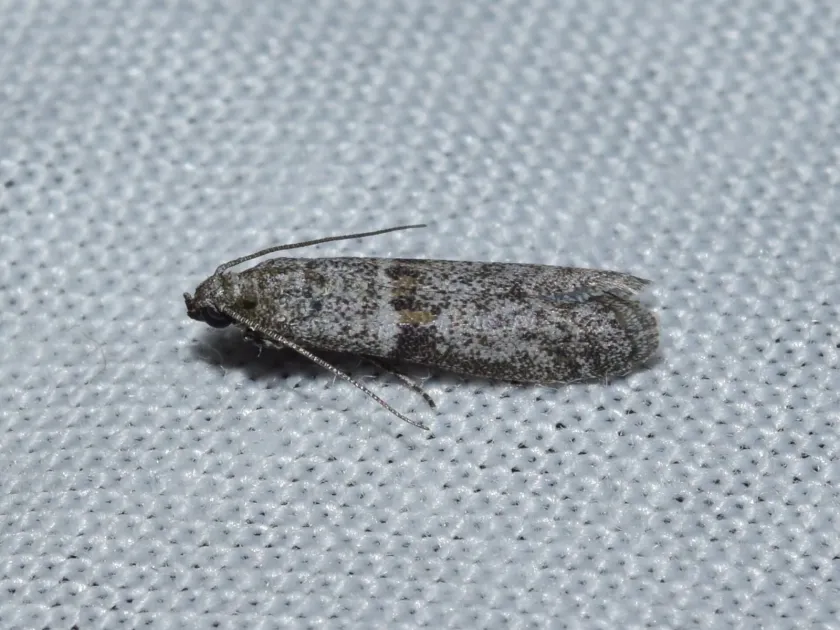
The almond moth (Cadra cautella) belongs to the order Lepidoptera, family Pyralidae. Adult moths have a wingspan of approximately 18–20 mm.
The forewings are typically grayish-brown, featuring a dark transverse band, while the hindwings are pale, translucent, and fringed with fine hairs.
Larvae (caterpillars) grow up to 15 mm in length. Their bodies range from off-white to yellowish-pink, with a distinct dark brown or black head capsule.
Pupation occurs within a tough, silken cocoon constructed by the mature larva. These cocoons are often found in cracks, crevices, or directly within the food substrate.
The life cycle duration is highly dependent on ambient temperature and humidity, allowing for multiple overlapping generations in controlled storage environments.
What it damages
The almond moth is a cosmopolitan pest that infests a vast range of stored goods, including wheat, barley, maize, rice, and various processed grain products.
It is particularly destructive to oilseeds, nuts (especially almonds and walnuts), dried fruits, cocoa beans, and confectionery products.
The damage is primarily caused by the larvae, which feed on the embryos and endosperm of grains, resulting in significant weight loss and reduced product quality.
A hallmark of infestation is the dense webbing produced by larvae, which binds grains and food particles into matted clumps, causing spoilage.
This webbing also traps feces and shed larval skins, leading to contamination and creating favorable conditions for the growth of molds and pathogenic fungi.
When it appears
In heated warehouse environments, the almond moth does not enter diapause and can reproduce continuously throughout the year.
Optimal development occurs at temperatures between 25 °C and 30 °C, where a full generation cycle can be completed in as little as 30 to 45 days.
While adult moths are sensitive to cold, the larval stage is resilient and can survive in unheated structures during cooler months, resuming activity as temperatures rise.
In field conditions, the moth remains active during the warm season, moving into storage facilities as harvest products are introduced.
High relative humidity (above 65%) significantly accelerates larval growth rates and increases the overall survival rate of the population within stored bulk goods.
Signs of infestation
The most immediate sign of infestation is the observation of small adult moths flying near ceilings or around bags of stored goods during dusk.
Presence of fine, silk-like webbing on the surface of grain stacks or food containers is a definitive indicator of larval activity and prepupal stages.
Infested products often appear clumped together, and separation of these clumps reveals silken channels constructed by the feeding larvae.
A noticeable shift in the aroma of stored produce, often accompanied by a musty smell, indicates both the moth's presence and associated microbial degradation.
Exit holes in damaged grains or seeds, accompanied by a fine dust composed of larval excreta and food particles, signify an advanced stage of infestation.
Control measures
Sanitation is the cornerstone of management; regular cleaning of bins, floor cracks, and machinery prevents the buildup of food debris that sustains the moth population.
Effective storage management includes cooling the grain bulk via aeration, as temperatures consistently below 10 °C significantly inhibit larval development.
For established infestations, professional fumigation using phosphine-based products is the standard approach to eliminate all life stages within grain.
Pheromone-baited traps are highly effective for monitoring adult moth populations and identifying the early stages of an infestation before it spreads.
- Seal all warehouse doors and windows to exclude moths.
- Use fine-mesh screens on ventilation systems.
- Practice the "first-in, first-out" inventory method to minimize storage time.
Content graph
Connections · Almond moth
Most often together:
Marketplace
Products · 13

Dzhin
«Юнісіті Ентерпрайсіс Л.П.», Единбург, Великобританія
Rodenticides
0
0
·
62
1 offer
14.19 €per 1 kg
Buy


Biology
Taxonomy
- Latin name
- Cadra cautella
- Order
- Lepidoptera (butterflies)
- Family
- Pyralidae
- EPPO code
- EPHECA
Community
Discussion
No discussions yet — be the first.