
Poplar gall aphid
Byrsocrypta longisetosa
Description
How to identify
The poplar gall aphid belongs to the Pemphigidae family and is a specialized pest affecting various species within the Populus genus.
Adults possess specialized piercing-sucking mouthparts, which are evolved specifically for feeding on plant sap within host tissues.
The morphology of these insects includes distinct features that allow them to thrive in protected environments inside leaf galls.
The species is known for its complex life cycle, which involves alternating between host tissues and forming unique physiological structures.
Entomologists identify the species by its specific setal patterns and the characteristic morphology of the galls it induces.
What it damages
The primary hosts of this aphid are various poplar trees, which are often used in forestry and urban landscaping applications.
The damage is primarily concentrated on the leaf blades, where the aphid induces the formation of protective gall structures.
While the galls appear as local deformities, they disrupt normal metabolic and photosynthetic processes within the leaf tissue.
Severe infestations can lead to a reduction in the overall vigor of young trees, affecting their growth rate and structural integrity.
In high populations, the aphid can cause premature leaf senescence, leading to defoliation before the end of the growing season.
When it appears
The life cycle commences in early spring when fundatrices hatch from overwintered eggs deposited in bark crevices.
As the tree buds open, the aphids migrate to the young leaves, initiating the formation of the characteristic galls.
Generations develop successively inside the protective environment of the galls throughout the spring and early summer months.
By mid-summer, winged forms are produced to disperse the population and colonize new, healthy host plants nearby.
As temperatures decline in autumn, the aphids produce sexual forms that lay overwintering eggs, ensuring survival for the next season.
Signs of infestation
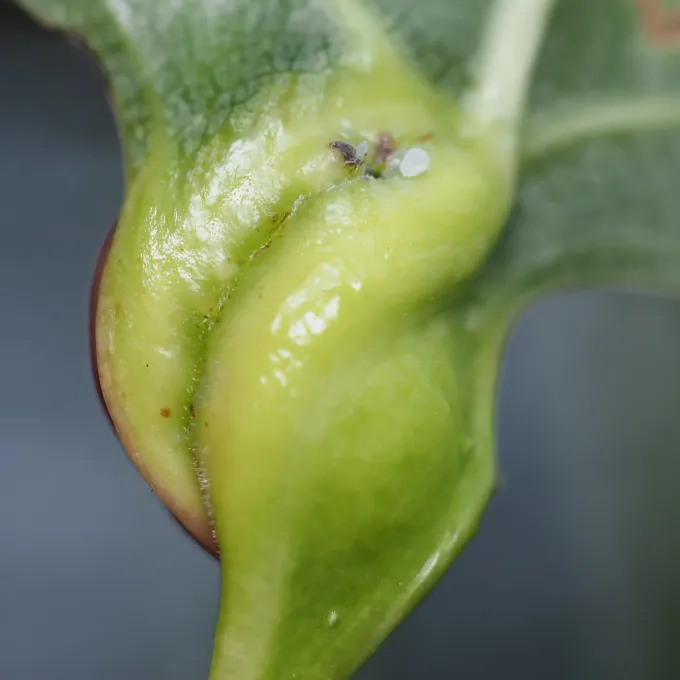
The most prominent sign of infestation is the appearance of spherical or elongated galls on the surfaces of poplar leaves.
These galls often exhibit different coloration compared to the healthy leaf tissue, making them visible upon close inspection.
Inside these structures, one can find colonies of aphids at various developmental stages, often accompanied by honeydew secretions.
Affected leaves may show signs of curling, stunted growth, or discoloration as the aphids deplete the plant of essential nutrients.
- Presence of distinct leaf galls
- Leaf curling and yellowing
- Colonies found inside leaf swellings
- Reduced canopy density
Control measures
Chemical control involves the application of systemic insecticides that are absorbed by the tree and circulate through its vascular system.
Applications should be timed correctly, targeting the period before the galls fully enclose the aphid population for maximum efficacy.
Silvicultural practices, such as pruning and destroying heavily infested plant material, can help reduce the local population density.
Biological control agents, including lady beetles and hoverfly larvae, play a significant role in suppressing aphid numbers naturally.
In landscape management, selecting resistant poplar clones is the most sustainable strategy to minimize the impact of this pest.
Taxonomy
- Latin name
- Byrsocrypta longisetosa
- Order
- Hemiptera (bugs, aphids, leafhoppers)
- Family
- Aphididae
- EPPO code
- BYRSLO
Discussion
No discussions yet — be the first.