
Red ring nematode
Bursaphelenchus cocophilus
Description
How to identify
The red ring nematode (Bursaphelenchus cocophilus) is a microscopic plant-parasitic nematode within the Aphelenchoididae family. It is recognized globally as the primary agent of the lethal red ring disease affecting palms.
Adult worms are slender and translucent, typically measuring around 1 mm in length. They reside within the intercellular spaces of palm trunks and petioles, feeding directly on living plant tissues.
The life cycle of this nematode is obligately linked to the palm weevil (Rhynchophorus palmarum). The nematode larvae attach to the insect's cuticle or enter its body, using the beetle as a vector for dispersal.
Under tropical conditions, the pathogen reproduces rapidly, allowing it to complete multiple generations in a single month, which leads to massive infestation levels within the host.
Due to its high destructive potential, Bursaphelenchus cocophilus is classified as a significant quarantine pest in many palm-growing countries across the Americas.
What it damages
The nematode primarily impacts the coconut palm (Cocos nucifera) and oil palm (Elaeis guineensis). However, various ornamental species are also susceptible to colonization.
Infection occurs when the vector beetle creates feeding or oviposition wounds, allowing the nematodes to enter the internal vascular system of the palm.
The nematodes migrate throughout the stem, damaging the parenchyma cells and destroying the integrity of the vascular bundles, which disrupts the transport of nutrients.
As the nematode population density increases, the host plant suffers from physiological stress, leading to systemic wilting and eventual tissue decay.
A single infestation can devastate an entire plantation if management strategies are not implemented promptly to contain the spread of the pathogen.
Signs of infestation
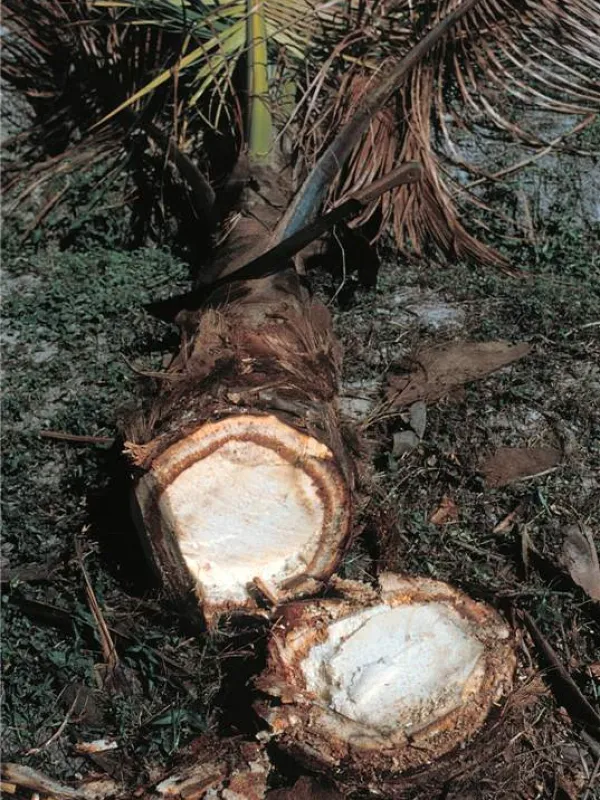
The hallmark symptom is the characteristic red to brown ring visible in the transverse cross-section of the palm trunk, typically 2 to 5 cm from the outer cortex.
Externally, the first signs appear as chlorosis of the oldest leaves, which turn yellow and then brown as the tissue dies progressively upwards.
The central spear leaf often shows signs of necrosis or deformation, and the entire crown eventually collapses as the plant succumbs to the disease.
Affected trees exhibit premature nut drop and reduced yield, followed by a total cessation of flowering as the palm loses its metabolic capacity.
If the trunk is severely damaged, the internal tissue may become soft or fermented, which can be detected by an unpleasant odor upon cutting into the stem.
Control measures
Eradication is the primary control strategy. Once a tree shows symptoms, it must be cut down and burned to eliminate both the nematode reservoir and the vector population.
Integrated Pest Management (IPM) focuses on controlling the palm weevil using pheromone-baited traps to capture adult insects before they can spread the disease.
Strict quarantine measures are essential to regulate the movement of palm products and ensure that planting material is free from nematode contamination.
Plantation hygiene, such as avoiding unnecessary injuries to palm trunks and removing dead organic debris, is crucial for reducing potential entry points for the parasite.
Chemical control is largely preventative and aimed at protecting trees from vector insect attacks, as direct control of nematodes inside the tree trunk remains difficult.
Taxonomy
- Latin name
- Bursaphelenchus cocophilus
- Order
- Nematodes
- Family
- Aphelenchoididae
- EPPO code
- RHAACO
Discussion
No discussions yet — be the first.