

Description
How to identify
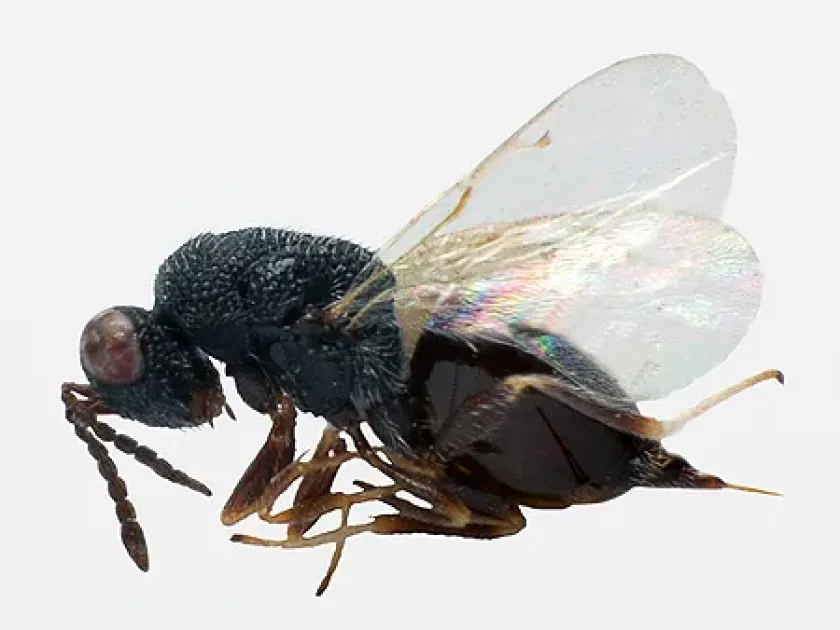
The alfalfa seed chalcid, known scientifically as Bruchophagus gibbus, is a tiny Hymenopteran wasp belonging to the Eurytomidae family. Adults measure only 1.5–2.0 mm in length.
These insects are characterized by their jet-black body color with a distinct metallic sheen. The common name refers to the visibly thickened hind femora of the adult.
Larvae of this pest are white, legless, and curved, specifically adapted to consume the internal tissues of seeds. They occupy the entire interior space of the seed as they develop.
Adult females possess a specialized ovipositor designed to penetrate the outer wall of developing legume pods, allowing them to lay eggs inside the growing seeds.
Adult wasps are most active during the sunny, warm periods of the day, frequently observed visiting alfalfa flowers to nectar and perform mating activities.
What it damages
The primary hosts for the alfalfa seed chalcid are alfalfa, clover, and occasionally sainfoin. The insect causes direct losses in seed yield for these legume crops.
Larvae feed internally on the seed endosperm and embryo, completely hollowing out the interior. This results in seeds that are non-viable and weigh significantly less than healthy ones.
The damage often goes unnoticed because the external pod wall remains intact. Consequently, the infestation is frequently discovered only during the cleaning or threshing process.
Economic damage can be severe, often reaching 50% or more in untreated fields. This makes seed production highly challenging in regions where the pest is endemic.
The pest's ability to survive in both field residues and storage containers poses a constant threat to seed quality and trade security.
When it appears
The alfalfa seed chalcid overwinters as a full-grown larva inside infested seeds that remain in the field or are stored in bags or silos.
As temperatures rise in the spring, the larvae pupate, and adults emerge in synchronization with the development of the host plant’s flower buds.
There are typically one or two generations per year. The timing is tightly linked to the phenology of the legume crops, ensuring a constant food supply for the offspring.
The second generation is of particular concern as it develops in late-season seeds, which will serve as the source of infestation for the following growing season.
Climate factors such as temperature and humidity determine the rate of development and the intensity of the adult emergence during the flowering period.
Signs of infestation
The most diagnostic sign of an infestation is the presence of small, perfectly circular emergence holes found on the surface of the legume seeds.
Seeds infested by the chalcid are brittle, dull-colored, and hollow. They often float when placed in water, providing a simple method for quality testing.
Careful dissection of seeds under a microscope reveals the presence of larvae or the empty shell left behind after the adult has emerged.
In the field, the presence of adult wasps on blooming flowers during the peak of the season serves as a key indicator of potential seed damage to follow.
Reduced germination rates in stored seeds, despite proper storage conditions, are a strong indication that the seed lot has been compromised by this pest.
Control measures
Management of the alfalfa seed chalcid requires an integrated approach focusing on sanitation and disruption of the pest's life cycle.
Crop rotation and geographical isolation of new seed fields from old, infested stands are fundamental strategies for mitigating risk.
- Deep plowing to bury infested seeds deep in the soil.
- Thorough cleaning of seed lots to remove light, infested seeds.
- Elimination of wild legume hosts in and around the field.
- Timely harvesting to remove seeds before the next generation emerges.
- Application of insecticides timed with the onset of flowering.
Chemical control is most effective when targeted at adults before they can oviposit. Monitoring emergence patterns is crucial for the success of any treatment.
Post-harvest treatment, such as fumigation of seed stocks in silos, is necessary to ensure that the pest is not transported to new geographical areas.
Reference
Connections · Alfalfa seed chalcid
Most often together:
Marketplace
Products · 1
Biology
Taxonomy
- Latin name
- Bruchophagus gibbus
- Order
- Hymenoptera
- Family
- Eurytomidae
- EPPO code
- BRPHGI
Community
Discussion
No discussions yet — be the first.