
Wheat aphid
Brachycolus tritici
Description
How to identify
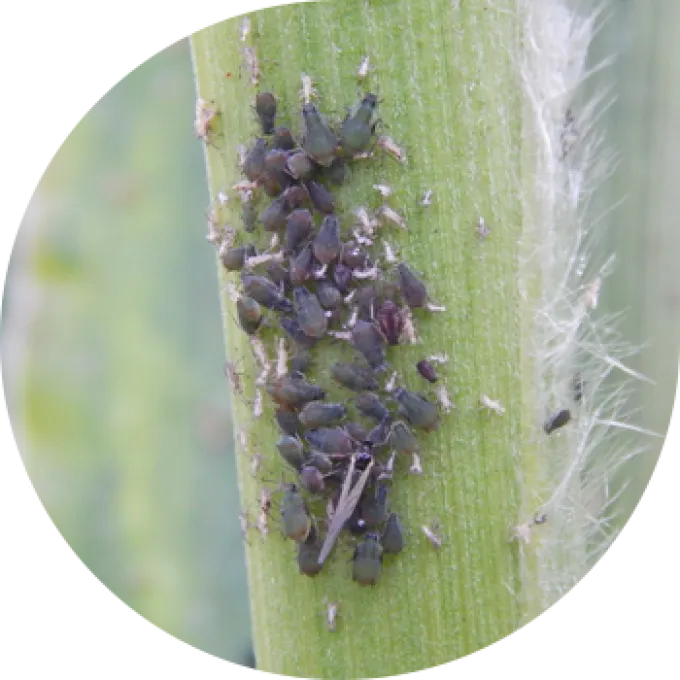
The wheat aphid Brachycolus tritici is a small insect characterized by a pale green or grayish-green body, often covered in a fine waxy coating. Its distinct morphology includes short antennae and specific tubes, known as cornicles, on the abdomen.
Both winged and wingless forms exist within a single population. Winged individuals allow the species to disperse rapidly to neighboring fields, while wingless forms focus on colony growth.
Taxonomically, this pest belongs to the order Hemiptera and the family Aphididae. They prefer a secluded lifestyle, residing primarily inside the tightly curled leaves of host plants.
Populations are known for high reproductive rates, particularly under moderate temperatures. Their ability to reproduce parthenogenetically allows for rapid exponential growth in a very short time.
Regular field monitoring using scouting methods is essential. Because of their size and tendency to hide within plant structures, early detection is crucial for effective population management.
What it damages
This aphid primarily targets winter and spring wheat. While it favors wheat, it can also infest barley, rye, and various wild grass species surrounding the crop field.
The aphids feed by piercing plant tissues with their mouthparts and sucking out cell sap. This direct feeding leads to the depletion of vital nutrients, significantly weakening the plant.
Damage reduces the photosynthetic efficiency of the leaves. As a result, plant growth is severely stunted, and the overall vigor of the crop is compromised throughout the season.
Beyond direct feeding, Brachycolus tritici acts as a vector for various cereal viruses. The transmission of these pathogens often causes more economic damage than the physical feeding itself.
Yield loss is significant and results from reduced grain fill and smaller ear size. In severe infestations, the quality of the harvested grain is significantly diminished.
When it appears
The life cycle begins in early spring as temperatures rise, allowing the aphids to emerge from their overwintering sites. They often start colonizing new crops during the tillering stage.
During the summer months, population growth can be influenced by weather conditions. Excessive heat and drought may suppress activity, causing the aphids to retreat to the cooler parts of the plant.
In the autumn, aphids migrate to newly planted winter cereal fields. This period is critical, as they lay eggs that will survive the winter, establishing the foundation for the next year's population.
The life cycle encompasses several overlapping generations. This rapid succession of generations, fueled by parthenogenetic reproduction, ensures that the species can quickly capitalize on available host plants.
Overwintering eggs are laid near the base of the stems. These eggs are highly resistant to cold and frost, ensuring the survival of the species even in harsh winter conditions.
Signs of infestation
The most distinctive symptom of an infestation is the curling and distortion of leaves, often referred to as a "goffered" or wrinkled appearance. Aphid colonies are typically tucked away inside these folds.
Affected leaves often show chlorotic symptoms, turning yellow or reddish as the plant's health declines. Without intervention, these tissues eventually turn necrotic and die.
Infested crops appear noticeably shorter than healthy plants. These patches of stunted growth are a clear visual indicator of heavy aphid presence in the field.
Sticky honeydew secretions are commonly found on the surface of the leaves. This substance serves as a substrate for sooty mold growth, which further inhibits photosynthesis.
Grain ears on heavily infested plants are often poorly developed. This structural degradation is a direct result of long-term sap-sucking, which disrupts the plant's internal transport system.
Control measures
Cultural practices, such as deep plowing in the autumn, are effective for destroying volunteer cereals that act as bridges for the aphid population between seasons.
Adjusting planting dates to ensure crops reach certain growth stages outside the peak migration periods of the aphids is an important preventative strategy.
The selection of pest-resistant wheat varieties is a long-term solution that reduces the reliance on synthetic chemicals and builds a more resilient cropping system.
Chemical control should be implemented based on economic injury thresholds. Systemic insecticides are generally preferred as they can reach aphids hidden within the curled leaf structures.
Biological control, including the conservation of natural enemies like lady beetles, lacewings, and predatory bugs, plays a vital role in maintaining the aphid population below damaging levels.
Taxonomy
- Latin name
- Brachycolus tritici
- Order
- Hemiptera (bugs, aphids, leafhoppers)
- Family
- Aphididae
- EPPO code
- BRAYTR
Discussion
No discussions yet — be the first.