

Peach aphid
Brachycaudus persicae
Description
How to identify
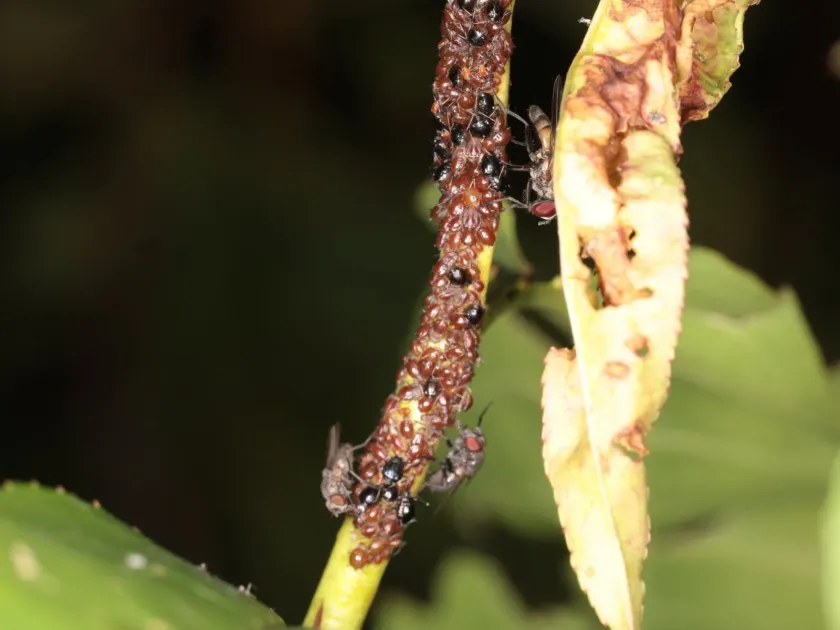
The peach aphid (Brachycaudus persicae) belongs to the order Hemiptera and the family Aphididae. Adults are easily recognized by their shiny, dark brown or black appearance.
The lifecycle includes wingless and winged forms, which allow the species to colonize new parts of the tree or different hosts efficiently.
The population expands rapidly during the spring through parthenogenesis, with many generations produced over a single growing season.
Towards the end of the summer, sexual forms appear to produce eggs that overwinter on the bark, ensuring the survival of the species until the following spring.
These aphids tend to congregate in high-growth areas, often creating dense mats on the undersides of leaves where they are protected from environmental factors.
What it damages
This pest targets stone fruit species, most notably peach, nectarine, plum, and almond trees, causing severe physiological stress.
The primary damage occurs on developing buds and young shoots, which become curled, stunted, and severely deformed due to the aphid's feeding activity.
Infested trees show reduced vigor, and heavy infestations can lead to premature fruit drop and a significant decrease in overall yield quality.
Brachycaudus persicae acts as a vector for various plant viruses, which poses a long-term threat to the health and longevity of the orchard.
Furthermore, the secretion of honeydew promotes the growth of sooty mold, which blocks photosynthesis and makes the remaining fruit unattractive.
When it appears
The seasonal activity begins in early spring, synchronized with the bud burst phase, as the fundatrices emerge from overwintering eggs.
Peak populations are typically recorded during the late spring months of May and June, when temperatures are optimal for rapid development.
During the peak summer months, activity may fluctuate based on heat and moisture levels, though the pest often persists on succulent growth.
Autumn marks the transition period where the population produces sexual forms that prepare for the winter survival stage.
The winter stage is spent entirely as an egg, which is highly resilient to cold weather and serves as the starting point for the next year's cycle.
Signs of infestation
The most visible sign is the curling of young leaves, which creates a protective shelter for the aphid colony inside the leaf rolls.
Sticky honeydew on the foliage and branches is a clear indicator that a colony is active and feeding nearby in the canopy.
The presence of large numbers of ants is a reliable secondary sign, as they tend to the aphids to collect the secreted honeydew.
Yellowing leaves, stunted shoot development, and early leaf drop are classic symptoms of a severe infestation that requires immediate attention.
A closer look at the undersides of the leaves usually reveals clusters of shiny, dark insects that are diagnostic for this specific species.
Control measures
Dormant oil sprays applied in late winter or early spring are highly effective at killing overwintering eggs before they hatch.
During the growing season, systemic insecticides should be used if biological controls, such as ladybugs or lacewings, fail to limit the population.
Avoid excessive nitrogen fertilization, as it induces soft, succulent growth that is highly attractive to aphids and supports faster colony growth.
Encouraging biodiversity by planting flowering plants nearby can provide a habitat for natural predators that feed on aphids.
- Prune away infested suckers and water sprouts to remove habitat.
- Monitor trees weekly during the spring growth flush.
- Use selective insecticides to preserve beneficial insect populations.
Content graph
Connections · Peach aphid
Most often together:
Marketplace
Products · 1
Biology
Taxonomy
- Latin name
- Brachycaudus persicae
- Order
- Hemiptera (bugs, aphids, leafhoppers)
- Family
- Aphididae
- EPPO code
- ANURPN
Community
Discussion
No discussions yet — be the first.