
Thistle aphid
Brachycaudus cardui
Description
How to identify
The thistle aphid (Brachycaudus cardui) belongs to the family Aphididae, order Hemiptera. It is a common pest that alternates between stone fruit trees and various herbaceous plants.
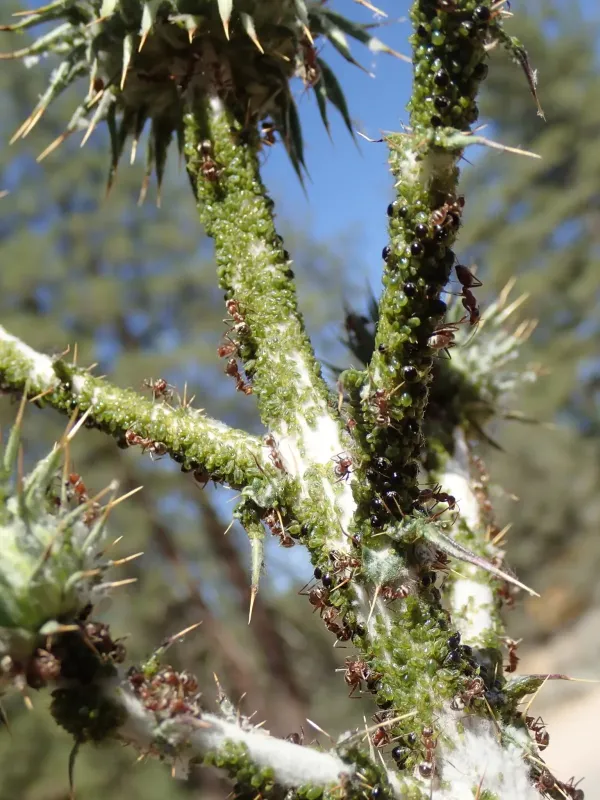
Adult aphids are typically 1.5–2.5 mm long, with a body coloration ranging from light green to yellowish-green. Their distinctive feature is a powdery, wax-like coating that gives them a dusty appearance.
The life cycle begins with eggs overwintering in the bark crevices and near the buds of host trees. In the spring, wingless fundatrices hatch and start reproducing on the succulent new growth of fruit trees.
As the season progresses, winged forms emerge to migrate to their secondary summer hosts, primarily thistles (Carduus species) and other Asteraceae, where they continue their life cycle.
In late summer or autumn, sexual forms return to the primary fruit tree hosts to lay winter-hardy eggs, ensuring the species survives until the following spring.
What it damages
The primary victims of this aphid are stone fruits, including plums, damsons, apricots, and peaches. They aggressively feed on the sap of young shoots and tender leaves.
By sucking the sap, they cause significant physiological stress to the tree, resulting in stunted growth and severe leaf deformation. The leaves often curl tightly and may change to a reddish or yellow hue.
The aphids secrete toxic enzymes while feeding, which disrupts the normal development of the shoots. This leads to the characteristic curling and "nest-like" appearance of the terminal foliage.
This pest is also a vector for several plant viruses, which can severely impact tree health and fruit quality. Viral infections can lead to long-term decline in orchard productivity.
The excretion of honeydew promotes the growth of sooty mold, a fungus that covers the leaf surface in a black film, hindering photosynthesis and reducing the overall vigor of the tree.
Signs of infestation
The most prominent sign of infestation is the tight curling and wrinkling of leaves at the tips of new growth. These curled leaves often hide large colonies of aphids.
Excessive ant activity on the tree is a classic indicator. Ants protect the aphids from predators to feed on the sweet honeydew, effectively acting as "shepherds" for the colony.
Visible sticky residues (honeydew) on the leaves and branches provide early warning signs before severe leaf deformation becomes obvious.
- Curled and deformed terminal leaves.
- Visible colonies with a white, powdery wax covering.
- Sticky honeydew patches on foliage.
- Increased ant traffic on branches.
- Black, sooty mold growth on leaves.
If you observe stunted, twisted shoots in early summer, inspecting the underside of the leaves will almost certainly reveal a dense population of these aphids.
Control measures
Dormant season sprays applied early in the spring are crucial for eliminating overwintering eggs on the bark before the buds begin to burst.
Weed management is vital; removing thistles and other host weeds from the vicinity of the orchard disrupts the migration cycle and reduces the pressure on the trees during the summer.
Controlling ant populations using tree bands or insecticides on the trunk prevents them from protecting the aphids, making the aphids more vulnerable to natural predators.
During the growing season, systemic insecticides are highly effective as they travel within the plant tissues to reach aphids protected inside the curled leaves.
Promoting a healthy environment for natural enemies such as ladybirds, lacewings, and hoverflies can provide significant long-term biological control, keeping the thistle aphid population at manageable levels.
Taxonomy
- Latin name
- Brachycaudus cardui
- Order
- Hemiptera (bugs, aphids, leafhoppers)
- Family
- Aphididae
- EPPO code
- BRDSCA
Discussion
No discussions yet — be the first.