
Boxelder bug
Boisea trivittata
Description
How to identify
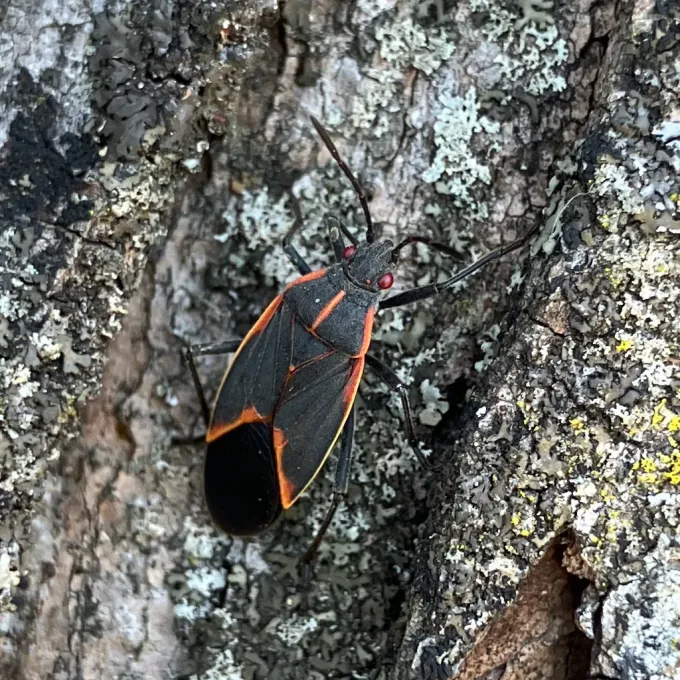
The boxelder bug (Boisea trivittata) is a member of the Rhopalidae family. Adults typically measure about 10 to 14 millimeters in length and are easily recognized by their dark gray or black bodies with distinct bright red or orange markings on the pronotum and wing veins.
Nymphs, or immature bugs, are smaller and lack wings. They are predominantly bright red in color, gradually developing black structural elements as they progress through several molting stages to reach adulthood.
These insects are well-known for their congregating behavior. They often gather in large clusters on sun-warmed surfaces, such as the trunks of boxelder trees, stone walls, or the south-facing sides of buildings during autumn.
They possess a piercing-sucking mouthpart, which they use to extract sap from plant tissues. While they are not harmful to humans or pets, their presence in homes can be a significant nuisance during the cooler months.
Identification is straightforward due to their unique coloration and their tendency to be found in close association with their primary host plant, the boxelder maple.
What it damages
Boxelder bugs primarily feed on the seeds, leaves, and tender twigs of boxelder maple trees. By inserting their beak into the plant tissue, they drain vital nutrients, which can cause minor damage to the tree's health.
While mature, healthy trees are generally not killed by these insects, heavy infestations can lead to stunted growth and leaf deformation. Seeds damaged by the bugs may have reduced germination rates.
In addition to maples, they have been observed feeding on other fruits, including plums, cherries, and grapes. This feeding can result in surface pitting or scarring on the fruit, rendering it less desirable for consumption.
The impact is often more aesthetic than physiological. Foliage that has been heavily fed upon may turn yellow or brown prematurely, leading to a thin canopy during the growing season.
For most residential areas, the primary damage is considered to be the nuisance of the bugs invading living spaces rather than severe destruction of the trees themselves.
When it appears
The life cycle of the boxelder bug is heavily influenced by seasonal temperature changes. They overwinter as adults, seeking protection in cracks of tree bark, rock crevices, or within the walls of houses.
In spring, as temperatures rise, the bugs emerge to feed and lay eggs on the host trees. The first generation of nymphs typically appears in late spring or early summer, following the start of seed development on the trees.
Throughout the summer, multiple generations may occur if conditions are favorable and food is abundant. This leads to an increase in population density, which peaks towards the end of the summer season.
As autumn approaches and temperatures begin to drop, the adults start their search for winter hibernation sites, often aggregating on warm structures, which is when they are most noticeable to homeowners.
The duration of their development stages is temperature-dependent, with warmer summers resulting in faster maturation and potentially higher population numbers by the following year.
Control measures
The most effective long-term management strategy is to remove female boxelder trees from the landscape. Since they are the primary host, removing them eliminates the main source of food and reproduction.
For chemical control, contact insecticides can be applied directly to the clusters of bugs when they are spotted in early spring or on exterior walls during the fall migration.
Preventing bug entry into homes is critical. This involves caulking cracks around windows, doors, and utility pipes, as well as installing fine-mesh screens on vents and windows to block their entry.
Mechanical removal, such as using a vacuum cleaner to gather the bugs from house siding or interior walls, is a quick and non-toxic way to manage their presence inside human dwellings.
Maintaining a clean yard by raking up leaves and removing debris beneath host trees helps reduce the number of potential hiding spots for the bugs to overwinter successfully.
Taxonomy
- Latin name
- Boisea trivittata
- Order
- Hemiptera (bugs, aphids, leafhoppers)
- Family
- Aphididae
- EPPO code
- LEPCTR
Discussion
No discussions yet — be the first.