
Boxelder bug
Boisea
Description
How to identify
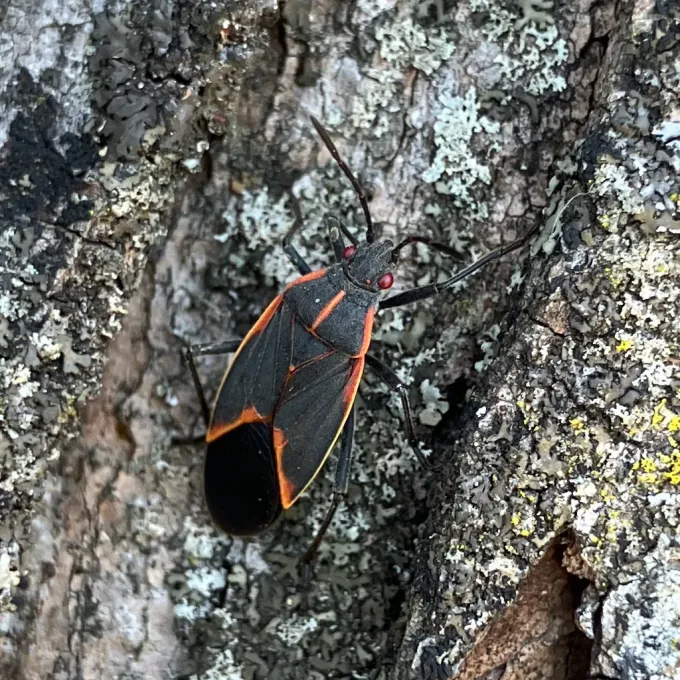
The Boxelder bug (Boisea trivittata) is a member of the Rhopalidae family within the Hemiptera order. Adult insects are roughly 10–14 mm long, recognizable by their black bodies with distinctive red or orange markings on their wings and pronotum.
Nymphs, or immature stages, lack fully developed wings and are predominantly bright red. They often gather in large groups, feeding and maturing alongside the adults throughout the growing season.
These insects are well-known for their habit of overwintering as adults in protected locations, including dry wall voids, bark crevices, and various man-made structures near host trees.
The lifecycle begins with egg-laying in the spring, typically on the bark of host trees. The larvae hatch and progress through several instars before reaching the adult stage by late summer.
The species is highly mobile, showing seasonal behavior patterns that involve migrating from feeding sites on trees to sheltering sites in residential areas during the autumn months.
What it damages
The primary host for the Boxelder bug is the boxelder maple (Acer negundo), though they may feed on other maple species, ash trees, and occasionally ornamental fruit trees.
These bugs use their piercing-sucking mouthparts to extract sap from leaves, soft shoots, and seeds, which can cause significant stress to the host tree's overall health.
While they rarely cause the death of mature trees, severe infestations can lead to yellowing, leaf spot, and stunted growth of shoots, reducing the tree's ornamental appeal.
In vineyards or fruit orchards, they can occasionally damage ripening fruit by causing pitting and discoloration, although this is usually considered a secondary concern.
The primary economic and social impact is the nuisance caused when thousands of bugs invade homes, garages, and patios, searching for warmth during the transition to winter.
Signs of infestation
Clear signs of an infestation include the presence of large clusters of red and black bugs congregating on sun-exposed surfaces, such as walls or tree trunks, during warm weather.
Leaf damage manifests as pale, discolored spots where the bugs have pierced the tissue to feed, often followed by leaf curling or premature senescence.
The presence of fecal spotting, which appears as small dark droplets on leaves or branches, indicates high localized activity of the insects in the canopy.
A mass migration of insects toward the foundations and siding of houses during autumn is the most obvious indication of a large nearby population looking for overwintering sites.
If you notice the bright red nymphs feeding in high numbers on seeds or succulent new growth, it confirms that a reproduction cycle is occurring in the immediate vicinity.
Control measures
The most effective long-term management strategy involves removing debris, such as piles of leaves or wood, around the base of trees to minimize favorable overwintering habitats.
To prevent home invasion, ensure that all exterior gaps, cracks, and vents are sealed or fitted with fine mesh screens to deny entry to seeking adults.
Chemical control can be achieved through the application of contact insecticides on the bugs when they cluster in large numbers, particularly in the spring or early autumn.
For localized infestations on trees, horticultural soaps or botanical oils can be applied directly to the nymphs to provide a safe and effective knockdown method.
- Seal exterior cracks and crevices.
- Remove leaf litter and garden debris.
- Apply insecticidal soaps to large clusters.
- Use professional pest control services for heavy indoor infestations.
Taxonomy
- Latin name
- Boisea
- Order
- Hemiptera (bugs, aphids, leafhoppers)
- Family
- Aphididae
- EPPO code
- BOISSP
Discussion
No discussions yet — be the first.