

Pest · Coleoptera (beetles) · affects Fodder beet, Potato, Winter barley
Especially harmful
Flax flea beetle
Aphthona euphorbiae
Description
How to identify
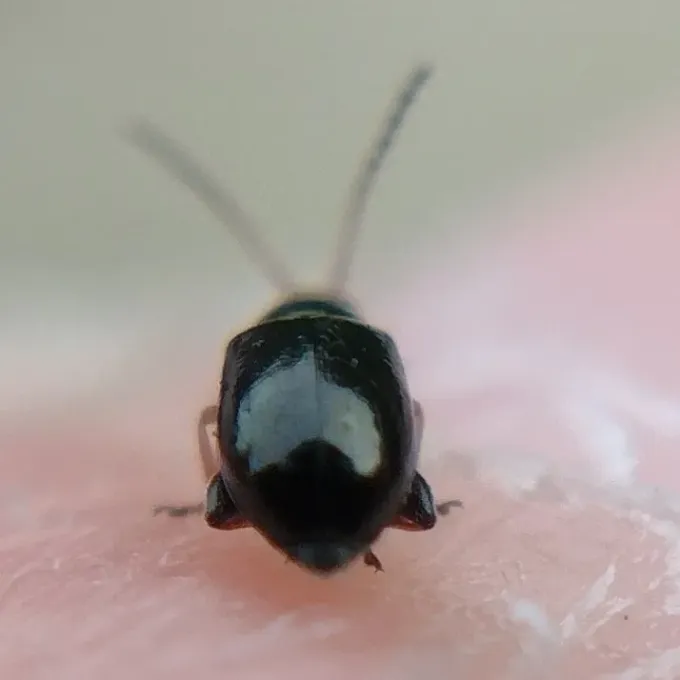
The flax flea beetle belongs to the Chrysomelidae family within the Coleoptera order. It is a small jumping beetle typically measuring between 1.5 and 2.5 mm in length, characterized by its metallic or yellowish-brown body.
The hind legs are notably enlarged, acting as a spring mechanism for rapid movement. Their antennae are filiform, consisting of eleven segments. The beetles are highly active and can quickly colonize large field areas under favorable conditions.
What it damages
While primarily a pest of common flax, the flax flea beetle is polyphagous and feeds on various crops. Host plants include forage beet, winter rapeseed, winter barley, potatoes, and winter wheat, making it a significant threat in diversified farming.
Adult beetles pose the highest risk to seedlings by feeding on cotyledons and young leaves. When infestation density is high, the beetles can cause total loss of emerging crops by destroying the leaf tissue, which inhibits photosynthesis.
When it appears
The pest overwinters as an adult in the upper soil layers, sheltered by plant debris or field margins. Emergence occurs in early spring as temperatures rise, usually when the air temperature exceeds 10 degrees Celsius.
The primary period of activity is concentrated in late spring and early summer. The beetle completes one generation annually, with hot and dry weather conditions significantly favoring rapid population growth and increasing the severity of damage.
Signs of infestation
Signs of infestation include small, irregular, or circular holes in leaves, often referred to as shot-hole damage. In severe cases, the leaf lamina may be completely destroyed, leaving only the veins behind.
- Presence of small, jumping beetles on the foliage.
- Small, distinct punctures or ulcers on seedling leaves.
- Wilting, yellowing, and eventual death of plant shoots.
- Retarded plant growth due to severe defoliation at early stages.
Control measures
Integrated pest management strategies are essential, starting with crop rotation and the destruction of host weeds. Sowing early to allow plants to grow past the vulnerable seedling stage is a recommended cultural practice.
Chemical control involving systemic insecticides or foliar sprays is often necessary during the peak emergence phase. Seed treatment is widely used as a preventative measure to ensure protection of emerging plants during their most susceptible period.
In brief
6
Damages crops
Content graph
Damages crops · 6
Content graph
Connections · Flax flea beetle
Most often together:
Marketplace
Products · 2

Biology
Taxonomy
- Latin name
- Aphthona euphorbiae
- Order
- Coleoptera (beetles)
- Family
- Chrysomelidae
- EPPO code
- APHTEU
Community
Discussion
No discussions yet — be the first.