
Acorn moth
Blastobasis glandulella
Description
How to identify
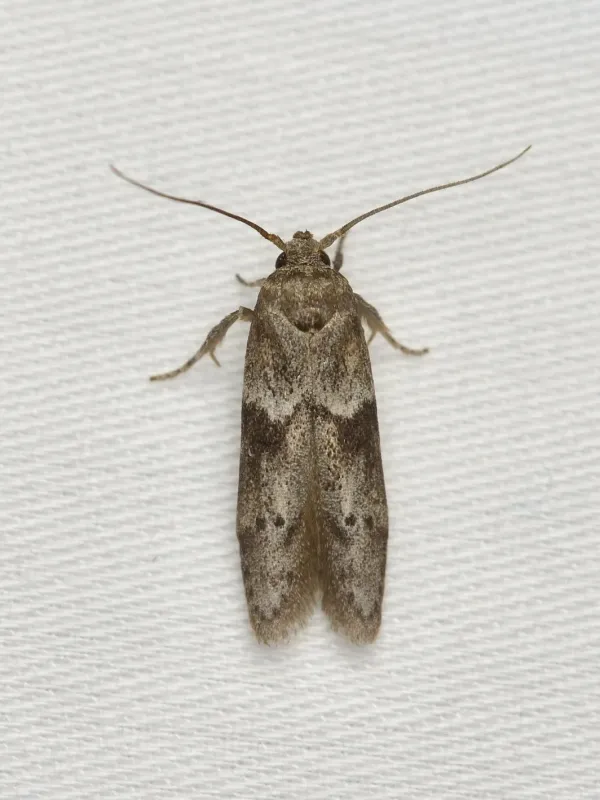
The acorn moth (Blastobasis glandulella) belongs to the Blastobasidae family of the order Lepidoptera. It is a small moth, often difficult to spot due to its cryptic coloration.
The adult moth features a wingspan of approximately 12–16 mm, with forewings that are grayish-brown and speckled with dark markings, serving as camouflage against tree bark.
The larvae, or caterpillars, are the destructive stage of the life cycle. They are small, typically pale to reddish-brown, and equipped with strong mandibles to bore into seeds.
Due to their small size and nocturnal habits, adults are rarely seen by foresters, making the identification of the species primarily based on larval characteristics and acorn damage.
Microscopic examination of adult morphology is often required for precise identification, as the species shares visual similarities with other closely related micro-moths.
What it damages
The primary damage is caused by larvae feeding on the interior of acorns, specifically targeting the cotyledons and the developing embryo of the oak nut.
This feeding activity renders the acorn unviable for germination, leading to significant losses in oak regeneration efforts in both natural forests and nurseries.
The presence of larvae also introduces secondary pathogens, such as fungi and bacteria, which cause the acorn to rot rapidly once the integrity of the shell is breached.
In cases of high infestation, this moth can destroy the vast majority of an acorn crop within a specific localized area, causing severe ecological disruption.
Acorns damaged by the moth typically fall prematurely, becoming susceptible to ground-dwelling predators and moisture, which leads to total spoilage of the harvest.
When it appears
Adult moths typically emerge in mid-summer, coinciding with the period when oak trees are developing their new crop of nuts.
Females lay eggs on the surface of developing acorns, often near the cap. The larvae hatch and immediately bore into the shell to start their feeding process.
The larval stage lasts throughout the late summer and autumn months, during which the caterpillar remains inside the acorn, feeding and growing.
The insect typically overwinters as a full-grown larva inside the acorn, either while the nut is still on the tree or after it has fallen to the forest floor.
Pupation occurs in the following spring, leading to the emergence of a new generation of adults, thereby completing the annual cycle of the pest.
Signs of infestation
The most diagnostic sign is a small entry hole on the acorn shell, often accompanied by frass (larval excrement) or silk webbing near the opening.
Infested acorns are significantly lighter than healthy ones. A common field test is to pick up the acorn; a lightweight, hollow-feeling nut is usually a sign of infestation.
Internally, the acorn is often filled with powdery frass and excavated tunnels, with the endosperm partially or entirely consumed by the larvae.
Prematurely falling acorns that appear yellowed or discolored before the usual harvest time are highly likely to be infested by the acorn moth larvae.
If the larva has completed its development, a circular exit hole will be visible on the shell, indicating that the adult moth has already emerged.
Control measures
The most effective cultural practice is the immediate collection and disposal of fallen acorns to reduce the population of overwintering larvae in the area.
Water flotation is a standard method for sorting seeds: sound acorns sink, while infested ones with internal damage or cavities tend to float and can be removed.
Cold storage is highly effective for treated seed lots, as low temperatures prevent further larval activity and development during the storage period.
Biological control involves maintaining a diverse habitat to encourage the presence of parasitoid wasps that naturally keep moth populations in check.
In forest nursery settings, protective netting or physical barriers may be used, though these are generally impractical for large-scale woodland management.
Taxonomy
- Latin name
- Blastobasis glandulella
- Order
- Lepidoptera (butterflies)
- Family
- Blastobasidae
- EPPO code
- BLAAGL
Discussion
No discussions yet — be the first.