
Darkling beetle
Blapstinus fuliginosus
Description
How to identify
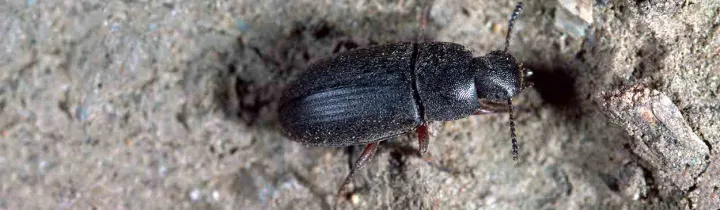
The darkling beetle (Blapstinus fuliginosus) is a member of the Tenebrionidae family. These insects are characterized by a compact, oval-shaped body ranging from 4 to 6 mm in length, with a matte, dark brown to black coloration.
The elytra of the beetle feature fine longitudinal rows of punctures, serving as a distinct morphological indicator. The larvae are cylindrical and possess highly chitinized, yellow-brown bodies, often referred to as "false wireworms" due to their resemblance to click beetle larvae.
These insects are primarily nocturnal, showing most of their activity during twilight hours or at night. During the day, they remain hidden beneath soil clods, crop residue, or within cracks in the ground to avoid direct sunlight.
The life cycle encompasses four stages: egg, larva, pupa, and adult. The females lay eggs in clusters within the soil, preferring environments that are rich in organic matter and retain moisture, which is crucial for early larval development.
Detection is often achieved through soil sampling. Observing the presence of adults or larvae in the seed furrow or near the roots of germinating plants is a primary method of identifying an infestation in a field.
What it damages
Darkling beetles are significant pests during the germination and early seedling stages of various crops, including wheat, corn, sunflowers, and soybeans. They cause injury by consuming seeds and feeding on the underground portions of stems and roots.
The damage often results in reduced plant populations and uneven emergence across the field. Seedlings may appear yellowed or wilted and eventually die because the pest has severed the root system or tunneled into the stem.
In many cases, the most severe economic impact occurs when environmental conditions delay plant growth, leaving seeds and seedlings exposed to beetle feeding for an extended period.
Mechanical feeding wounds provide entry points for soil-borne pathogens, which can induce rot and further compromise the plant's health, leading to total yield loss in localized areas of the field.
Fields with significant crop residue, such as those under minimum or no-till practices, are more prone to higher populations of darkling beetles, as these residues provide both food and shelter for the insects.
When it appears
Activity typically begins in the early spring as soil temperatures rise. Overwintering adults emerge from the deeper layers of the soil to feed on emerging crops, making spring the period of highest risk for young plants.
The larval stage remains active throughout the warmer months, focusing on organic material within the soil. While they primarily feed on decaying matter, they will turn to live plant roots if other food sources are scarce.
Summer conditions with low moisture can lead to a reduction in surface activity, as the insects move deeper into the soil profile to stay cool and retain moisture during peak daytime heat.
As autumn approaches, the beetles prepare for the winter. Both adults and larvae transition into a dormant state, burrowing deeper into the soil to survive freezing temperatures until the next season.
Annual population fluctuations are common and are heavily influenced by the previous year's tillage practices and the amount of residual organic matter remaining on the soil surface.
Control measures
Effective management begins with proper crop rotation, which prevents the build-up of beetle populations. Rotating susceptible crops with less attractive varieties can significantly reduce localized outbreaks.
Tillage is a powerful tool for controlling darkling beetles. Standard plowing and soil cultivation disturb the soil, destroying larvae and pupae while exposing them to predatory birds and beneficial insects.
Seed treatment with systemic insecticides is the most effective way to protect germinating seeds from initial attack. This preventative measure ensures that the plant is shielded during its most vulnerable stage of development.
Monitoring fields before planting is essential. Soil samples help assess the beetle pressure, allowing for informed decisions regarding the use of soil-applied insecticides or high-concentration seed treatments.
- Maintain field hygiene by managing weed populations that provide alternative food.
- Promote rapid seedling growth through optimal fertilization and soil preparation.
- Utilize high-quality, vigorous seeds to ensure faster emergence.
Taxonomy
- Latin name
- Blapstinus fuliginosus
- Order
- Coleoptera (beetles)
- Family
- Tenebrionidae
- EPPO code
- BLAPFU
Discussion
No discussions yet — be the first.