
False wireworm
Blapstinus dilatatus
Description
How to identify
The false wireworm (Blapstinus dilatatus) is a member of the Tenebrionidae family, which are commonly known as darkling beetles.
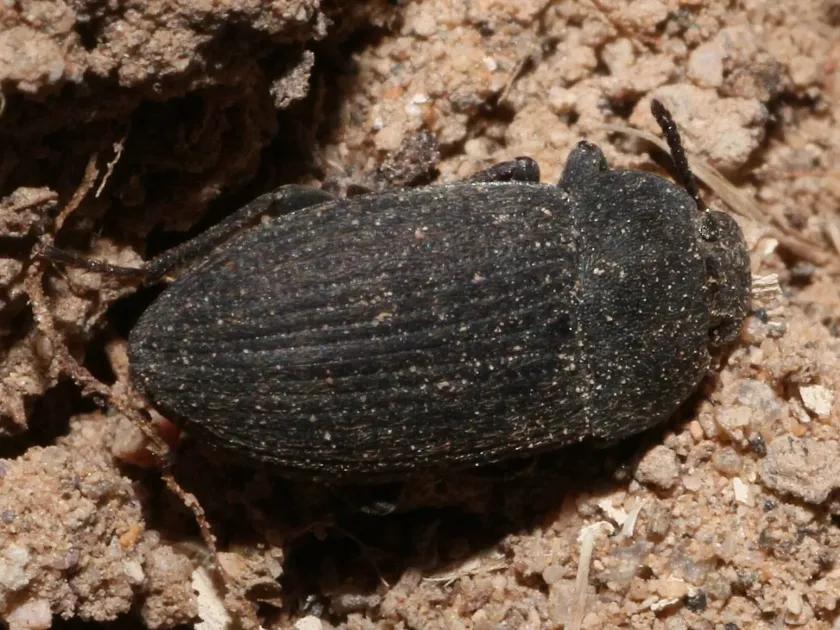
Adult beetles are relatively small, typically measuring between 5 to 7 millimeters in length, with a matte, dark brown to black coloration.
The larvae are referred to as false wireworms because they resemble true wireworms (click beetle larvae) but belong to a different family; they are cylindrical, hard-bodied, and yellowish-brown.
These insects prefer dry, sandy soil environments, making them particularly problematic in semi-arid agricultural regions.
The adults are nocturnal and often hide under plant debris or in soil crevices during the day, making them difficult to detect without focused scouting.
What it damages
The false wireworm is a generalist pest that attacks a wide variety of field crops, particularly during the germination and seedling emergence stages.
Commonly affected crops include wheat, barley, corn, sunflowers, and various vegetable species planted directly into the soil.
Adult beetles are notorious for feeding on germinating seeds, often hollowing them out completely before the plant can emerge.
Larvae feed on the roots and the lower stems of young plants, frequently leading to stunted growth, wilting, and eventually the death of the seedling.
High infestation levels can result in significant stand reduction, often necessitating field replanting and causing substantial economic loss for growers.
When it appears
Adult beetle activity typically begins in the early spring as soon as soil temperatures reach favorable levels for emergence from overwintering sites.
The most critical window of damage occurs from the time of planting until the seedlings reach the four-leaf stage, when they are most vulnerable to subterranean feeding.
During the heat of mid-summer, populations often seek deeper, cooler layers of soil, where they survive until environmental conditions become more favorable.
The insect typically completes one generation per year, with the adult stage being the primary form that survives the winter months.
Scouting should be intensified during the early planting season, particularly following a mild winter which may lead to higher surviving populations.
Signs of infestation
The most noticeable sign of a false wireworm infestation is the uneven appearance of crops in the field, characterized by patches of missing or dead seedlings.
When digging around the base of missing plants, farmers may find hollowed-out seeds or remnants of the subterranean stem showing clear feeding marks.
Wilting of seedlings in the absence of drought stress or other pathogens often suggests root damage caused by larval feeding.
Finding dark-colored beetles under soil clods or near the crowns of injured plants is a definitive indicator of their presence.
- Poor crop emergence and missing rows.
- Hollowed seeds found during soil examination.
- Feeding scars on the stems of young seedlings.
- Presence of darkling beetles in the rhizosphere.
Control measures
Effective management begins with cultural practices, such as maintaining good crop rotation to disrupt the life cycle of the pest.
Proper soil tillage, especially deep fall plowing, helps expose larvae to natural predators and creates unfavorable conditions for overwintering.
Seed treatments with systemic insecticides are considered the most efficient way to protect seeds and seedlings from immediate attack.
Weed control is essential, as many common weeds can sustain larval populations even in the absence of primary crop hosts.
In cases of severe infestation, growers may utilize soil-applied granular insecticides at the time of planting to provide a protective zone around the seed.
Taxonomy
- Latin name
- Blapstinus dilatatus
- Order
- Coleoptera (beetles)
- Family
- Tenebrionidae
- EPPO code
- BLAPDI
Discussion
No discussions yet — be the first.