
Blaps mortisaga
Blaps mortisaga
Description
How to identify
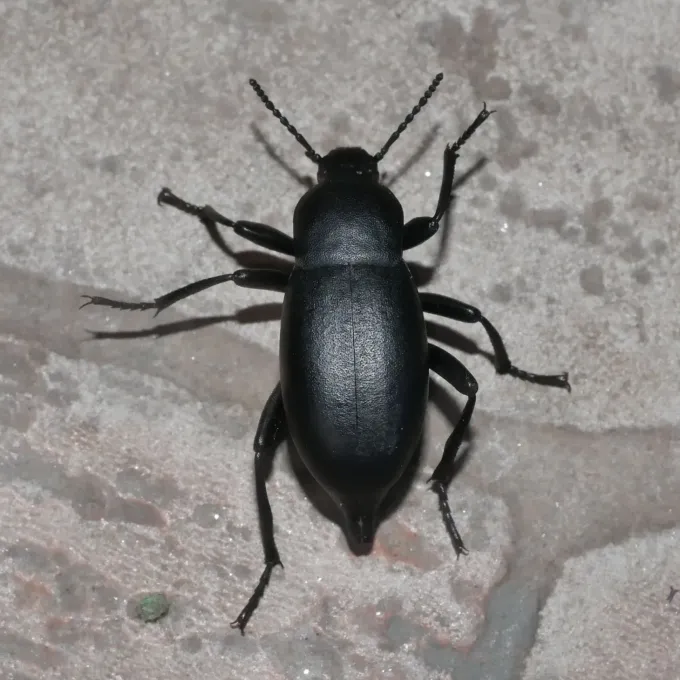
Blaps mortisaga, commonly known as the churchyard beetle, belongs to the Tenebrionidae family. This darkling beetle is a large insect, typically measuring between 20 and 28 mm in length, with a matte black or dark brown body.
The defining physical feature of this species is the elongated, pointed end of the elytra, often described as a "tail." The body surface is finely pitted, and the antennae are moderately long, adapted for sensing in dark environments.
The larvae, known as false wireworms, are cylindrical and heavily sclerotized. They are yellowish-brown in color and can grow up to 40 mm long, featuring a very hard exterior that protects them in soil.
Adults are primarily nocturnal, spending daylight hours hiding in soil crevices, under stones, or inside agricultural buildings. When threatened, they secrete a pungent, foul-smelling defensive fluid.
The lifecycle of Blaps mortisaga is relatively long, often spanning multiple years. The female lays eggs directly into the soil, where the larvae develop, feeding on organic matter or plant tissues as they grow through several instars.
What it damages
This beetle is a polyphagous pest capable of damaging various agricultural crops. Cereal crops, row crops, and some vegetables are particularly susceptible to their feeding activities.
The primary damage is caused by the larvae living in the upper soil layers. They feed aggressively on newly sown seeds, consuming the embryo and preventing germination, which leads to patchy crop stands.
Beyond seeds, the larvae can attack the underground portions of stems and root systems of young seedlings. This feeding damage causes wilting, yellowing, and often the total loss of the young plant.
While adults may feed on aerial parts of plants, their economic impact is generally lower than that of the larvae. However, in high-density populations, adult beetles can also contribute to crop yield losses.
The damage is most severe during dry spring seasons. When decaying organic matter—their natural food source—is scarce, the larvae switch their feeding behavior to live crop tissues.
Signs of infestation
The first indicator of an infestation is the sudden appearance of bare patches or gaps in newly emerged crop rows. Inspection of seeds in the soil often reveals characteristic hollowed-out kernels.
The presence of larvae can be detected through soil sampling or by placing traps. False wireworms are highly mobile and easily distinguishable from true wireworms by their specific morphology.
Affected plants may show signs of yellowing or wilting and can be pulled out of the soil with minimal effort due to damaged root systems. Evidence of gnawing can often be seen on the roots and underground stems.
Adult activity is usually noticed at night near humid spots or piles of decaying organic matter. Large aggregations of these beetles near barns or storehouses are a strong indicator of a localized population explosion.
Farmers should monitor fields for high numbers of darkling beetles, especially in areas where previous crops left behind significant amounts of stubble or plant residue.
Control measures
Effective management begins with proper soil tillage. Deep plowing in autumn exposes larvae to harsh weather conditions and predators, significantly reducing their population density before the next growing season.
Crop rotation is an essential preventive measure. Avoiding continuous cultivation of highly susceptible crops in infested fields limits the food supply for developing larvae.
Seed treatment with systemic insecticides is the most effective way to protect seedlings during the critical germination phase. This ensures the young plant is guarded as soon as it begins to sprout.
Keeping fields clear of weeds is crucial, as weed-free environments are less attractive to females looking for places to lay eggs. Reducing alternative food sources helps manage population growth.
In cases of severe infestation, soil-applied insecticides can be used during planting. Additionally, ensuring optimal growing conditions to accelerate early plant development helps crops quickly pass through the most vulnerable stage.
Taxonomy
- Latin name
- Blaps mortisaga
- Order
- Coleoptera (beetles)
- Family
- Tenebrionidae
- EPPO code
- BAPSMO
Discussion
No discussions yet — be the first.