
Silverleaf whitefly
Bemisia tabaci
Description
How to identify
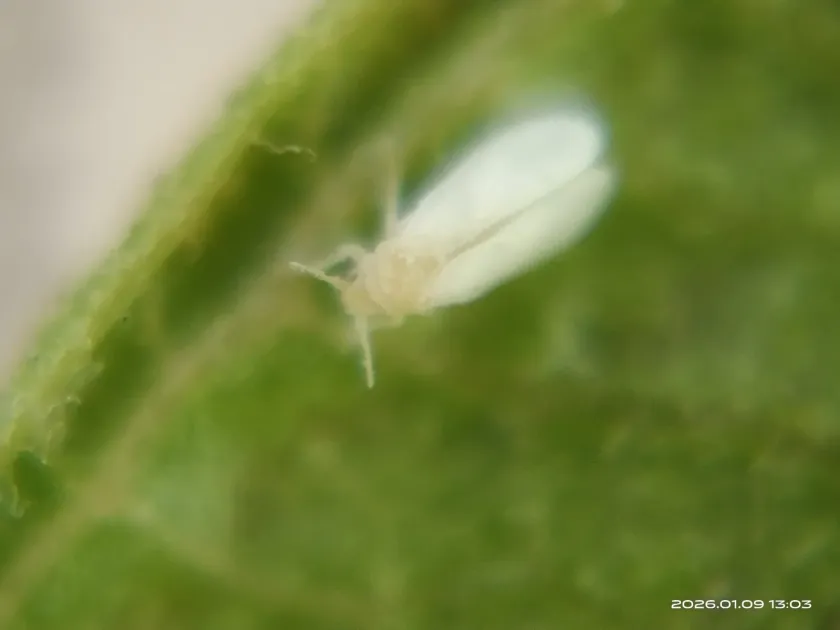
The silverleaf whitefly (Bemisia tabaci) is a small hemipteran insect belonging to the family Aleyrodidae, known for its significant impact on global agriculture.
Adults are tiny, measuring approximately 1 mm in length, and are covered in a fine, white, waxy powder that gives them their characteristic appearance.
The nymphs go through several instars and are typically translucent or pale yellow, feeding on the undersides of leaves where they remain largely immobile.
Eggs are deposited on the undersides of leaves in a circular or irregular pattern and turn from white to a brownish hue as they mature.
This species is highly variable, with various biotypes that differ significantly in host range, pesticide resistance, and the ability to transmit viruses.
What it damages
Bemisia tabaci is an extreme polyphage, capable of feeding on hundreds of different plant species, including vegetables, cotton, and ornamental crops.
Direct damage occurs through sap-feeding, which removes nutrients and causes plants to wilt, stunt, or lose vigor, leading to yield reductions.
The insects secrete large amounts of honeydew, which serves as a substrate for sooty mold, reducing the plant's ability to perform photosynthesis effectively.
Perhaps the most devastating impact is the transmission of plant viruses, particularly begomoviruses, which cause severe leaf curling and yellowing.
In infested plants, the market value of the harvest is often significantly reduced due to blotchy ripening of fruits and contamination with sooty mold.
When it appears
In temperate climates, the whitefly typically flourishes during the warmer months, while in greenhouses, it can reproduce continuously throughout the year.
Temperature is the primary driver of population growth; optimal development occurs between 25°C and 30°C, significantly shortening the generation time.
During peak summer months, populations can explode, spreading rapidly between adjacent fields and within large-scale greenhouse facilities.
As winter approaches, whiteflies seek protected environments like greenhouses or sheltered ornamental plantings to survive low temperatures.
The lifecycle is completed quickly, often in less than three weeks under ideal warm conditions, resulting in multiple generations per season.
Signs of infestation
The most immediate sign of infestation is the presence of white adults flying around the plant canopy when the foliage is disturbed.
Yellowing, curling, and drying of leaves, especially on younger tissues, are common symptoms of heavy feeding pressure by the nymphs.
The presence of sticky honeydew on the leaves and stems often attracts ants and promotes the growth of black sooty mold fungus.
Plants may show irregular ripening or discoloration, which is frequently associated with the viral infections transmitted by the whitefly.
- Clouds of white insects when plants are shaken.
- Sticky residue on leaves and surrounding soil.
- Black sooty mold on the leaf undersides.
- Stunted plant growth and yellowing leaf veins.
Control measures
Effective management begins with monitoring using yellow sticky traps to detect initial migrations and determine the appropriate timing for intervention.
Biological control, utilizing natural enemies like Encarsia formosa, Eretmocerus wasps, or predatory bugs, is highly successful in controlled environments.
Chemical control must be implemented with caution by rotating insecticides with different modes of action to prevent the development of resistant populations.
Cultural practices such as removing weed hosts, maintaining proper greenhouse hygiene, and using insect-proof netting are essential for long-term prevention.
Integrated Pest Management (IPM) is the most sustainable approach, combining habitat manipulation, biological agents, and selective chemical applications.
Taxonomy
- Latin name
- Bemisia tabaci
- Order
- Hemiptera (bugs, aphids, leafhoppers)
- Family
- Aleyrodidae
- EPPO code
- BEMITA
Discussion
No discussions yet — be the first.