
Tobacco whitefly
Bemisia
Description
How to identify
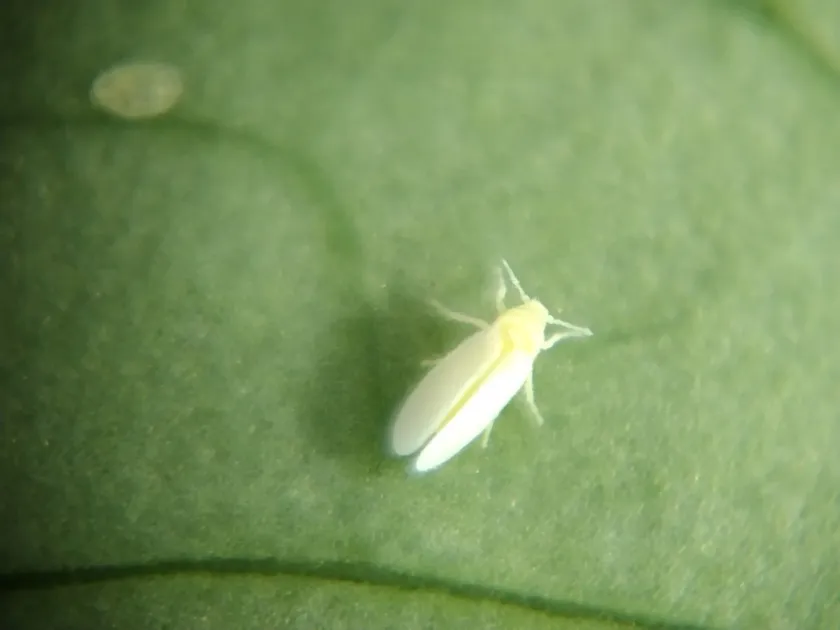
The tobacco whitefly (Bemisia tabaci) is a small sap-sucking insect of the family Aleyrodidae, known globally for its extreme adaptability and invasiveness.
Adults are approximately 1 mm long with pale yellow bodies and white waxy-coated wings, which help them survive in various environmental conditions.
The life cycle involves an egg, four nymphal instars, and an adult stage. The nymphal stage is particularly destructive because the nymphs are immobile and feed continuously.
This pest thrives in warm climates and greenhouse conditions, where it can complete a generation in as little as 15 to 25 days depending on the host plant.
Reproduction is highly efficient, often involving arrhenotoky, where unfertilized eggs produce males, which significantly accelerates the colonization of new areas.
What it damages
It is a major pest for a vast range of crops including tomatoes, cucumbers, peppers, and various ornamental plants in both greenhouses and open fields.
The whitefly feeds by inserting its stylets into the plant's phloem to extract sap, which leads to stunted plant growth and overall reduced yield quality.
In addition to direct damage, it causes economic loss in crops like cotton, soybeans, and tobacco by weakening the plants and making them susceptible to diseases.
Infestations often result in leaf senescence, which prevents proper photosynthesis and results in significant biomass loss for the affected agricultural crops.
The constant pressure from feeding populations can lead to total crop failure if management interventions are not implemented at early stages of development.
Signs of infestation
The first indicator is usually the presence of honeydew, a sticky substance secreted by the whiteflies that coats the surface of leaves and stems.
This secretion encourages the growth of sooty mold, which appears as a dark, powdery substance on the leaves and inhibits their ability to absorb sunlight.
Yellowing (chlorosis) of leaves, coupled with curling and irregular ripening of fruits, is a classic sign of tobacco whitefly damage in greenhouse tomatoes.
Perhaps the most severe sign is the presence of plant viral diseases; Bemisia tabaci is a primary vector for over 100 plant viruses including geminiviruses.
When disturbing the canopy of an infested plant, a large cloud of tiny white insects becomes visible, indicating that the population level is significantly high.
Control measures
Integrated Pest Management (IPM) is essential, starting with the use of pest-free certified seedlings to prevent initial contamination of the cultivation area.
Biological control agents, such as predatory beetles or parasitoid wasps like Eretmocerus eremicus, provide an effective way to manage population spikes.
Chemical control should rely on a rotation of insecticides with different modes of action to mitigate the high risk of developing pesticide resistance.
- Deployment of yellow sticky traps for monitoring and reducing adult populations.
- Sanitation protocols to remove weed hosts that harbor the pest throughout the year.
- Physical barriers like fine-mesh insect-proof netting for greenhouse ventilation openings.
Maintaining optimal irrigation and fertilization helps plants withstand some feeding pressure, although strict monitoring remains the cornerstone of effective control.
Taxonomy
- Latin name
- Bemisia
- Order
- Hemiptera (bugs, aphids, leafhoppers)
- Family
- Aleyrodidae
- EPPO code
- BEMISP
Discussion
No discussions yet — be the first.