
Poplar twig moth
Batrachedra praeangusta
Description
How to identify
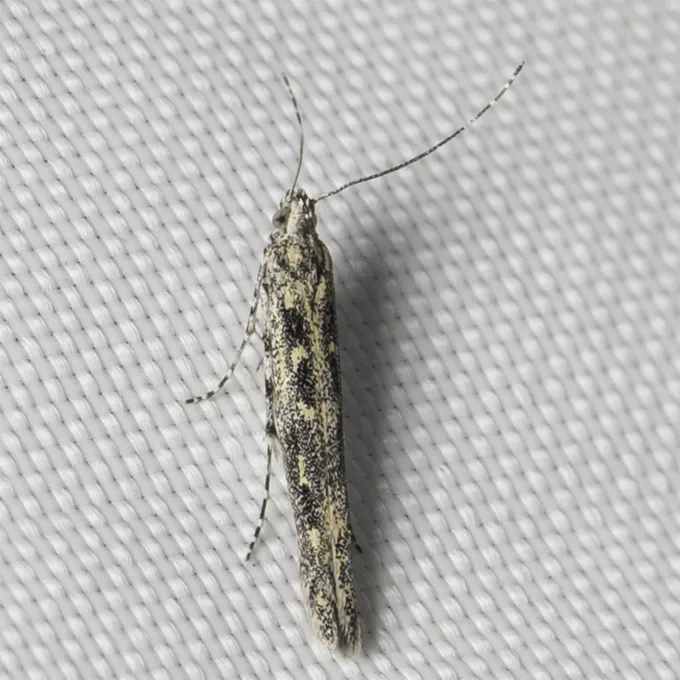
The poplar twig moth (Batrachedra praeangusta) is a small moth belonging to the Batrachedridae family within the order Lepidoptera. The wingspan of an adult moth typically ranges from 13 to 16 millimeters.
The forewings are narrow and lanceolate, colored in various shades of greyish-brown to ochre with distinct dark dusting. When resting, the moth holds its wings tight against the body, resembling a small twig.
The hindwings are significantly narrower than the forewings and possess a long fringe of hair-like scales along the edges, which is a characteristic feature of this species.
The larvae are slender, measuring approximately 10 millimeters in length. They are typically yellowish or greenish-white in color with a distinctive brown head capsule, facilitating camouflage among poplar buds.
Pupation occurs within a thin, silken, white cocoon. These cocoons are often hidden in deep crevices of the tree bark or tucked away among leaf litter, providing effective protection during the dormant stage.
What it damages
The primary host plants for this species are various poplar species, specifically aspen (Populus tremula) and black poplar. In some cases, the moth may also infest willow trees located in the vicinity.
The larvae feed primarily on developing buds, catkins, and young shoots. By boring into the buds, they consume the internal tissues, which causes the entire shoot to fail to develop correctly.
In forest nurseries, the damage caused by larvae can be quite severe, often resulting in stunted growth or deformed stems in young saplings, which reduces their commercial value for timber production.
Heavy infestations lead to the weakening of mature trees, making them susceptible to secondary attacks by wood-boring beetles and pathogenic fungi that thrive in compromised tree tissue.
Visually, the damage manifests as stunted foliage at the tips of branches, which can be particularly noticeable in urban settings where the aesthetic value of the trees is high.
When it appears
Adult moths are typically active from late spring to early summer. They are nocturnal insects and are often found in flight during the twilight hours or at night when mating occurs.
Larvae appear in early spring, timing their emergence perfectly with the bud break of the host trees. This ensures they have immediate access to nutrient-rich, tender plant tissues.
The life cycle typically includes a single generation per year, though development rates can be influenced by local climate conditions and spring temperature patterns.
The species overwinters as either late-instar larvae or pupae. They seek shelter in bark crevices, leaf mulch, or other debris near the base of the tree to survive winter temperatures.
The spring phenology of the poplar twig moth is strictly tied to the development of the host tree, allowing the larvae to initiate their feeding exactly when the buds start to swell.
Signs of infestation
One of the most characteristic signs of infestation is the presence of delicate silken webbing spun around the developing buds and clusters of young leaves, which the larvae use for protection.
Feeding larvae often cause the leaves to curl or become deformed. The presence of tiny dark granular frass (excrement) caught within the webbed leaf clusters is a clear indicator of active feeding.
The buds themselves may appear brown and hollowed out. They do not open properly and often remain tightly sealed by the webbing produced by the larvae during their developmental phase.
Damage to the shoot tips often results in a withered or scorched appearance, which can be observed across the canopy if the infestation population is sufficiently high.
- Silken webbing on terminal shoots.
- Curled, damaged, and discolored leaf clusters.
- Stunted or dead buds that fail to produce leaves.
Control measures
Biological control using Bacillus thuringiensis sprays is a highly effective method for managing larvae populations while minimizing impact on non-target beneficial insects.
Chemical control, if necessary, should be applied during the early bud burst stage, targeting the young larvae before they penetrate deeper into the plant tissue for protection.
Sanitation practices such as raking and destroying fallen leaves or pruning heavily infested branches can help reduce the overwintering population density of the moth.
Encouraging natural predators such as parasitic wasps and predatory beetles in the surrounding landscape can provide long-term sustainable regulation of the moth population.
Regular tree monitoring using pheromone traps can help arborists and foresters track the moth's emergence and determine the optimal timing for intervention, ensuring minimal ecological disruption.
Taxonomy
- Latin name
- Batrachedra praeangusta
- Order
- Lepidoptera (butterflies)
- Family
- Batrachedridae
- EPPO code
- BATRPR
Discussion
No discussions yet — be the first.