
Batrachedra enormis
Batrachedra enormis
Description
How to identify
Batrachedra enormis belongs to the family Batrachedridae, within the order Lepidoptera. This small insect often remains unnoticed until a mass infestation begins due to its modest size and secretive lifestyle within host plants.
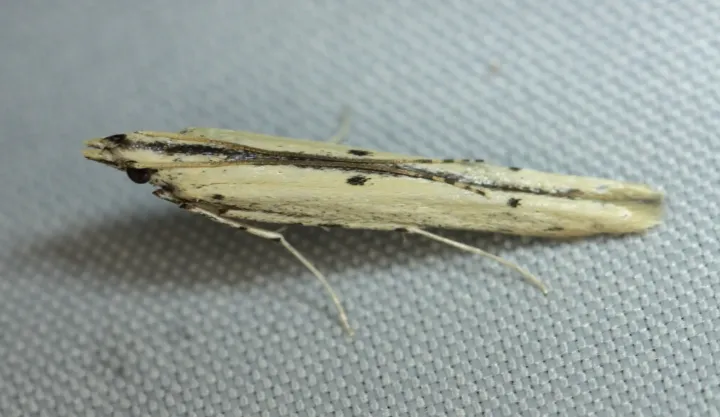
Adults are small moth-like insects with narrow wings characteristic of this family. Their coloration is typically cryptic, allowing them to camouflage effectively on plant stems and the soil surface during daylight hours.
The larvae of this species possess a well-developed chewing mouthpart adapted for penetrating plant tissues. Their development progresses through several instars, during which they increase significantly in size and cause primary damage to crops.
Systematically, this pest is studied as a specialized species adapted to specific feeding conditions. Research indicates that Batrachedra enormis populations are subject to seasonal fluctuations depending on regional climatic conditions.
Microscopic examination of larvae is the key factor for identification, as external plant damage is often similar to the activity of other hidden-living pests, necessitating professional agronomic inspection.
What it damages
This pest primarily infests cereal crops, causing serious damage to the vegetative organs of the plants. Specifically, there is damage to stems and tillering nodes, which negatively affects the overall development of the crop.
Larvae are capable of penetrating the stem, where they feed on succulent tissues, disrupting sap flow. This weakens the plant and makes it vulnerable to other pathogens or external environmental stress factors.
Mass reproduction of Batrachedra enormis can lead to a significant yield reduction in cereal fields. In heavily infested fields, yellowing and premature wilting of leaves are observed, which is critical during active growth phases.
Beyond direct tissue consumption, the presence of the pest inside the stem creates favorable conditions for the development of fungal and bacterial infections. Thus, damage caused by this insect is often complex in nature.
The economic threshold of harm depends on the crop growth stage: damage during the tillering and jointing phases is most dangerous, as any breach in stem integrity leads to a sharp loss in spike productivity.
When it appears
The development cycle of Batrachedra enormis is closely linked to crop phenology. Adult activity begins with the arrival of stable warm temperatures in spring, coinciding with the start of cereal vegetation.
Eggs are laid on plant surfaces or leaf axils, from where hatched larvae immediately seek places to feed and penetrate deep into the stem tissue.
Summer marks the peak activity of larvae, which feed intensively before pupation. Depending on geographic location, the species may complete one or two generations per season.
The pest overwinters as a pupa or late-instar larva in plant debris or the topsoil layer. This ensures high survival rates of the population even under unfavorable winter conditions.
For monitoring the pest's presence, the use of pheromone traps and regular phytosanitary surveys of crops during critical growth phases is highly recommended.
Signs of infestation
One of the first signs of infestation is the appearance of "whiteheads" or individual plants lagging in growth compared to their neighbors. Damaged stems may deform or develop an abnormal bend.
Opening the stem reveals characteristic tunnels bored by the larvae, along with the pest's excrement. Internal tissues appear consumed, confirming the activity of Batrachedra enormis larvae.
Traces of entry holes are sometimes visible on the surfaces of leaves and stems. Often, necrotic spots form around these entry points due to secondary infections.
- Yellowing of apical leaves.
- Delayed heading.
- Presence of holes on stems.
- Larvae found inside tissues.
- Premature plant drying.
Careful field inspection during morning hours allows for the detection of adult moths, which flutter short distances when disturbed, serving as an indirect indicator of high population density.
Control measures
Control of this pest should be based on a combination of agrotechnical and chemical measures. Crop rotation is a primary measure that effectively breaks the developmental cycle of Batrachedra enormis.
High-quality autumn plowing helps destroy overwintering stages by burying plant debris deep into the soil. This reduces the likelihood of mass emergence in the following season.
In cases of high pest density, the application of systemic insecticides is recommended. Chemicals should be applied during the larval hatching period, when they are most vulnerable before penetrating the stem.
The elimination of weeds around field borders plays an important role, as these areas can serve as additional reservoirs to maintain the pest population throughout the growing season.
Regular monitoring and the use of biological control agents, such as entomophages, can significantly reduce the pesticide load on the agroecosystem while ensuring reliable control of the pest population.
Taxonomy
- Latin name
- Batrachedra enormis
- Order
- Lepidoptera (butterflies)
- Family
- Batrachedridae
- EPPO code
- BATREN
Discussion
No discussions yet — be the first.