
Alfalfa leafhopper
Austroasca alfalfae
Description
How to identify
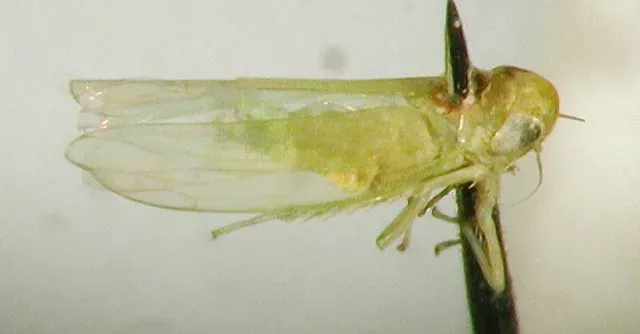
The alfalfa leafhopper (Austroasca alfalfae) belongs to the Hemiptera order and Cicadellidae family. These insects are small, typically measuring 3 to 4 mm in length.
Adults exhibit a distinct yellowish-green coloration, allowing them to blend seamlessly with the foliage of forage crops. Their wings are transparent with a faint greenish hue.
Nymphs resemble the adults in appearance but are smaller and lack fully developed wings. They are extremely active and jump quickly when disturbed.
Females deposit eggs directly into plant tissues, often within the leaf veins or succulent stems, providing protection from environmental stressors.
The life cycle is influenced by climatic conditions, with populations thriving during warm, dry weather patterns typical of mid-summer agricultural seasons.
What it damages
While alfalfa is the primary host, this leafhopper can also feed on various other legumes and wild plants found within or near the field edges.
Both adults and nymphs feed by piercing the plant epidermis and sucking out cellular sap, which disrupts the plant's normal metabolic processes.
Heavy infestations lead to significant stunting of crop growth, reducing the biomass production essential for high-quality hay or silage harvesting.
The feeding process often introduces or facilitates the spread of phytoplasma and viral diseases, which can severely compromise the longevity of the alfalfa stand.
Persistent feeding stress lowers the nutritional quality of the forage, as the plant directs resources towards repair rather than vegetative development.
Signs of infestation
The initial signs of infestation manifest as small, white, or chlorotic spots on the leaf surface where the leafhoppers have extracted plant sap.
As feeding continues, these spots coalesce, causing leaves to yellow, curl, and eventually exhibit marginal necrosis or reddish discoloration.
In the field, a key sign is the mass movement of insects; walking through an infested patch will cause swarms of leafhoppers to jump and fly short distances.
A closer inspection of the undersides of leaves will reveal the presence of nymphs, which are often overlooked due to their small size and greenish camouflage.
Visually, affected stands show uneven growth patterns and a duller overall appearance compared to healthy, vigorous parts of the field.
Control measures
Effective management begins with timely harvesting, which physically removes the habitat and food source for the leafhopper population in the field.
Maintaining clean field margins by controlling weeds is crucial, as many wild plants serve as reservoirs for leafhoppers between alfalfa cutting cycles.
Integrated pest management protocols should be followed, using insecticides only when economic thresholds are exceeded to minimize impact on beneficial insects.
Selecting varieties with dense pubescence can create a physical barrier, making it more difficult for leafhoppers to feed and lay eggs.
- Conduct regular sweep net monitoring to assess population densities.
- Ensure proper irrigation to help plants recover from feeding stress.
- Follow strict safety intervals after chemical applications.
Taxonomy
- Latin name
- Austroasca alfalfae
- Order
- Hemiptera (bugs, aphids, leafhoppers)
- Family
- Cicadellidae
- EPPO code
- AUSSAL
Discussion
No discussions yet — be the first.