
Sorghum shoot fly
Atherigona varia
Description
How to identify
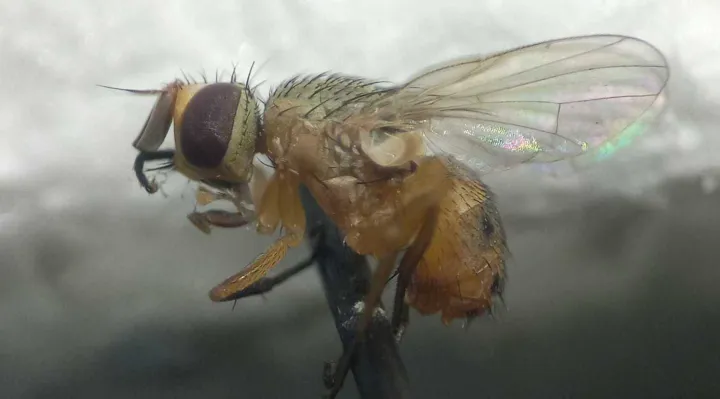
The sorghum shoot fly, known scientifically as Atherigona varia, is a significant pest belonging to the order Diptera and the family Muscidae. The adult fly is a small insect, measuring approximately 3–4 mm in length, with a greyish-yellow body and distinct dark spots on its abdomen.
Larvae are legless, creamy-white in color, and reach a length of about 6-7 mm at maturity. They lack a defined head, which is typical for many muscid flies, and are primarily found inside the stems of host plants.
Eggs are elongated and white, typically deposited singly on the underside of young leaves. Under optimal warm and humid conditions, the entire life cycle can be completed in as little as 20 days.
The population dynamics of this pest are highly influenced by environmental factors, with high humidity and moderate temperatures favoring rapid multiplication and peak infestation periods.
The fly undergoes a complete metamorphosis, passing through the egg, larval, pupal, and adult stages, with the pupal stage occurring either in the soil or within the plant residues.
What it damages
The primary host crops for Atherigona varia include grain and sweet sorghum, Sudan grass, and various species of millet, causing substantial damage during the early stages of growth.
The pest is most destructive to seedlings between the emergence stage and the 4-leaf stage. During this period, the plant is extremely susceptible as the growing point is easily accessible to the larvae.
After hatching, the larva migrates to the base of the central shoot and bores into the stem, ultimately cutting off the main growing point of the plant.
The damage caused by the larvae results in the death of the central shoot, a condition commonly referred to as "deadheart," which prevents the plant from developing a proper panicle.
Significant infestations can lead to a drastic reduction in plant stand density, forcing farmers to resort to replanting if the economic threshold is exceeded in the early season.
Signs of infestation
The most diagnostic symptom of an infestation is the yellowing and subsequent drying of the youngest leaf, which becomes clearly visible against the healthy green foliage of the crop.
Affected plants often display a stunted growth habit and increased tillering, producing multiple side shoots that rarely develop into productive stems, leading to an irregular crop stand.
Close inspection of the stem base may reveal small entry holes made by the larvae, which are often associated with brownish discoloration and internal decay of the stem tissues.
When the central leaf is pulled, it often comes away easily from the whorl and emits a foul odor, indicating that the larvae have destroyed the internal succulent tissues of the shoot.
In heavily infested fields, the crop exhibits a uneven appearance with patches of dead or deformed plants, significantly reducing the potential yield of the sorghum field.
Control measures
Effective management begins with seed treatment using systemic insecticides, which provides essential protection for the vulnerable early-stage seedlings against early-season attacks.
Adjusting the planting time is a critical strategy; early sowing ensures that the crop passes its most susceptible developmental stage before the peak population of the flies emerges.
Good agricultural practices, such as the removal of alternate weed hosts and crop residues, help to minimize the local population of the pest in the field ecosystem.
Chemical control can be implemented through foliar applications of insecticides when monitoring indicates that the economic injury level is being approached during the peak season.
- Use of resistant or tolerant sorghum hybrids.
- Implementing appropriate crop rotation schedules.
- Monitoring pest populations using yellow sticky traps.
- Providing adequate soil fertilization to promote vigorous early growth.
Taxonomy
- Latin name
- Atherigona varia
- Order
- Diptera (flies)
- Family
- Muscidae
- EPPO code
- ATHEVA
Discussion
No discussions yet — be the first.