
Aphrodes albifrons
Aphrodes albifrons
Description
How to identify
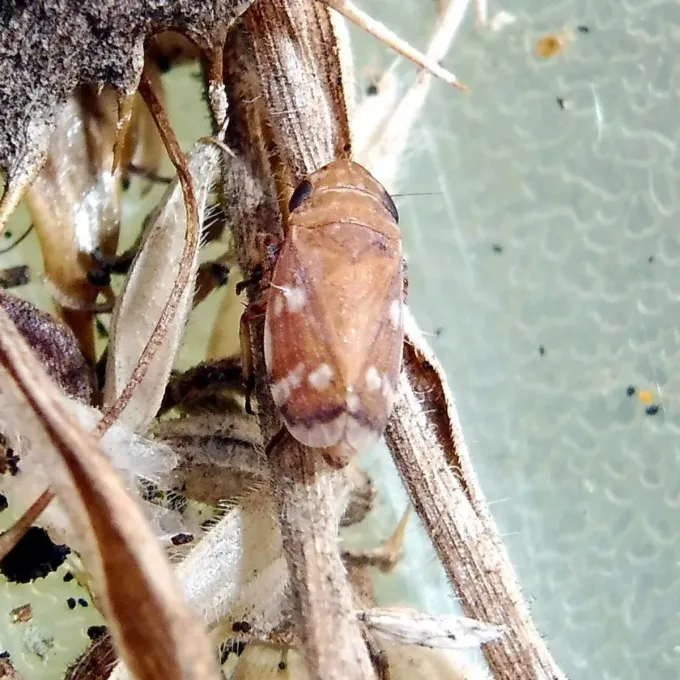
Aphrodes albifrons is a species of leafhopper belonging to the order Hemiptera and the family Cicadellidae. These insects are characterized by a flattened, wedge-shaped body typically measuring between 5 and 7 millimeters in length.
The coloration of adults varies from pale brown to dark gray-brown, serving as effective camouflage against dry grasses and stubble. A distinctive feature is the presence of a pale, light-colored patch or stripe on the frontal part of the head.
Equipped with piercing-sucking mouthparts, these insects are specialized for feeding on the sap of various herbaceous plants. Their hind legs are well-developed for jumping, which is their primary method of locomotion when disturbed.
The life cycle follows a hemimetabolous development path, progressing through the egg, five nymphal instars, and the adult stage. Overwintering typically occurs as eggs laid within plant tissues or as nymphs sheltered in the base of grasses.
They are widely distributed across the Eurasian continent, commonly found in meadow ecosystems, pastures, and agricultural fields where cereal crops and wild grasses abound.
What it damages
This leafhopper primarily feeds on various cereal crops, including wheat, barley, and oats, as well as various forage grasses such as fescue and timothy. They thrive in fields where host plants are abundant and provide constant nutritional sources.
The primary damage is caused by the extraction of phloem sap from the leaves and stems. This process weakens the plant, disrupts its physiological balance, and reduces its ability to perform photosynthesis effectively.
Beyond physical damage, Aphrodes albifrons is recognized as a potential vector for various phytoplasmas and plant viruses. These pathogens can cause significant stunting and yield losses, far exceeding the impact of the insects' direct feeding.
Symptoms of infestation often include chlorosis (yellowing), curling of leaves, and an overall lack of vigor in the crop. In severe cases, the affected plants may dry out prematurely, significantly reducing grain quality.
The impact is particularly pronounced during the vegetative growth stage of cereals, where plant energy is diverted from development to coping with the physiological stress induced by the pests.
When it appears
The activity of Aphrodes albifrons begins in early spring as temperatures rise, allowing nymphs to emerge from their overwintering sites to begin feeding on young, nutrient-rich foliage.
Adult populations usually reach their peak in mid-summer, coinciding with the flowering and grain-filling stages of most cereal crops. This period represents the highest risk of viral transmission.
Depending on local climatic conditions and the availability of host plants, the species can complete one or two generations per season. Warm, dry summers are generally favorable for their rapid population growth.
As autumn approaches, the insects move toward senescence or prepare for overwintering, depositing eggs on crop residues or in the soil, ensuring the continuity of the species for the following year.
Monitoring for this pest is typically conducted using sweep nets early in the morning or late in the evening when the insects are most active and prone to jumping from the canopy.
Signs of infestation
The earliest signs of infestation appear as tiny, pale stippling or spotting on the leaf surfaces, which represent the locations where the leafhoppers have pierced the tissue to feed.
The presence of the insects themselves is the most reliable indicator; walking through a field during an outbreak will cause them to jump repeatedly, creating a visible "spray" effect in the foliage.
Plants affected by significant leafhopper pressure often display visible stunting compared to unaffected areas of the field. This uneven crop development is a common observation in infested regions.
The accumulation of honeydew on the leaves may also serve as a sign. This sugary substance can facilitate the growth of sooty mold, which appears as a black, powdery coating on the plant surface.
- Small chlorotic spots on leaves.
- Active jumping of adults when plants are disturbed.
- Visible plant stunting and reduced height.
- Presence of sooty mold on the leaf surfaces.
Control measures
Cultural management is essential, starting with the control of grassy weeds that serve as reservoirs for leafhoppers between crop seasons. Eliminating these alternative hosts reduces early-season pressure.
Field hygiene, such as post-harvest stubble destruction and deep plowing, helps disrupt the life cycle by destroying overwintering eggs and nymphs living in the soil and residues.
When economic thresholds are exceeded, the use of systemic insecticides is recommended to effectively manage populations. These treatments target the insects while they are actively feeding on the sap.
Biological control, which involves protecting and encouraging natural enemies such as spiders, ground beetles, and parasitic wasps, can play a significant role in stabilizing pest numbers.
Application of chemical controls should be timed carefully, ideally during low activity periods for beneficial insects, to ensure that the ecological balance of the field is maintained.
Taxonomy
- Latin name
- Aphrodes albifrons
- Order
- Hemiptera (bugs, aphids, leafhoppers)
- Family
- Cicadellidae
- EPPO code
- APROAL
Discussion
No discussions yet — be the first.