
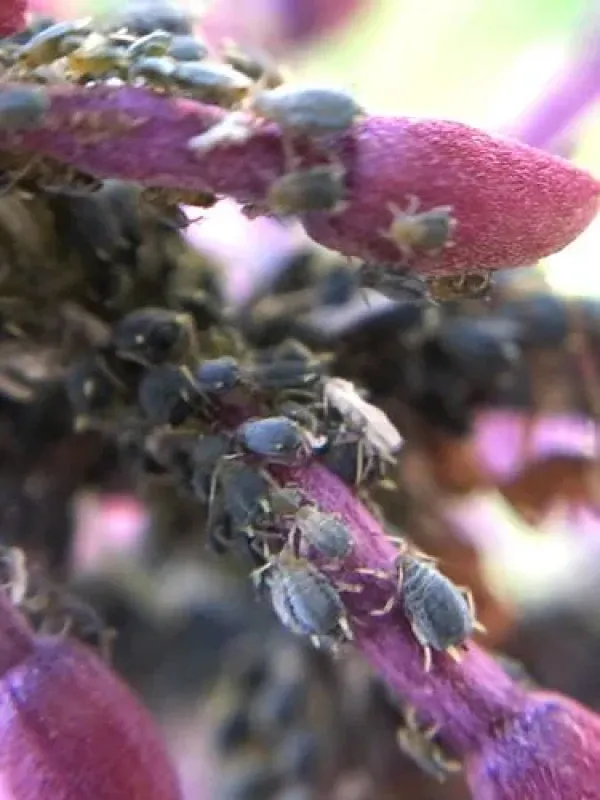
Variable aphid
Aphis varians
Description
How to identify
The variable aphid Aphis varians is a member of the Aphididae family. These tiny, soft-bodied insects typically measure between 1.5 and 2.5 mm in length and possess a highly adaptable biological profile.
The coloration of these aphids is quite variable, ranging from light green to yellow or pinkish tones, which often serves as camouflage against the foliage of their host plants.
They exhibit a complex lifecycle, transitioning between wingless forms that reproduce asexually and winged forms that facilitate dispersal across new agricultural areas.
Equipped with specialized piercing-sucking mouthparts, these insects penetrate the plant epidermis to access nutrient-rich sap, which is their primary food source.
These aphids tend to form dense colonies, often hiding on the underside of leaves or within the folds of developing terminal buds, making early detection a challenge.
What it damages
The variable aphid targets various solanaceous crops and other garden plants. Their feeding activity significantly impacts the physiological processes of the host plant by diverting essential nutrients.
Heavy infestations lead to severe leaf curling, yellowing, and premature senescence. The resulting reduction in leaf surface area directly hinders the plant's ability to photosynthesize effectively.
Damage to apical meristems causes stunted growth and stem deformity. In many cases, infected plants fail to produce healthy buds, leading to substantial yield losses in vegetable production.
Perhaps most destructively, this species acts as a vector for multiple plant viruses. Feeding creates entry points for pathogens, which can cause systemic infections that are irreversible.
Furthermore, the accumulation of honeydew secreted by the aphids provides a substrate for sooty mold fungi, which creates a dark film on leaves, further inhibiting gas exchange and light absorption.
When it appears
The annual cycle typically begins in early spring when overwintering eggs hatch into fundatrices. Monitoring during this stage is crucial to prevent early-season outbreaks.
As temperatures rise during the summer months, the population can explode due to the rapid reproduction of asexual generations. Under optimal conditions, a new generation can emerge every week.
Winged migratory individuals appear mid-season when colonies become overcrowded. These individuals are capable of flying to neighboring fields, spreading the infestation rapidly.
As day length shortens in autumn, the aphids switch to sexual reproduction. The resulting eggs are laid on stems or plant debris to ensure the species survives the winter dormancy period.
Understanding these phenological shifts is essential for agronomists to time intervention strategies and scouting efforts correctly.
Signs of infestation
One of the most obvious signs is the appearance of curled or crinkled leaves at the tips of shoots. This deformation is a classic symptom of localized aphid feeding.
The presence of a sticky, glistening substance on the leaf surfaces confirms that the aphids are actively feeding and excreting honeydew.
Increased ant activity around plants is a reliable indicator. Ants are often attracted to the honeydew and will actively protect aphid colonies from predators.
Small, pale insect skins cast off during molting are often visible on leaves. These white remnants are a clear signal that a growing population is present.
General wilting or yellowing of the plant, even when moisture is adequate, may suggest that large aphid colonies are depleting the plant's resources.
Control measures
Effective management begins with sanitation, such as removing weeds that act as early-season reservoirs for aphid populations.
Biological control agents, including lady beetles, lacewings, and hoverflies, should be encouraged by creating favorable habitats around the crops.
For chemical interventions, systemic insecticides are often the most effective because they protect the new growth where aphids prefer to feed.
Integrated pest management (IPM) practices require monitoring population levels and only spraying when the economic injury threshold is reached.
- Scout fields weekly, focusing on terminal buds.
- Remove and destroy heavily infested plant parts.
- Apply insecticidal soaps for localized outbreaks.
- Rotate chemical modes of action to prevent resistance.
Taxonomy
- Latin name
- Aphis varians
- Order
- Hemiptera (bugs, aphids, leafhoppers)
- Family
- Aphididae
- EPPO code
- APHIVA
Discussion
No discussions yet — be the first.