
Willow aphid
Aphis salicariae
Description
How to identify
The willow aphid (Latin: Aphis salicariae) is a small sap-sucking insect belonging to the family Aphididae. Adults typically measure between 1.5 and 2.5 mm in length and can vary in color from pale green to brownish-black, depending on the season and host conditions.
The insect exhibits a complex life cycle characterized by both winged and wingless forms. Wingless females (apterae) are responsible for rapid colony expansion through asexual reproduction, while winged forms (alatae) facilitate dispersal to new host trees.
Winter survival is ensured by the egg stage, which is deposited in crevices of the bark or near dormant buds. As spring arrives, these eggs hatch into fundatrices, which start the new generation of the season.
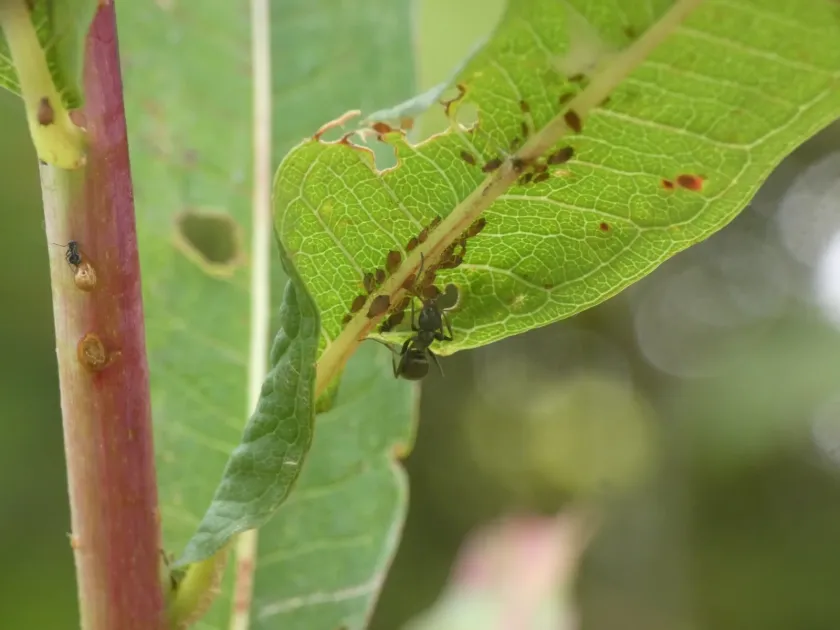
Aphid colonies are well-known for their mutualistic relationship with ants. The ants protect the aphids from natural predators, such as ladybugs and lacewings, in exchange for honeydew, a sugary secretion produced by the aphids.
These pests multiply with incredible speed due to parthenogenesis, meaning a single female can establish a large colony in a matter of weeks under optimal environmental conditions.
What it damages
Willow species (genus Salix) are the primary hosts for this aphid. They prefer to feed on the tender, actively growing tissues of young shoots and the undersides of leaves where sap flow is high.
The feeding process involves injecting saliva into the plant tissue, which causes significant physiological disruption. This can lead to the stunting of growth, leaf deformation, and a reduction in the overall vigor of the tree.
Heavy infestations can lead to premature leaf drop, making the tree look unattractive and reducing its ability to undergo photosynthesis effectively. This is particularly harmful to young willow saplings in nursery settings.
In addition to direct feeding damage, the aphids act as vectors for various plant diseases. The stress caused by aphid feeding often makes the tree more susceptible to secondary fungal or bacterial infections.
The accumulation of honeydew on the foliage provides an ideal substrate for the growth of sooty mold, a dark, fungus-like covering that blocks sunlight and further damages the health of the willow tree.
When it appears
Activity begins in early spring, synchronized with the breaking of buds on willow trees. This is the period when the plant provides the most nutritious sap for the newly hatched larvae.
The peak population growth typically occurs during late spring and early summer when the trees are putting out a flush of new growth, providing abundant food resources for the insects.
During hot and dry spells in mid-summer, the population growth may stabilize or slightly decline, but it usually picks up again if conditions remain favorable or if irrigation is provided to the trees.
In the autumn, the aphids undergo a final cycle that results in the production of sexual forms. These individuals mate and lay the eggs that will overwinter on the bark of the host tree.
Regular monitoring of young shoots starting in April is essential. Early detection is the key to preventing the aphids from overwhelming the tree's natural defenses and causing irreversible damage.
Signs of infestation
One of the most obvious signs is the curling or crinkling of young leaves. If you unfold these leaves, you will likely find clusters of aphids hiding inside and feeding on the sap.
The presence of honeydew, which makes the leaves feel sticky, is a strong indicator of aphid presence. This substance often attracts ants and promotes the growth of black sooty mold.
A high density of ants patrolling the branches of the willow is a clear sign that an aphid colony is present. The ants are likely tending the aphids, harvesting the honeydew they produce.
Yellowing leaves, also known as chlorosis, often occur as a result of the constant sap removal by the aphids, which interferes with the tree's ability to produce chlorophyll.
In severe cases, you may notice the tips of the branches dying back, often resulting in a sparse canopy and the failure of the willow tree to reach its full growth potential during the season.
Control measures
Cultural control practices are the first line of defense. Proper fertilization, avoiding excessive nitrogen, helps maintain a sturdy growth habit that is less attractive to aphids compared to soft, succulent shoots.
For smaller infestations, physically washing the aphids off the branches with a strong jet of water can be very effective. This method is environmentally friendly and does not harm the tree.
Encouraging natural predators is an excellent long-term strategy. By maintaining a garden that supports ladybugs, lacewings, and parasitic wasps, you can often keep aphid populations below a level that causes economic damage.
If chemical control is necessary, choose selective insecticides that have minimal impact on non-target pollinators. Systemic insecticides can be useful but should be applied in accordance with local regulations and timing.
Sticky bands applied to the trunk of the tree can prevent ants from accessing the colony. Without their "guards," aphids become much more vulnerable to the natural predators mentioned above, leading to natural control of the infestation.
Taxonomy
- Latin name
- Aphis salicariae
- Order
- Hemiptera (bugs, aphids, leafhoppers)
- Family
- Aphididae
- EPPO code
- COMPCO
Discussion
No discussions yet — be the first.