
Raspberry aphid
Aphis rubicola
Description
How to identify
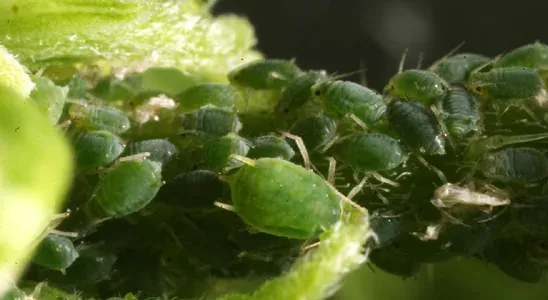
The raspberry aphid (Aphis rubicola) is a small sap-sucking insect belonging to the Aphididae family. These insects are typically yellowish or light green, blending in with the young tissues of their host plants.
They typically over-winter as eggs laid on the canes of raspberry plants near the buds. As spring temperatures rise, these eggs hatch into nymphs, which begin to feed immediately on the developing foliage.
The lifecycle includes several generations per year. During the summer, winged forms (alates) emerge, which are capable of flying to different parts of the patch or to neighboring gardens to establish new colonies.
These aphids prefer the tender parts of the plant, such as the undersides of young leaves and the tips of growing shoots, where the epidermis is thin and sap is easily accessible.
Understanding their reproductive speed is crucial, as a small colony can expand into a massive infestation within just a few weeks if environmental conditions are favorable for their growth.
What it damages
The primary hosts are raspberries and blackberries. By feeding on the phloem sap, the aphids extract essential nutrients that the plant requires for growth and fruit development.
Feeding often causes significant leaf curling and deformation. The plant's photosynthesis efficiency drops as leaves become distorted and chlorotic due to the toxins injected during the feeding process.
Severe infestations lead to stunted growth of new canes. The tips of the shoots may become twisted or fail to elongate, which negatively impacts the plant's vigor for the upcoming season.
A major concern is that Aphis rubicola acts as a vector for various plant viruses, such as leaf curl and mosaic viruses. Once a plant is infected with these viruses, its health declines rapidly.
Fruit quality is also heavily compromised. Infected plants produce fewer, smaller, and lower-quality berries, making the harvest unsuitable for commercial use or home consumption.
Signs of infestation
The most recognizable sign is the curling and yellowing of terminal leaves on new growth. When leaves are inspected, clusters of aphids are often visible on the underside.
Sticky honeydew secretions often cover the leaves, attracting ants and encouraging the growth of sooty mold, which appears as a black, dusty coating on the leaf surface.
Impaired development of the raspberry canes, such as curling of the tips and reduced vigor, is a strong indicator of an active and prolonged aphid infestation.
Increased ant activity on the canes is a reliable secondary sign. Ants actively farm aphids to collect their honeydew, providing the pests with protection from natural predators.
Yellowing, mottling, or dwarfing of the foliage are classic symptoms of the viral diseases transmitted by this aphid species, which often appear weeks after the initial colonization.
Control measures
Cultural control is the first line of defense. Pruning and removing old, infested canes during the winter helps reduce the number of over-wintering eggs on the plantation.
Biological control involves supporting natural enemies like ladybirds (ladybugs), lacewings, and hoverflies. These predators are effective at keeping aphid populations in check.
Chemical control should be applied carefully. Systemic insecticides are effective when used before blooming or after harvest to ensure that the chemical does not reach the ripening fruit.
For organic management, insecticidal soaps or neem oil applications can be used to coat the insects and suffocate them, provided that thorough coverage of the leaf undersides is achieved.
- Monitor growth tips regularly starting in early spring.
- Control ant populations to expose aphids to predators.
- Use selective insecticides to minimize harm to beneficial pollinators.
- Keep the patch weed-free to reduce alternative hosts for aphids.
Taxonomy
- Latin name
- Aphis rubicola
- Order
- Hemiptera (bugs, aphids, leafhoppers)
- Family
- Aphididae
- EPPO code
- APHIRC
Discussion
No discussions yet — be the first.