
Pawnee aphid
Aphis pawneepae
Description
How to identify
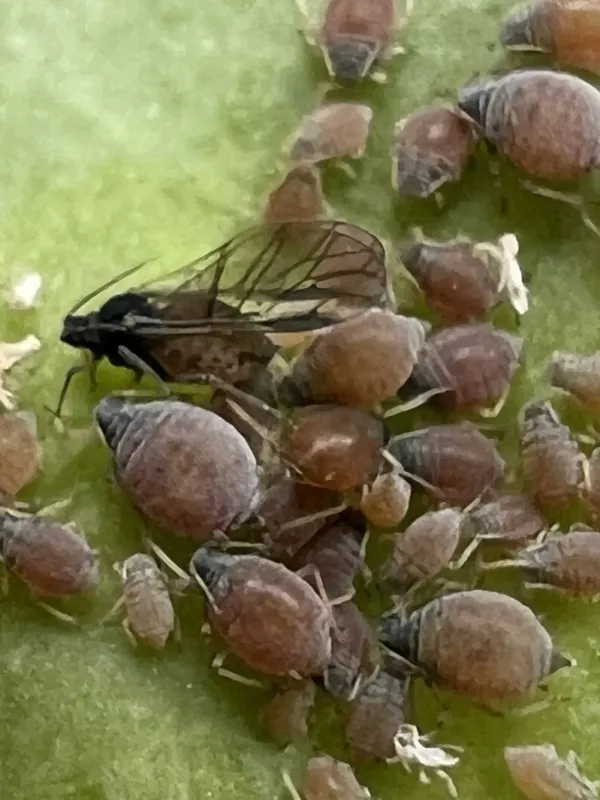
The Pawnee aphid (Aphis pawneepae) is a small insect belonging to the order Hemiptera and the family Aphididae. This species has adapted its morphology to specific host plants found in prairie and surrounding ecosystems.
Adults typically measure between 1.5 and 2.5 millimeters in length. Their coloration ranges from pale green to yellowish-brown, providing excellent camouflage on the undersides of leaves.
The insect's body is soft and pear-shaped. It features two characteristic structures on the abdomen known as cornicles, which are used to secrete defensive substances.
The aphid reproduces both parthenogenetically (without fertilization) during the growing season and sexually at the end of the year to produce overwintering eggs.
Being a specialized species, its identification is often confirmed by its presence on specific indigenous host plants, making it a distinct entity in local entomological studies.
What it damages
This pest primarily affects plants within the Asteraceae family. In an agricultural or horticultural context, this may pose a localized threat to ornamental species or specific medicinal plants.
The aphid feeds on cell sap from young shoots and leaves, resulting in a significant depletion of nutrients. This deprivation slows down the overall vegetative growth and plant development.
In cases of heavy infestation, leaf deformation is common. Leaves may curl, turn yellow, and drop prematurely, severely hindering the plant's ability to perform photosynthesis.
A critical aspect of its damage is the secretion of honeydew. This sticky substance promotes the growth of sooty mold, which blocks sunlight and interferes with tissue respiration.
Beyond direct feeding damage, these aphids act as vectors for various plant viruses, potentially leading to systemic infections that decrease yield quality or threaten plant health.
When it appears
The life cycle of Aphis pawneepae is closely tied to the phenology of its host plant. Initial colonies emerge in early spring, coinciding with the start of active sap flow.
During the summer months, the pest reaches its peak activity, with favorable temperatures allowing for rapid population growth and shorter generational cycles.
As autumn approaches, physiological shifts occur in the aphid population to prepare for dormancy. This involves the emergence of sexual morphs that lay fertilized, cold-hardy eggs.
The egg stage serves as the overwintering mechanism, often deposited in bark crevices or at the base of perennial stems to survive harsh winter conditions.
Spring hatching occurs in synchronization with bud break, ensuring that the next generation has immediate access to tender, nutritious plant tissues.
Signs of infestation
The first visible indicator of infestation is the appearance of small clusters of insects on the undersides of leaves or near the tips of succulent shoots.
A shiny, sticky layer of honeydew on the foliage serves as a clear diagnostic sign that the aphid colony is well-established and actively feeding.
Distortion, twisting, and stunted growth of shoot tips provide evidence of significant plant stress and tissue damage caused by the aphid's feeding activity.
The presence of ants is a common secondary sign; they are often found tending to aphid colonies to harvest the honeydew, simultaneously protecting the pests from natural predators.
A black, soot-like fungal growth on the leaves is a late-stage symptom, indicating that the infestation has reached a level requiring immediate intervention.
Control measures
Cultural control is the first line of defense; this involves removing weeds or secondary hosts that serve as reservoirs for the aphid population.
Biological control methods utilize natural enemies. Predators such as lady beetles, lacewings, and parasitic wasps are highly effective at suppressing aphid numbers in natural habitats.
When the economic injury level is reached, the application of systemic insecticides may be necessary to target the pests effectively within the plant tissues.
Proactive monitoring during early spring allows for the detection of initial populations, often enabling control before the infestation becomes widespread.
It is essential to rotate between different chemical classes of insecticides to prevent the development of resistance within the aphid population.
Taxonomy
- Latin name
- Aphis pawneepae
- Order
- Hemiptera (bugs, aphids, leafhoppers)
- Family
- Aphididae
- EPPO code
- PERNPA
Discussion
No discussions yet — be the first.