
Holly aphid
Aphis ilicis
Description
How to identify
The holly aphid (Aphis ilicis) belongs to the order Hemiptera and the family Aphididae. It is a specialized pest that exclusively targets various species of holly (genus Ilex).
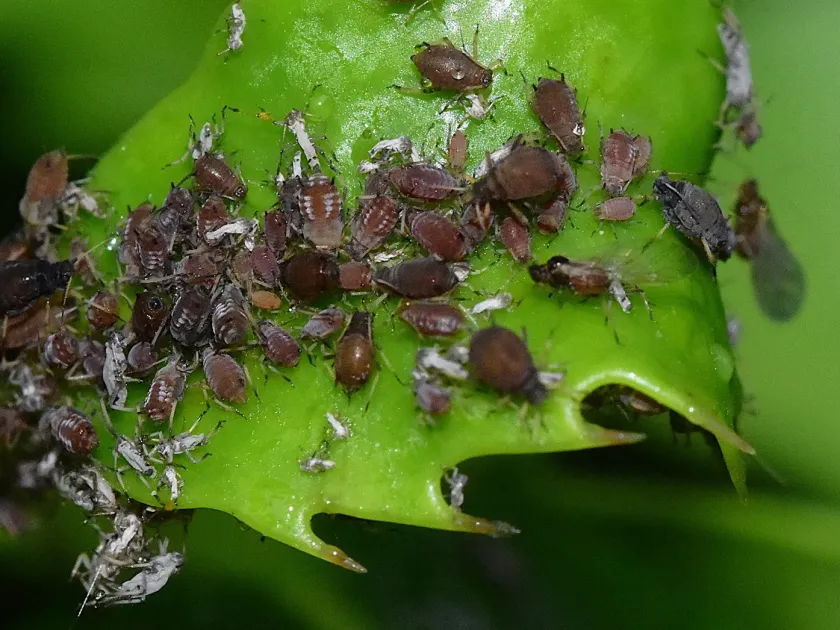
Adult aphids are small insects, typically measuring between 1.5 and 2.5 mm in length. Their body color ranges from dark brown to almost black, providing camouflage against the dark, glossy leaves of the holly plant.
Like all aphids, they possess piercing-sucking mouthparts used to feed on the sap of the host plant. Immature stages, or nymphs, look similar to adults but are smaller and wingless.
These insects form dense colonies, usually found on the underside of young leaves or clustering around the tender growing tips of the plant.
They are frequently attended by ants, which protect the aphids from predators in exchange for the sugary honeydew they excrete.
What it damages
The primary host for this aphid is the English holly (Ilex aquifolium), although other decorative holly varieties can also be infested.
The aphids primarily feed on the newest growth, where the nutrient-rich sap is most accessible for their rapid reproduction and development.
By extracting large quantities of sap, the aphids drain the plant's energy, which can lead to stunted growth and reduced vigor in young shoots.
Severe infestations can lead to the wilting and distortion of young leaves, making the plant look unsightly and reducing its overall aesthetic value.
In addition to direct feeding damage, the honeydew excreted by the aphids provides a substrate for the growth of sooty mold, which further harms the plant.
When it appears
Activity begins in early spring, as soon as the plant starts producing new buds and shoots, providing the initial food source for the overwintered eggs.
Peak population levels typically occur during late spring and early summer, when environmental conditions are optimal for the aphid life cycle.
Multiple generations occur throughout the growing season, with winged forms emerging to colonize other holly plants in the vicinity.
As autumn approaches and temperatures drop, the aphids begin to decline, shifting their focus toward laying eggs for the following year.
The overwintering eggs are laid in protected areas, such as bark crevices or near the base of the buds, ensuring the survival of the species through winter.
Signs of infestation
The most prominent sign of an infestation is the curling and distortion of the tips of young shoots, as the leaves fail to develop correctly due to feeding damage.
The presence of a sticky, shiny substance on the foliage, known as honeydew, is a classic indication that sap-sucking insects are present.
A secondary sign is the appearance of a black, powdery coating known as sooty mold, which grows on the honeydew and blocks sunlight from reaching the leaf surface.
- Curled and deformed young foliage.
- Increased ant activity on the stems and branches.
- Sticky honeydew residue on the leaves.
- Black sooty mold covering parts of the plant.
- Slow or erratic growth of the new spring shoots.
Careful inspection of the undersides of the leaves will reveal the dark, clustered bodies of the aphids if they are present in significant numbers.
Control measures
Control measures should be implemented promptly upon the first observation of colonies to prevent the infestation from spreading across the shrub.
For minor infestations, washing the leaves with a mild insecticidal soap solution can effectively remove aphids and clean away the honeydew.
For more severe cases, systemic insecticides may be required to treat the plant thoroughly and ensure that feeding aphids are eliminated.
Managing the ant population around the holly plant is beneficial, as removing the ants allows natural predators like ladybirds and lacewings to control the aphid numbers.
Regular monitoring and pruning of heavily infested tips can help keep the population in check and promote healthy recovery of the shrub.
Taxonomy
- Latin name
- Aphis ilicis
- Order
- Hemiptera (bugs, aphids, leafhoppers)
- Family
- Aphididae
- EPPO code
- APHIIC
Discussion
No discussions yet — be the first.