
Buckthorn aphid
Aphis frangulae
Description
How to identify
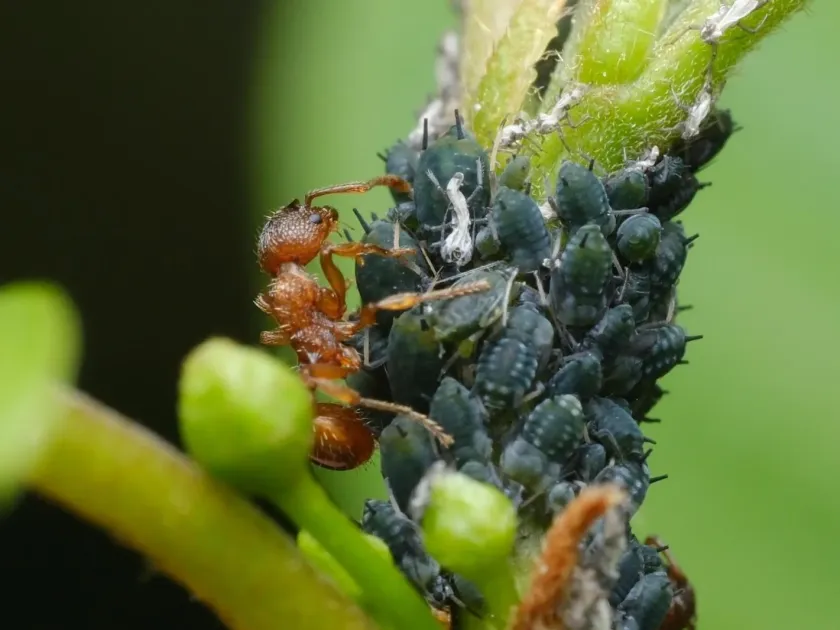
The buckthorn aphid (Aphis frangulae) is a species of aphid belonging to the family Aphididae. It is a small insect, typically measuring between 1.5 and 2.0 mm in length.
The body color ranges from yellowish-green to deep green or almost brown, depending on the plant host and the age of the individual aphid.
The primary host for this species is the alder buckthorn (Frangula alnus). The aphid overwinters in the egg stage, which is deposited on the branches of the buckthorn bush.
The life cycle involves seasonal migration. In the spring, wingless fundatrices hatch from eggs, followed by several generations of winged and wingless individuals that move to secondary hosts.
This species is highly efficient at reproducing via parthenogenesis, allowing it to quickly build massive colonies on preferred host plants during the summer months.
What it damages
The buckthorn aphid is a polyphagous pest that causes significant damage to various crops, including potatoes, tomatoes, and beans, alongside its primary host.
When feeding, aphids pierce the plant tissue and suck out the sap. This process leads to the stunted growth of new shoots, leaf curling, and overall plant weakening.
Beyond direct damage, this aphid is a notorious vector for several plant viruses. The introduction of these viruses into vegetable crops can cause mosaic disease and necrosis.
Heavy infestations reduce the photosynthesis capability of leaves, which directly impacts the yield of tuber crops like potatoes and reduces fruit quality in tomatoes.
Plants infested during hot and dry weather are particularly vulnerable, as they lack the vigor to withstand the stress caused by both aphid feeding and environmental conditions.
When it appears
The life cycle begins in early spring when the buds of the alder buckthorn start to swell, providing the first food source for the hatching larvae.
Mass migration to agricultural fields typically occurs in late spring or early summer, synchronized with the rapid vegetative growth of primary vegetable hosts.
Throughout the summer, the population grows exponentially on vegetables. Multiple generations are produced, with winged individuals facilitating the spread to neighboring plants.
As autumn approaches and day length decreases, the aphids produce sexual forms that migrate back to the buckthorn shrubs.
The cycle completes with the laying of overwintering eggs on the woody branches of the buckthorn, where they remain dormant until the following spring.
Signs of infestation
The most noticeable sign of infestation is the curling and distortion of young leaves, which often appear stunted or crinkled compared to healthy foliage.
The presence of honeydew — a sticky, sugary substance excreted by aphids — is a clear indicator. This substance often leads to the growth of sooty mold.
Sooty mold appears as a dark, powdery coating on leaves and stems, which inhibits photosynthesis and gives the plants a dirty, unhealthy appearance.
Ant activity on plants is a major red flag. Ants are frequently observed farming aphids, protecting them from predators in exchange for the sugary honeydew secretions.
Close inspection of the undersides of leaves will reveal dense clusters of aphids, which often look like small, translucent or colored bumps moving along the veins of the leaf.
Control measures
Cultural control strategies include the removal of buckthorn bushes from the vicinity of vegetable fields to eliminate the primary overwintering site for the pest.
Biological control can be very effective if natural predators such as lady beetles, lacewings, and hoverfly larvae are protected by avoiding broad-spectrum pesticides.
If economic damage thresholds are reached, systemic insecticides, particularly those containing neonicotinoids or similar compounds, are often necessary for effective management.
Monitoring the undersides of leaves during the early season is crucial. Early intervention prevents the aphid population from reaching levels that are difficult to manage.
- Applying insecticidal soaps for light infestations as a low-toxicity alternative.
- Using reflective mulches in gardens to deter winged aphids from landing on crops.
- Maintaining healthy soil moisture to help plants withstand aphid-induced stress.
Taxonomy
- Latin name
- Aphis frangulae
- Order
- Hemiptera (bugs, aphids, leafhoppers)
- Family
- Aphididae
- EPPO code
- APHIFG
Discussion
No discussions yet — be the first.