
Strawberry aphid
Aphis forbesi
Description
How to identify
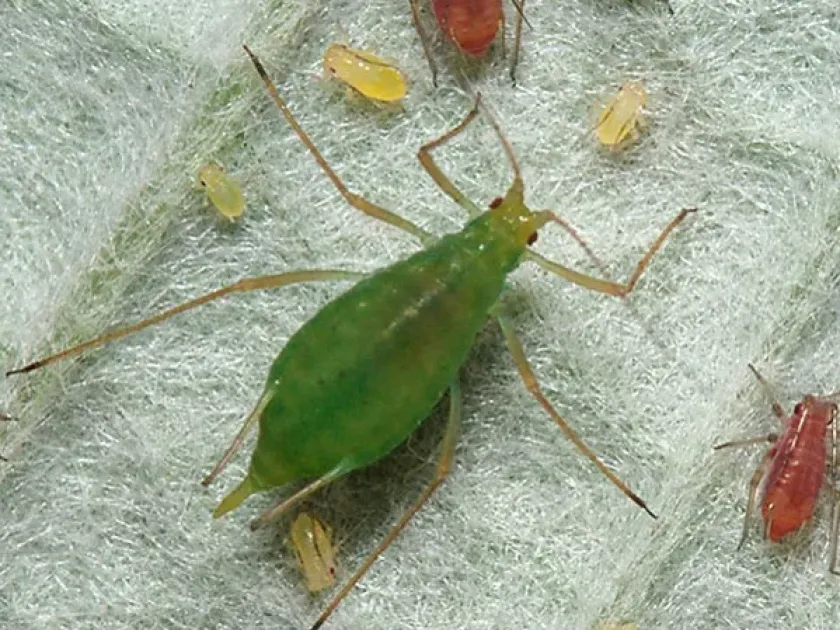
The strawberry aphid (Aphis forbesi) is a small insect belonging to the family Aphididae. It measures approximately 1–1.5 mm in length and exhibits a pale yellowish-green to bright green body color.
The species exists in both winged and wingless forms. Winged individuals are primarily responsible for the dispersal of the colony to new plants, while wingless forms settle on the underside of leaves and along stems.
These insects possess piercing-sucking mouthparts, which they use to feed on the plant's phloem. They lead a largely sedentary lifestyle, often gathering in dense colonies on tender young tissue.
The strawberry aphid has an exceptionally high reproductive rate, allowing for the development of multiple generations during a single growing season under optimal conditions.
The species overwinters as eggs laid on the host plant. As temperatures rise in early spring, these eggs hatch into fundatrices (stem mothers), initiating the cycle of infestation.
What it damages
The primary host of this pest is the cultivated strawberry (Fragaria × ananassa). By feeding on the plant sap, the aphids extract essential nutrients, causing significant stress to the host plant.
Perhaps more damaging than the feeding itself is the aphid’s role as a vector for various plant viruses, such as strawberry crinkle virus, which can cause permanent systemic damage to the crops.
Severe infestations result in leaf curling, yellowing, and stunted growth. The plant's ability to undergo photosynthesis is compromised due to tissue damage and the growth of sooty mold.
The honeydew excreted by the aphids promotes the growth of black sooty mold on the foliage, which further blocks light and air circulation, leading to premature leaf drop.
Ultimately, a heavy aphid infestation leads to reduced berry size, poor fruit quality, and a significant decrease in total yields, potentially weakening the plants to the point of mortality.
When it appears
The activity of the strawberry aphid begins early in the spring, coinciding with the first flush of leaf growth. The peak population density typically occurs during the flowering and fruit-setting stages.
During the peak of summer, high temperatures can inhibit colony growth. However, in cooler, shaded environments or seasons with moderate temperatures, the aphids remain active throughout the summer.
A second period of increased population growth often occurs in late summer or early autumn when new leaf flushes are available for the aphids to exploit.
With the onset of autumn and cooling weather, the aphids produce sexual forms that mate and lay eggs, ensuring the species survives the winter months.
Understanding the life cycle relative to the strawberry phenological stages is crucial for timing scouting activities effectively and implementing control measures at the right moment.
Signs of infestation
The initial signs of an aphid infestation are the curling and crinkling of young leaves, which often turn yellow or develop irregular chlorotic patches.
Sticky honeydew on the leaves and stems is a reliable indicator of aphid presence. This substance is frequently accompanied by the arrival of ants, which defend the aphids from predators.
Failure of flower stalks to develop properly or the abortion of flower buds suggests that the plant has reached a critical level of stress due to sap loss.
If left unmanaged, the development of black sooty mold on the surface of the leaves provides clear evidence of a well-established and long-standing aphid colony.
- Curled and deformed young leaves
- Presence of sticky honeydew
- Increased ant activity on the plants
- Yellowing (chlorosis) of foliage
- Stunted or aborting flower buds
Control measures
Integrated Pest Management (IPM) is essential. Start by keeping the area free of weeds, as they can act as alternative hosts for the aphid during the off-season.
Controlling ant populations around the strawberry beds is highly recommended, as ants protect aphids from natural enemies like ladybirds, lacewings, and parasitic wasps.
Biological control agents, such as insecticidal soaps, neem oil, or fungal-based sprays (e.g., Beauveria bassiana), can effectively reduce aphid populations with minimal ecological impact.
In cases of severe infestation, systemic insecticides may be used, provided that application guidelines are strictly followed to avoid harming bees and other beneficial pollinators.
After the harvest is complete, removing older, infested foliage can help reduce the population of aphids and eggs, creating a cleaner start for the next season.
Taxonomy
- Latin name
- Aphis forbesi
- Order
- Hemiptera (bugs, aphids, leafhoppers)
- Family
- Aphididae
- EPPO code
- APHIFO
Discussion
No discussions yet — be the first.