
Willow aphid
Aphis farinosa
Description
How to identify
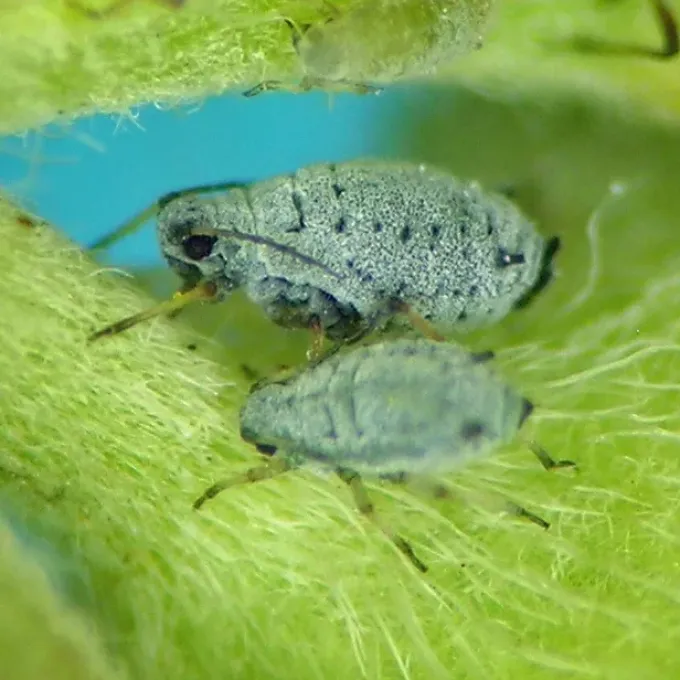
The willow aphid (Aphis farinosa) is a small insect belonging to the order Hemiptera and the family Aphididae. It is commonly found on various species of Salix (willow trees).
The most distinctive feature of this species is the thick, waxy, mealy secretion that covers its body, giving it a whitish appearance. The body color typically ranges from pale green to brownish.
The aphid life cycle involves both wingless females, which reproduce viviparously, and winged individuals responsible for spreading the infestation to new branches.
These insects prefer to cluster on the undersides of young leaves and around the tender tips of willow shoots, where the sap is most accessible.
They overwinter as eggs, which are deposited on the bark of one or two-year-old shoots, ensuring the continuation of the species the following spring.
What it damages
The primary hosts of this pest are willow trees. It causes significant damage to decorative plantings, nursery saplings, and industrial willow crops.
By piercing and sucking the sap from the plant tissues, the aphid disrupts the tree's normal growth and depletes its energy reserves.
Feeding damage often results in leaf curling, yellowing, and premature leaf drop, which significantly impacts the aesthetic quality of the trees.
The secretion of honeydew promotes the growth of sooty mold, a black fungus that covers the leaves and blocks essential photosynthesis.
Young trees are especially vulnerable, as heavy infestations can lead to stunted growth and reduced vigor, making them susceptible to secondary diseases.
When it appears
The life cycle begins in early spring when the overwintered eggs hatch, coinciding with the bud break of the willow trees.
Throughout the growing season, multiple generations are produced. The rapid reproductive rate allows colonies to cover large areas of the tree in a short time.
Populations typically reach their peak in the first half of summer when temperatures and host conditions are optimal for aphid development.
As autumn approaches, sexual forms are produced, which mate and lay eggs on the bark to survive the winter temperatures.
Winged forms enable the migration of the pest to nearby plants, ensuring the infestation persists and expands throughout the garden area.
Signs of infestation
The primary symptom is the presence of visible aphid colonies covered in a white, mealy substance located on new growth and leaf undersides.
The leaves often exhibit distortion or curling, and the shoots may appear sickly or stunted compared to healthy growth on the same tree.
- A sticky, shiny residue known as honeydew on foliage.
- Black sooty mold covering the leaves and twigs.
- Increased ant activity, as ants "farm" the aphids for their honeydew.
- Premature yellowing and dropping of infected leaves.
Control measures
Management of the willow aphid requires an integrated approach, combining cultural practices with chemical interventions when necessary.
Cultural control includes pruning out heavily infested branches to reduce the initial population size and improve air circulation in the tree canopy.
Systemic insecticides are highly effective as they are absorbed by the plant and kill the aphids upon feeding, providing long-lasting protection.
For smaller infestations, a gentle wash with insecticidal soap or a homemade soap solution can help remove the protective waxy layer, making them vulnerable.
Controlling ant colonies is crucial, as ants protect aphids from natural predators like ladybugs and lacewings, preventing natural biological control.
Taxonomy
- Latin name
- Aphis farinosa
- Order
- Hemiptera (bugs, aphids, leafhoppers)
- Family
- Aphididae
- EPPO code
- APHIFR
Discussion
No discussions yet — be the first.