
Vetch aphid
Aphis coronillae
Description
How to identify
The vetch aphid (Aphis coronillae) is a member of the family Aphididae, order Hemiptera. It is a specialized pest that has evolved to feed specifically on plants within the Fabaceae family.
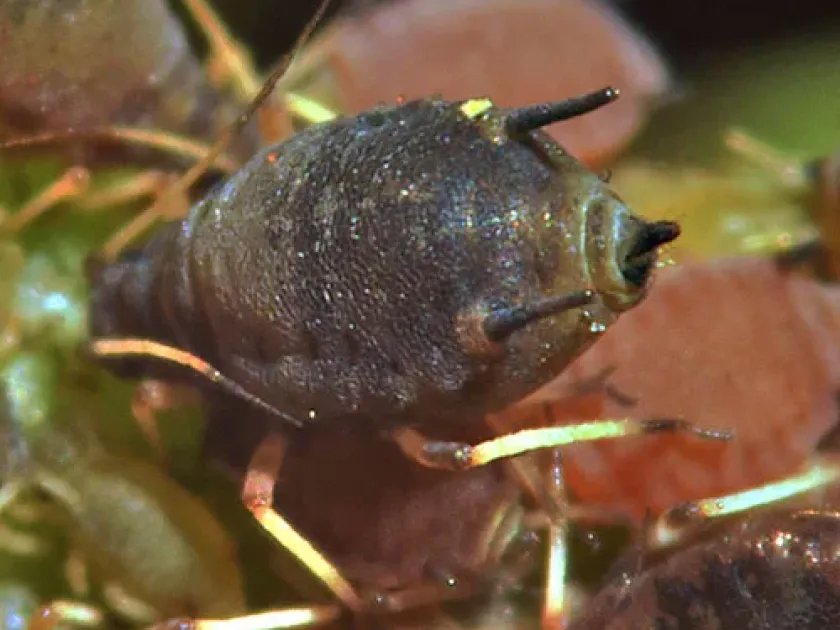
Visually, the insect is typical for its family: it has a small, soft body ranging in color from pale green to brownish. The head, antennae, and legs are usually darker than the rest of the body.
The life cycle involves multiple generations, including both wingless and winged forms. Winged aphids are essential for spreading the colony across different plant hosts.
Unlike generalist aphids, this species is highly host-specific. Identification often requires a magnifying glass, as the insects prefer hiding on the undersides of leaves.
They reproduce via parthenogenesis, allowing them to rapidly form massive colonies on a single plant, which significantly increases their potential for causing damage.
What it damages
The primary host is the crown vetch (Coronilla varia), though the aphid can also affect other legume species, including alfalfa and clover. This makes it a potential threat to forage production.
The pest tends to cluster on young shoots, flower stalks, and the undersides of leaves. By feeding on plant sap, they deplete the plant’s energy and inhibit normal physiological growth.
Feeding damage at the growing tips leads to curled, deformed leaves and stunted shoots. This disruption negatively impacts the plant's photosynthetic capacity and overall vigor.
Infested crops often suffer from reduced nutritional value and become more susceptible to secondary fungal infections. These infections are often fueled by the aphid’s waste products.
Massive outbreaks can cause substantial losses in green mass and seed yields, especially during dry spells when plants lack the resources to recover from the stress of the infestation.
When it appears
The pest's activity typically begins in early spring, as temperatures rise and the host plants begin their seasonal growth. Population density is closely linked to weather conditions.
The peak of population growth usually occurs between June and July. During this time, winged forms migrate extensively to occupy new areas of the field.
Migration activity persists throughout the growing season, requiring continuous surveillance of legume crops by farmers and agronomists.
As daylight decreases and temperatures drop in the autumn, the aphid prepares for overwintering, occasionally switching to sexual reproduction for the final generation of the year.
The insects overwinter primarily in the egg stage, which are deposited near the base of the plant or in the soil, ensuring the population restarts in the following season.
Signs of infestation
The first signs of infestation include curling and twisting of leaves at the shoot tips. Yellowish spots appear at the feeding sites, indicating tissue damage.
The secretion of "honeydew," a sticky sweet substance, is a primary indicator. This substance attracts ants, which often farm the aphid colonies for protection.
Sooty mold frequently develops on the honeydew, covering the leaves in a black layer that prevents sunlight from reaching the plant, further reducing photosynthesis.
Distorted flower stalks and premature flower shedding are signs that the infestation has reached a critical level, drastically lowering seed production.
- Curled leaves at shoot tips.
- Sticky residue on leaf surfaces.
- Ant clusters present near colonies.
- Black sooty mold growth.
- Stunted plant development.
Control measures
Effective management begins with proper crop rotation, which disrupts the aphid’s life cycle. Removing legume-family weeds around the field is also essential for prevention.
Biological control methods, such as encouraging natural predators like ladybugs, lacewings, and hoverflies, can keep aphid numbers below economic damage thresholds.
Chemical control should be used as a last resort when the threshold of damage is exceeded. Systemic insecticides are preferred to ensure long-term efficacy and safety for non-target species.
Agronomic practices, such as maintaining optimal soil fertility and choosing resistant varieties, help plants withstand aphid attacks and recover faster.
Regular field monitoring is crucial. Identifying infestations at an early stage allows for localized management, preventing the need for large-scale pesticide applications later on.
Taxonomy
- Latin name
- Aphis coronillae
- Order
- Hemiptera (bugs, aphids, leafhoppers)
- Family
- Aphididae
- EPPO code
- PERNSC
Discussion
No discussions yet — be the first.