
Anzygina leafhopper
Anzygina
Description
How to identify
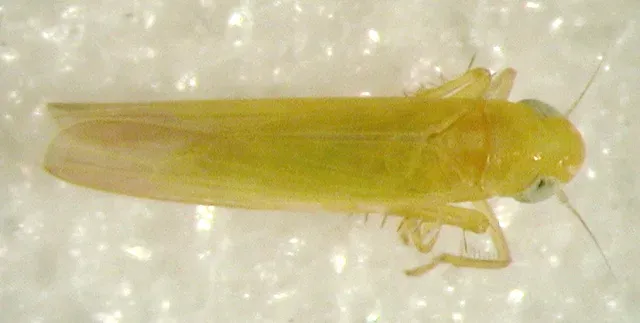
Anzygina leafhopper (genus Anzygina) belongs to the Cicadellidae family, order Hemiptera. These are small insects, typically ranging from 3 to 4 millimeters in length, which makes them difficult to detect in the early stages of infestation.
Adult insects are characterized by well-developed jumping hind legs, allowing them to move rapidly when disturbed. Their coloration is usually greenish or yellowish, serving as camouflage against the foliage of host plants.
The body is streamlined, and the wings are held in a roof-like position over the abdomen. These morphological features allow them to adhere to leaf surfaces efficiently, even in windy conditions.
Nymphs resemble the adults but are smaller and wingless. They undergo several molts through various instar stages, gradually increasing in size and developing pigmentation patterns.
The life cycle is closely synchronized with the host plant's growing season, with the insects completing their development through egg-laying within the leaf tissue.
What it damages
This pest affects a wide range of plants, including fruit trees, berry bushes, and various vegetable crops. They primarily feed on plant sap using their piercing-sucking mouthparts.
During feeding, they puncture the leaf epidermis, which leads to the localized death of plant cells. Repeated feeding can severely weaken the plant, affecting its overall vigor and growth.
Severe infestations cause a significant reduction in the photosynthetic capacity of leaves. Plants may exhibit stunted growth, wilting, and reduced overall productivity due to the loss of sap.
Beyond mechanical damage, Anzygina leafhoppers are known to be potential vectors for various plant viruses and phytoplasmas, which are transmitted through their saliva during feeding.
Significant damage often leads to leaf deformation and premature leaf drop. In agricultural settings, this results in lower yields and poor market quality of the harvested produce.
When it appears
The activity of the leafhopper begins in the spring, triggered by rising temperatures. They emerge from overwintering sites as soon as host plants start producing new foliage.
Peak population levels typically occur during the summer months. Under favorable conditions, the pest can complete multiple generations in a single season, leading to exponential population growth.
Feeding and reproductive activities continue until the autumn. The insects may migrate to nearby areas with greener vegetation to sustain their population before the onset of winter.
Overwintering occurs either as adults or eggs in protected environments, such as leaf litter, tree bark, or soil crevices, ensuring the survival of the species during cold periods.
Monitoring should begin during the early phenological stages of the crop to detect the first arrivals and prevent the establishment of a large population.
Signs of infestation
The first signs of infestation are small, pale, chlorotic spots on the upper leaf surface. These spots are the direct result of the insects feeding from the leaf underside.
Physical inspection of the lower leaf surface usually reveals the presence of nymphs or adults. When disturbed, these insects will jump or fly away, which is a key diagnostic behavior.
As the infestation progresses, the small spots merge, and the leaf develops a mottled, yellowed appearance. In extreme cases, the leaf margins may curl and dry out prematurely.
The presence of honeydew on the leaves may also indicate an infestation. This sugary substance can lead to the growth of sooty mold, which further hampers plant health.
- Mottled or chlorotic spots on leaves.
- Small jumping insects present on the foliage.
- Curled or deformed leaf edges.
- Presence of honeydew and secondary sooty mold.
Control measures
Management of the Anzygina leafhopper relies on good agricultural practices, such as removing weeds that serve as alternative hosts during the early part of the season.
Chemical control using systemic or contact insecticides is recommended when population thresholds are exceeded. Applications should be timed carefully to minimize impact on beneficial insects.
Yellow sticky traps are a highly effective tool for monitoring and early detection. Placing these traps allows growers to track population trends and optimize the timing of treatments.
Biological control strategies, including the conservation of natural predators like spiders and predatory bugs, help maintain leafhopper populations below economic injury levels.
Maintaining optimal plant health through proper irrigation and balanced fertilization increases the plant's resistance to pest damage and promotes rapid recovery.
Taxonomy
- Latin name
- Anzygina
- Order
- Hemiptera (bugs, aphids, leafhoppers)
- Family
- Cicadellidae
- EPPO code
- ANZYSP
Discussion
No discussions yet — be the first.