

Quince curculio
Anthonomus quadrigibbus
Description
How to identify
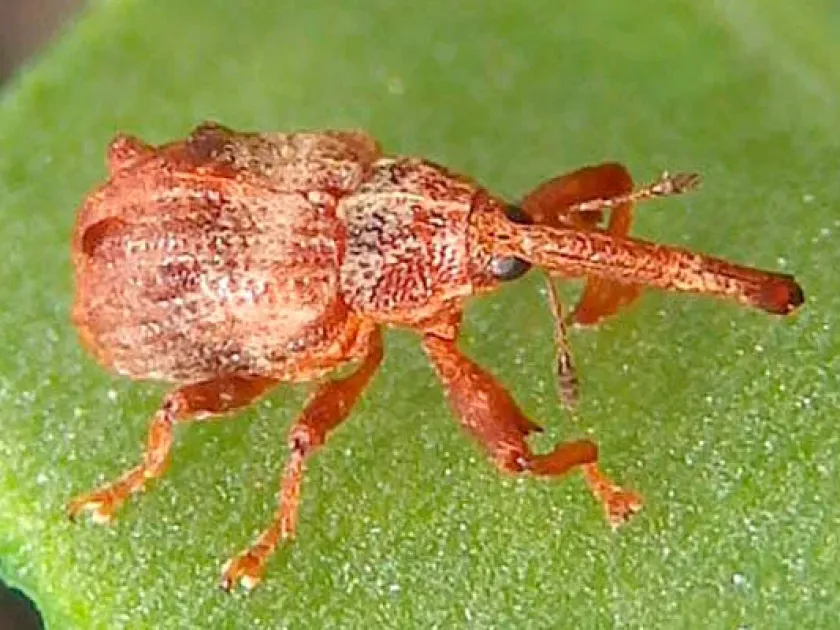
The Quince curculio (Anthonomus quadrigibbus) is a beetle belonging to the Curculionidae family. It is a snout beetle characterized by its elongated rostrum and specific morphological features.
Adult beetles are typically reddish-brown to dark brown, allowing them to blend in with bark and woody tissue. The most distinct identification feature is the presence of four prominent humps on their elytra (wing covers).
The larvae are legless, white, and possess a darker head capsule. They are exclusively internal feeders, spending their entire developmental phase within the fruit tissue, which makes them difficult to spot without dissecting the host plant.
The life cycle involves complete metamorphosis: egg, larva, pupa, and adult. Adults overwinter in leaf litter, debris, or deep crevices in the tree bark, becoming active once spring temperatures rise.
This species is highly adapted to feeding on pomaceous fruits. Unlike some other curculio species, it shows a strong preference for the developing fruit rather than the floral buds.
What it damages
The Quince curculio primarily attacks pomaceous fruits, with apples and pears being the most common hosts. It is also known to infest hawthorn and quince trees in various regions.
Adults cause minor damage by feeding on foliage and young fruit, leaving small circular feeding punctures. However, the larvae are responsible for the most significant economic damage.
Infested fruits often become malformed, showing deep pits or scars where the female has laid her eggs. As the larva bores deeper into the fruit to feed, it leaves a trail of frass and causes internal tissue rot.
In many cases, heavily infested fruit will drop prematurely. This leads to substantial harvest loss, and any fruit that remains on the tree is typically unmarketable due to the tunnels and internal decay.
Orchards that are left unmanaged or have poor sanitation practices are particularly susceptible to heavy infestations, as the fallen infested fruit provides an ideal environment for larval development.
When it appears
The emergence of adult beetles begins in early spring, synchronized with the onset of bud break and the beginning of the fruit tree growing season.
After a short period of maturation feeding, the beetles mate and females prepare to oviposit. Egg-laying typically occurs when the fruits are small and have recently set.
The larvae continue to grow throughout the summer months. As they reach maturity, they tunnel out of the fruit to pupate in the soil or remain within the fruit depending on the specific environmental conditions.
Late summer and early autumn mark the period when the new generation of adults emerges or completes its final developmental stage, preparing to seek shelter for the winter.
Monitoring for adults is critical from the petal fall stage through early summer to prevent the infestation from becoming established within the developing fruitlets.
Signs of infestation
The initial signs of infestation are small, round feeding punctures on the skin of developing fruitlets, which may bleed sap shortly after the initial attack.
Over time, the affected areas develop into distinct sunken pits or hard, corky scars. These scars significantly distort the shape of the growing fruit, often referred to as cat-facing.
Premature fruit drop in early to mid-summer is a major indicator of larval presence. Dissecting these fallen fruits will reveal the internal tunnel system and the presence of the white larva.
- Small circular feeding punctures on fruit.
- Deformed, pitted, or scarred fruit skin.
- Premature abscission of young fruitlets.
- Internal rotting and tunnels within the fruit flesh.
In cases of severe infestation, growers might notice a high density of exit holes on the surface of harvested or fallen fruit, indicating that the larvae have successfully completed their cycle.
Control measures
The most effective sanitation practice is the immediate and regular removal of all fallen, damaged fruit from the orchard floor to disrupt the lifecycle of the larvae.
Orchard management including keeping the ground clear of heavy leaf litter and maintaining tree health helps minimize the overwintering success of the adult beetles.
Trapping adults using physical barriers or specific sticky traps during the emergence period can help monitor populations and reduce the number of egg-laying females.
Chemical control programs generally target the adult stage shortly after petal fall. Application timing is crucial to ensure that insecticides are present before the eggs are deposited into the fruit.
Integrated Pest Management (IPM) encourages the use of selective insecticides and the preservation of natural predators, such as parasitic wasps, which can help manage pest density naturally.
Content graph
Connections · Quince curculio
Most often together:
Marketplace
Products · 1
Biology
Taxonomy
- Latin name
- Anthonomus quadrigibbus
- Order
- Coleoptera (beetles)
- Family
- Curculionidae
- EPPO code
- TACYQU
Community
Discussion
No discussions yet — be the first.