
Corn root aphid
Anoecia corni
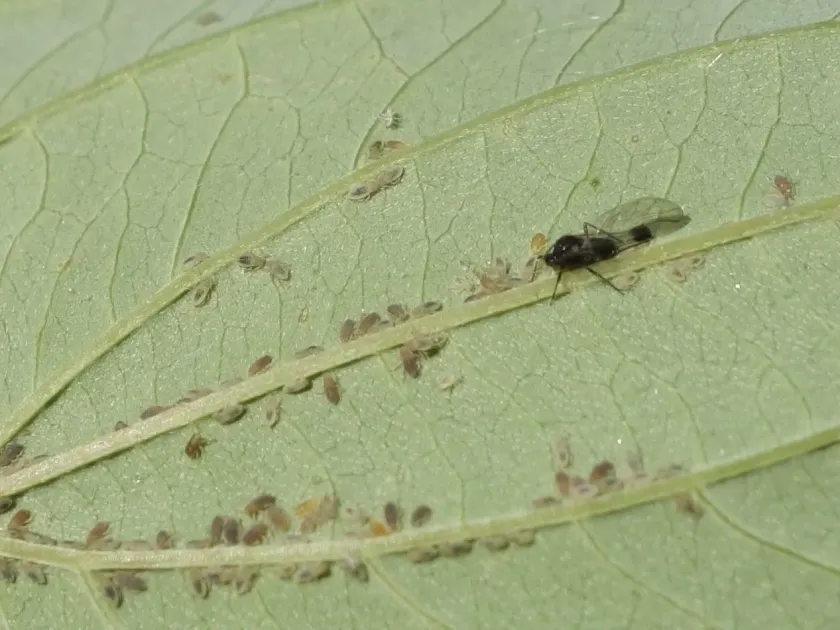
Description
How to identify
The Corn root aphid (Anoecia corni) belongs to the order Hemiptera and the family Aphididae. It is a host-alternating aphid species that requires specific trees and grasses for its life cycle.
The appearance of adults varies depending on their developmental stage. Wingless forms typically have an oval body ranging from yellowish-green to brown, covered with short hairs.
Winged forms possess specific wing venation characteristic of the genus Anoecia and distinct pigmentation patterns. Precise identification requires microscopic examination of the antennae and siphunculi structure.
The life cycle includes stages such as egg, nymph, and adult. The species overwinters exclusively as an egg on the branches of its primary host, the dogwood (Cornus).
During the summer months, adult females and their nymphs primarily inhabit the root systems of graminaceous plants, making them difficult to detect without careful excavation.
What it damages
The primary host is dogwood (Cornus sanguinea), where the initial spring generations develop. After the spring phase, the pest migrates to secondary hosts.
The most significant damage is inflicted on cereal crops, including wheat, barley, and rye. Many wild grass species also act as reservoir hosts for this pest.
The aphid feeds on the roots of plants, extracting phloem sap. This feeding activity leads to stunted growth and impaired development of the affected crops.
Heavy infestations on roots can facilitate the development of secondary fungal infections, as the feeding punctures damage plant tissues and compromise their structural integrity.
Damage symptoms manifest as reduced plant vigor, poor tillering, and premature wilting, particularly during drought conditions or when soil moisture is limited.
When it appears
The life cycle begins in early spring when nymphs emerge from eggs overwintered on dogwood. These early generations feed on the sap of young dogwood leaves and shoots.
In late spring or early summer, winged migration occurs. The aphids move from dogwood to secondary hosts, which are various species of grasses, coinciding with the active growth phase of cereals.
During the summer, several generations develop on the roots of the host grasses. Warm, moderately moist soil conditions are ideal for their rapid population growth.
In the autumn, as temperatures drop and the above-ground parts of grasses senesce, winged females migrate back to dogwood to mate and lay overwintering eggs.
Consequently, population peaks occur in May on dogwood and during July and August on the roots of cereal crops.
Signs of infestation
The first sign of infestation on dogwood is the curling and distortion of leaves, which may take on a yellowish hue due to the persistent feeding of the aphid colonies.
In cereal fields, signs of infestation include delayed growth and visible patches where plants appear stunted compared to healthy portions of the crop.
Upon inspecting the root systems of suspected plants, one can observe aphid colonies, often accompanied by ants that tend to the aphids for their honeydew secretions.
In areas where the aphids aggregate on roots, a white, waxy secretion produced by the aphids may be visible, along with residue of honeydew.
The presence of large dogwood hedges or trees near agricultural fields serves as an indicator of a higher potential risk for this aphid species.
Control measures
A primary management strategy is to maintain spatial isolation between cereal fields and dogwood plantings to disrupt the aphid's migration cycle.
Cultural control practices include the removal and management of grassy weeds in and around fields, which serve as intermediate breeding grounds during the summer.
Chemical control is most effective during the spring migration window, although targeting root-feeding aphids in large-scale field conditions presents significant technical challenges.
In gardens and small-scale plantings, applying systemic insecticides to dogwood in early spring, before the winged forms migrate to grasses, is an effective preventative measure.
Biological control involves conserving natural enemies, such as lady beetles, lacewings, and parasitic wasps, which help to suppress aphid populations naturally.
Taxonomy
- Latin name
- Anoecia corni
- Order
- Hemiptera (bugs, aphids, leafhoppers)
- Family
- Aphididae
- EPPO code
- ANOECO
Discussion
No discussions yet — be the first.