
Slow worm
Anguis fragilis
Description
How to identify
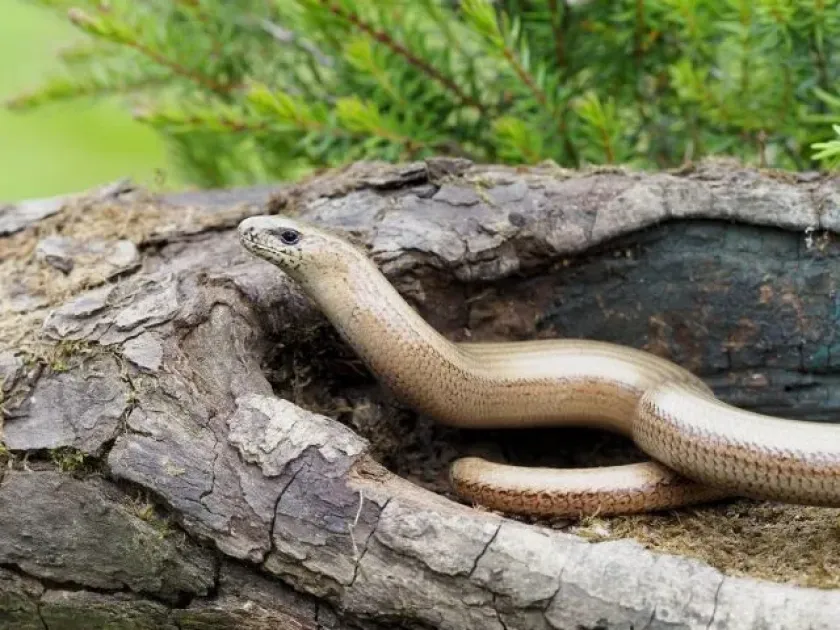
The slow worm (Anguis fragilis) is a legless lizard that is frequently mistaken for a snake, though it belongs to the family Anguidae.
Adult slow worms typically measure between 20 and 40 cm in length. They possess smooth, non-overlapping scales that give their body a distinctive, glass-like metallic sheen.
Unlike snakes, slow worms have eyelids that they can blink, and they are capable of autotomy, a process where they drop their tail to distract predators if they are threatened.
These reptiles are secretive and nocturnal or crepuscular, preferring damp, shaded habitats where they can remain hidden under debris or soil.
They are completely harmless to humans and are generally quite docile, preferring to retreat from human contact rather than engaging in defensive behavior.
What it damages
The slow worm is not a pest. It does not feed on vegetation, crops, or roots, and therefore poses no threat to agricultural yield or garden plants.
Its diet consists almost exclusively of invertebrates, including slugs, snails, spiders, and insect larvae, many of which are known garden pests.
By consuming large numbers of slugs and snails, the slow worm acts as a natural biological control agent, assisting in the management of garden ecosystems.
There is no factual evidence to suggest that slow worms cause any damage to agricultural products; any destruction observed in gardens is caused by other species.
Supporting slow worm populations is a sustainable way to manage garden pest levels without relying on heavy chemical pesticides.
When it appears
Slow worms emerge from hibernation in early spring, typically around April, when the soil temperature rises sufficiently for them to become active.
Throughout the summer months, they are active in seeking food and mates, particularly during cool, damp weather or just after rainfall.
As temperatures begin to drop in late autumn, they prepare for hibernation by seeking frost-free underground shelters or deep garden debris.
Hibernation is a communal activity, with individuals often grouping together in deep holes or beneath logs to conserve body heat during the winter.
Their activity patterns are highly seasonal and weather-dependent, with reduced movement during intense heat or severe drought conditions.
Control measures
No control measures are necessary, as the slow worm is a beneficial species that contributes to the health of the agricultural and garden environment.
The primary recommendation for those who wish to support these creatures is to avoid the use of chemical molluscicides and other broad-spectrum pesticides.
Maintaining compost heaps or areas with log piles provides excellent shelter for the slow worm and encourages them to take up residence in the garden.
When performing garden maintenance such as mowing or digging, it is advisable to be mindful of hidden reptiles to avoid accidental injury.
Educating gardeners about the identity of the slow worm helps preserve this species, which acts as a natural, low-cost pest control solution.
Taxonomy
- Latin name
- Anguis fragilis
- Family
- Anguidae
- EPPO code
- ANGSFR
Discussion
No discussions yet — be the first.