
Slow worm
Anguis
Description
How to identify
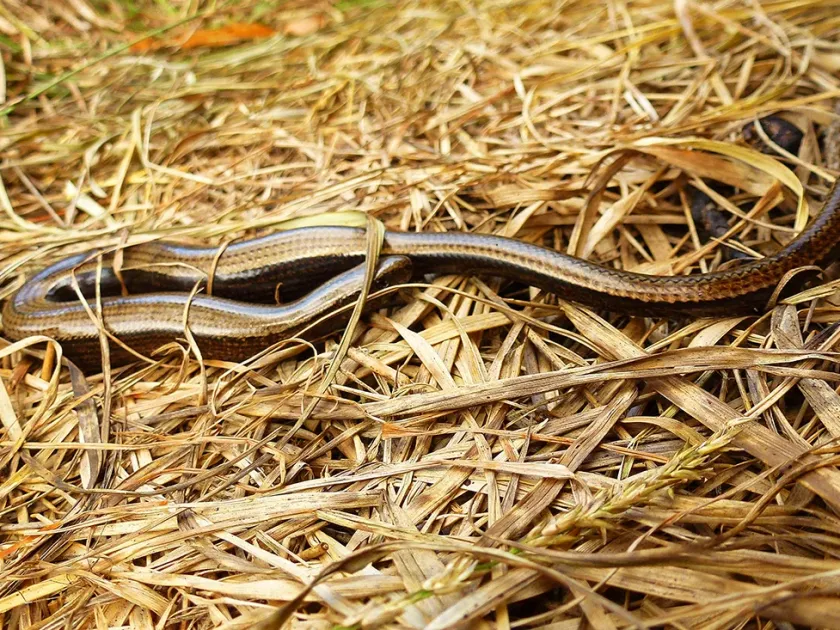
The slow worm (Anguis fragilis) is a legless lizard often mistaken for a snake. Unlike snakes, they have movable eyelids and ears, and they are capable of shedding their tail.
Adult specimens typically reach lengths of 40–50 cm. Their skin is smooth, comprised of overlapping scales that exhibit a distinct metallic sheen, ranging from grey to brown or copper.
The body structure is rather stiff, lacking the fluid movement seen in snakes. The head blends into the body without a distinct neck transition, which is a key identification feature.
They possess a blunt tail that is shorter than the body. This tail is fragile, serving as a defensive mechanism to distract predators while the lizard makes its escape.
Slow worms lead a secretive, crepuscular lifestyle. They favor moist habitats, dense vegetation, mulch, and piles of garden debris where they can remain hidden.
What it damages
The slow worm is not an agricultural pest; it causes no damage to crops, roots, or seeds. It does not feed on plant material at all.
Their diet is strictly carnivorous, consisting of slugs, snails, earthworms, and various larvae. This makes them highly beneficial for garden health.
By consuming slugs, which are notorious for destroying seedlings and leafy greens, slow worms provide a form of natural biological control against common pests.
They do not cause structural damage to trees or shrubs, nor do they spread plant diseases. They are harmless to the gardener and beneficial to the local ecosystem.
Classifying them as pests is incorrect. In any integrated pest management strategy, the presence of slow worms should be encouraged, not eliminated.
When it appears
The activity of slow worms begins in early spring, as soon as the soil temperatures rise. They frequently emerge to bask in the sun during warmer parts of the day.
During the summer, they adopt a more nocturnal or crepuscular routine to avoid excessive heat, often remaining underground or under dense foliage during the day.
In autumn, as temperatures drop, slow worms seek suitable hibernation sites. They locate deep crevices, voids beneath tree roots, or frost-free burrows to spend the winter.
Hibernation is a collective process; they often share wintering sites with others to conserve moisture and maintain a stable internal body temperature.
Their annual cycle is strictly dictated by climate and soil conditions, making them excellent indicators of a healthy and balanced garden soil environment.
Control measures
No pest control measures are required for slow worms. They are harmless animals that contribute significantly to the reduction of garden pests like slugs.
If you prefer not to have them near your home, simple exclusion is the best approach. Keeping lawns mowed and removing debris from the base of the house will discourage them from staying close.
Should you encounter one, it is best to leave it alone or gently relocate it to a nearby hedgerow, woodland, or wild patch on your property.
Avoid using heavy chemicals or pesticides, as these can kill the very creatures that keep slug populations in check and cause indirect harm to the slow worms.
- Maintain garden biodiversity by providing natural debris piles away from crops.
- Avoid manual destruction during tilling or digging.
- Use organic fertilizers to improve soil health and support a stable invertebrate population.
Taxonomy
- Latin name
- Anguis
- Family
- Anguidae
- EPPO code
- ANGSSP
Discussion
No discussions yet — be the first.