
American eel
Anguilla rostrata
Description
How to identify
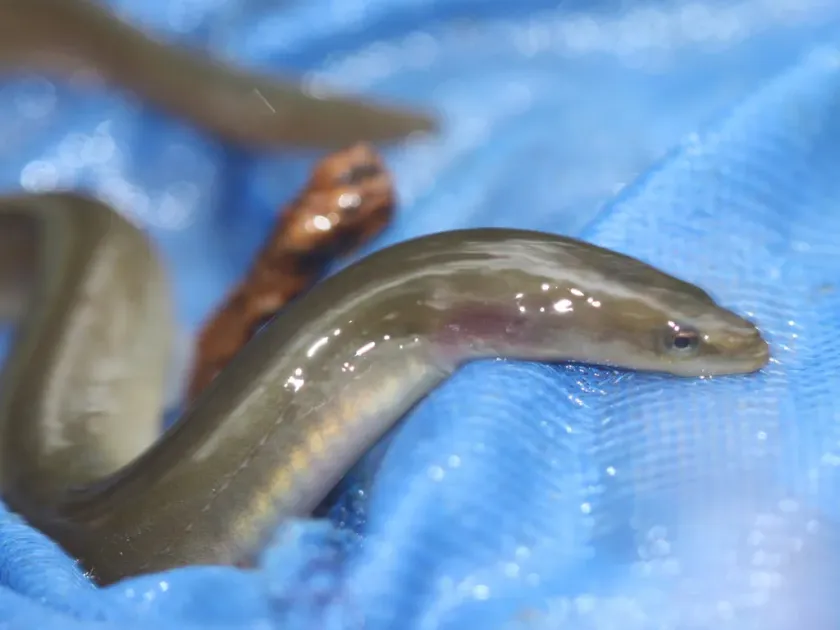
The American eel (Anguilla rostrata) is a catadromous fish belonging to the order Anguilliformes and the family Anguillidae.
It possesses a long, serpentine body covered with small scales embedded in its thick, mucus-covered skin, giving it a very smooth texture.
The head is relatively narrow with strong jaws, which are adapted for a predatory lifestyle in diverse aquatic environments.
It is crucial to clarify that the American eel is an aquatic vertebrate and has no biological link to plant-destroying pests in agriculture.
The confusion often stems from the terminology, as some microscopic plant-parasitic nematodes are commonly referred to as "eelworms" (Anguillidae family relation is purely linguistic in common parlance).
What it damages
The American eel does not cause any damage to agricultural crops as it is strictly a carnivore and an aquatic organism.
Its diet consists primarily of aquatic insects, crustaceans, worms, and smaller fish, making it an ecological component of freshwater and estuarine systems.
There is no evidence of this species interacting with terrestrial plants or causing harm to any harvestable crop yields.
Therefore, American eels are not considered pests in any professional agronomic sense and require no management on farms.
Any perceived damage to crops should be attributed to actual plant pests, such as slugs, beetles, or stem nematodes, rather than aquatic eels.
When it appears
The life cycle of the American eel is quite unique, involving a long migration from freshwater rivers to the Sargasso Sea for spawning.
During the warmer seasons, they are active in rivers and lakes, but this activity is localized to the water column.
As autumn approaches, adult eels begin their migration toward the ocean, which is purely a behavioral response to their biological life cycle.
This seasonal movement has absolutely no impact on the planting, growing, or harvesting seasons of agricultural crops.
Farmers do not need to factor the presence of this fish into their seasonal field management or crop protection plans.
Signs of infestation
Detection of the American eel in its habitat is limited to direct observation in bodies of water, often using specialized fishing nets or traps.
The presence of excess mucus or specific movement patterns in irrigation canals might indicate their presence to water management specialists.
Since the American eel does not attack plants, there are no characteristic symptoms of damage on crops that would indicate its "infestation."
If farmers observe damage to root systems or stems, it is likely the work of plant-parasitic nematodes or soil insects.
Monitoring for this species is irrelevant to crop health management and should not be included in field scouting practices.
Control measures
No control measures or protective actions are required for the American eel, as it is not a plant-feeding organism.
Management of water sources for irrigation should prioritize water quality rather than the removal of non-harmful fish like the American eel.
Using chemicals or pesticides to control this fish is strongly discouraged, as it poses a significant risk to the surrounding environment.
Effective crop protection should focus on identifying genuine threats like aphids, mites, or soil-borne pathogens, rather than aquatic species.
Ensure that staff and farm managers correctly distinguish between "eelworms" (nematodes) and the "American eel" (fish) to avoid unnecessary and incorrect treatment measures.
Taxonomy
- Latin name
- Anguilla rostrata
- Family
- Anguillidae
- EPPO code
- ANGLRO
Discussion
No discussions yet — be the first.