
Japanese eel
Anguilla japonica
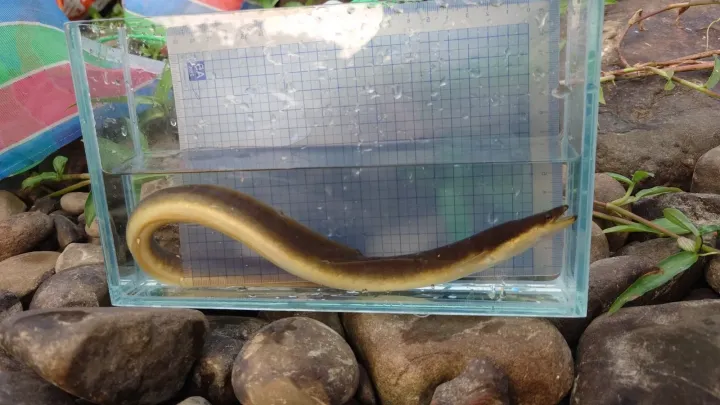
Description
How to identify
The Japanese eel (Anguilla japonica) belongs to the order Anguilliformes, family Anguillidae. It is a catadromous species that migrates between freshwater habitats and the deep ocean.
The fish features a long, snake-like body covered with small, embedded scales. Its appearance changes significantly throughout its lifecycle from larva to mature adult.
It is crucial to clarify that the Japanese eel is not a plant pest. It does not feed on crops, vegetables, or trees, and it has no impact on agricultural land.
The species is highly valued in the aquaculture industry, where it is farmed for commercial consumption in many countries.
The biological cycle is complex, involving metamorphosis stages such as leptocephalus, glass eel, elver, yellow eel, and silver eel.
What it damages
As the Japanese eel is a fish species, it does not cause any damage to vegetation or field crops. Linking this fish to agricultural damage is a misconception.
In aquaculture environments, it may impact other fish populations through predation, but this is an internal matter for fishery management.
There are no recorded instances of this fish species threatening horticultural or agronomic production systems.
The eel's presence in rivers or water supply channels is purely aquatic and does not jeopardize the health or yield of crops growing in fields.
Any negative perception of this species as a pest is scientifically unfounded in the context of agronomy and plant protection.
Control measures
No protection or control measures are required against the Japanese eel for agricultural purposes, as it is not a pest of any plant species.
In the aquaculture sector, control is limited to managing stocking densities and ensuring the health of the population in controlled tanks or ponds.
Using pesticides or chemicals in proximity to their habitats is detrimental and strictly prohibited due to potential environmental toxicity.
Management focuses on maintaining water quality and preventing the escape of cultured fish into natural water systems to preserve wild populations.
Sustainability efforts are currently focused on the conservation of the species, as wild stocks are facing decline due to overfishing and habitat changes.
Taxonomy
- Latin name
- Anguilla japonica
- Family
- Anguillidae
- EPPO code
- ANGLJA
Discussion
No discussions yet — be the first.