
Amrasca splendens
Amrasca splendens
Description
How to identify
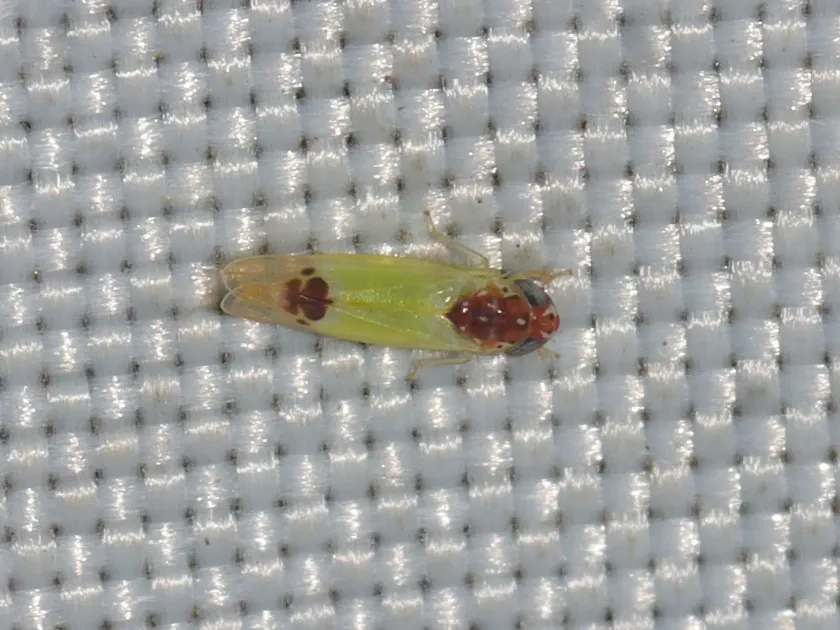
Amrasca splendens is a small insect belonging to the order Hemiptera and the family Cicadellidae (leafhoppers). Visually, adult specimens are characterized by an elongated body, often with a greenish or yellowish tint, which allows them to effectively camouflage themselves on the underside of leaves.
The insect's life cycle includes egg, nymph, and adult stages. Nymphs are externally similar to adults but lack fully developed wings and usually have a lighter, almost translucent coloration.
The primary identification trait is the insect's characteristic movement—abrupt jumping when disturbed, which is typical for members of the Cicadellidae family.
This species requires careful microscopic analysis for accurate identification due to its morphological similarity to other closely related species within the Amrasca genus.
The distribution of this species is most often associated with regions with warm climates, where temperature conditions facilitate the rapid development of several generations within a single growing season.
What it damages
The primary food sources for Amrasca splendens are members of the Malvaceae and Solanaceae families. Specifically, significant damage is caused to crops such as cotton, okra, and certain varieties of eggplant.
The pest leads a cryptic lifestyle, concentrating mainly on the underside of the leaf blade. Feeding occurs by piercing plant tissues and sucking out plant sap.
Intensive feeding by colonies of this pest leads to the disruption of normal photosynthesis, which eventually causes stunted growth and a significant reduction in the plant's vegetative mass.
In cases of mass infestation, the damage can lead to premature leaf drop, which significantly impacts the yield of technical and vegetable crops.
In addition to direct mechanical damage, these insects can act as potential vectors for phytoplasma and viral plant diseases, which significantly exacerbates the pest's severity.
Signs of infestation
The first visual sign of infestation is the appearance of specific chlorotic spots on the leaves, which gradually turn yellow, starting from the margins and spreading towards the center.
A characteristic symptom is the curling of the leaf margins downwards, often referred to as a "boat" shape, which makes damaged plants easily noticeable during field inspections.
Upon examining the underside of the leaf, one can discover numerous exuviae (cast skins) of the nymphs that remain on the plant after molting.
A slowdown in overall plant development, deformation of young shoots, and delayed flowering are indirect signs of a high pest population density.
- Yellowing of the leaf blade
- Deformation and curling of leaf margins
- Presence of jumping insects when shaking plants
- Presence of nymphal cast skins on the leaf underside
Control measures
Effective protection begins with agrotechnical measures, such as the destruction of crop residues and weed vegetation, which can serve as a reservoir for the pest during the off-season.
Crop rotation plays an important role, as it allows for the disruption of the reproductive cycle of insects specialized on specific crop types.
When the economic injury level is reached, systemic or contact-stomach insecticides approved for use on the respective crops should be applied.
It is important to rotate products from different chemical groups to prevent the development of resistance within the pest population to the active ingredients used.
Biological control methods include the preservation and augmentation of natural enemies of Amrasca, such as predatory bugs, lacewings, and specialized parasitic Hymenoptera.
Taxonomy
- Latin name
- Amrasca splendens
- Order
- Hemiptera (bugs, aphids, leafhoppers)
- Family
- Cicadellidae
- EPPO code
- AMRAZP
Discussion
No discussions yet — be the first.