
Amplicephalus
Amplicephalus
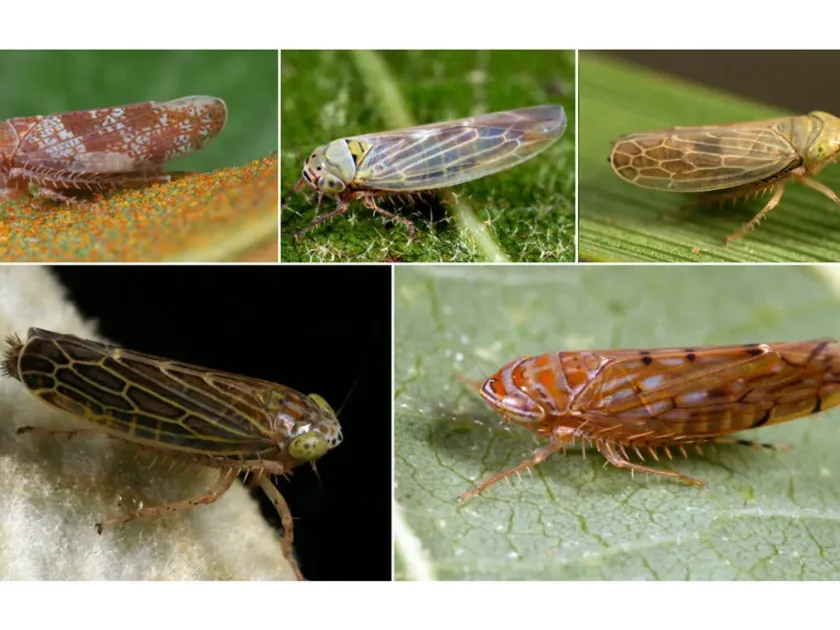
Description
How to identify
Amplicephalus is a genus of insects belonging to the order Hemiptera, family Cicadellidae (leafhoppers). These are relatively small insects, typically measuring between 3 and 5 millimeters in length.
Adult leafhoppers have an elongated body shape, usually exhibiting yellowish-brown or greenish coloration, which provides effective camouflage against host plants.
The head is distinctly broad, a characteristic feature from which the genus name is derived. The antennae are short and bristle-like, located beneath the eyes.
The wings are transparent with well-defined venation, folding roof-like over the back when the insect is at rest.
Nymphs share the general body plan of the adults but are wingless and often lighter in color, appearing more translucent in early stages.
What it damages
Amplicephalus leafhoppers primarily target cereal crops, including wheat, barley, oats, and various forage grasses.
The insects feed by piercing the plant epidermis with their specialized sucking mouthparts to extract sap, which leads to physical weakening of the host plant.
Beyond direct sap depletion, they act as critical vectors for phytoplasmas and viruses, causing plant deformation and physiological disorders.
Young cereal crops during the tillering stage are particularly vulnerable, as sap loss significantly inhibits their growth and structural development.
Severe infestations can lead to substantial reductions in grain yield, sometimes reaching 15-30% if the population density is not managed effectively.
When it appears
The life cycle and activity of Amplicephalus are highly dependent on ambient temperature, with peaks occurring from late spring through early summer.
They typically overwinter in the egg stage, deposited within plant tissues, or as nymphs in the crown area of wild perennial grasses.
As soon as temperatures rise above 12-15 degrees Celsius, nymphs emerge and begin feeding on wild vegetation near fields.
The population can complete multiple generations in a single season, reaching its highest numbers by mid-July during the grain development phase.
Migration to cultivated crops usually intensifies during dry spells when wild grasses dry out and become unsuitable for further feeding.
Signs of infestation
Initial signs of infestation appear as small white spots on the leaves, which eventually coalesce into larger chlorotic areas.
Plants affected by pathogens transmitted by these leafhoppers often display distinct red or yellow discolouration of the foliage.
Close inspection or sudden movement within the crop canopy often reveals the jumping activity of adult leafhoppers, signaling an active infestation.
The tips of the leaves may curl and wither, and in advanced cases, the entire plant may show stunting and deformed spikelets.
- Presence of sticky honeydew on leaf surfaces.
- Secondary fungal infections settling in feeding punctures.
- Reduced tillering and stunted height compared to healthy areas.
Control measures
Integrated pest management focuses on rigorous weed control, as non-crop vegetation serves as a primary reservoir for the pest population.
Crop rotation and maintaining spatial isolation between cereal fields and permanent pastures are essential to reduce migration pressure.
When infestation levels cross the economic injury threshold, systematic insecticide applications are recommended to suppress population growth.
Biological control methods include encouraging natural predators and parasitoids that prey on the leafhopper eggs and immature stages.
Field monitoring using yellow sticky traps is an effective strategy to determine the exact timing for insecticide applications to maximize efficiency.
Taxonomy
- Latin name
- Amplicephalus
- Order
- Hemiptera (bugs, aphids, leafhoppers)
- Family
- Cicadellidae
- EPPO code
- AMLISP
Discussion
No discussions yet — be the first.